
A useful way through
- List the objects you intend to store and how often you use them. Measure the largest representative pieces, including handles and packaging that will stay with them. Decide which items need drawers and which need a shelf or an upright position.
- Ask for internal compartment and opening dimensions as well as the overall furniture size. Hardware, dividers and door openings can reduce usable space. Keep each compartment’s measurements separate rather than describing the whole sideboard with one width.
- Check the operating space in the room. Mark door swings, drawer extension and nearby furniture with a paper or measured layout. Confirm the delivery route and any required assembly with the supplier. Ask about loading limits and stability from the actual product instructions.
- Compare the item list with the measured compartments and keep a small allowance for handling where needed. Resolve uncertain measurements with the seller before ordering. On delivery, compare the actual product and supplied instructions with the agreed specification.
Read the map as text
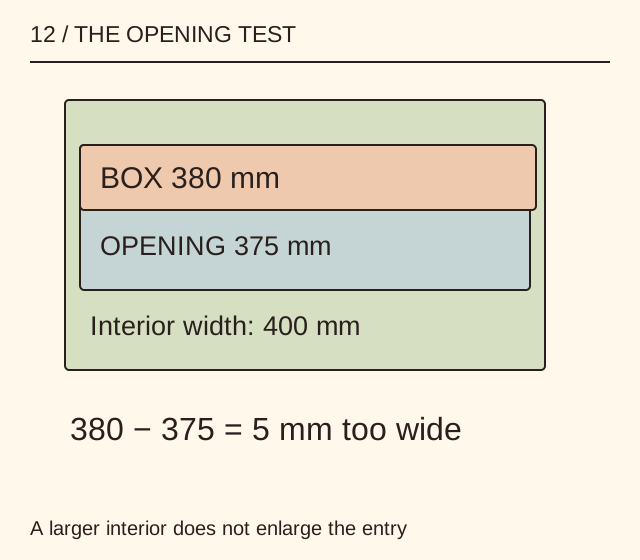
12 / THE OPENING TEST · BOX 380 mm · OPENING 375 mm · Interior width: 400 mm · 380 − 375 = 5 mm too wide · A larger interior does not enlarge the entry
- Box width
- Drawer interior
- Clear opening
- Decision
Put it into practice
In an illustrative check, a storage box is 380 mm wide and a drawer’s clear opening is 375 mm. A stated drawer interior of 400 mm does not solve the narrower entry: the box cannot pass through that opening in the proposed orientation. Record the limiting opening, not only the largest internal dimension.
Illustrative example, not a reported client project or test.
Your take-away checklist
Measure a sideboard for the things it needs to hold
- □ Box width: ____________________
- □ Drawer interior: ____________________
- □ Clear opening: ____________________
- □ Decision: ____________________
Before you act
Follow the manufacturer’s instructions for assembly, stability, anchoring and loads. Do not use this fit worksheet as a structural or tip-over safety assessment.
A completed example record
This is the illustrative case above. Download the blank version to record your own task.
- Box width
- 380 mmMeasure in its intended orientation
- Drawer interior
- 400 mmNot the entry width
- Clear opening
- 375 mmBox is 5 mm wider
- Decision
- Different box or compartmentConfirm the revised fit
A compartment inventory
For each shelf or drawer, record usable width, depth, height, opening restriction and intended contents. Add the manufacturer’s loading information where relevant; do not derive it from the material name.
When the product description is vague
A style name such as Corona does not establish construction, a single-piece structure or dimensions. Ask about the actual product code and specification. The earlier article’s general construction claims do not replace that information.
Sources & context
The earlier page, Uses For A Corona Sideboard Drawer, was published 2021-06-16 under the Maria Baldwin byline. This guide develops its subject into a new procedure and worked example by MichaelT editorial.