
A useful way through
- Measure the actual packed object, including loose parts and any wrapping that will travel with it. Record length, width, height and the way up it must remain. Distinguish the product’s own dimensions from the space needed by the protective system.
- Ask the packaging supplier for internal dimensions, material specification and the intended use. A display carton and a transport package have different jobs. Request a sample made to the proposed specification, including closures and inserts, before approving a quantity.
- Pack and unpack the sample in the real sequence. Check that the object fits, parts do not disappear below an insert, the closure works and the recipient can understand where to open it. Record any test actually performed; a neat-looking prototype has not thereby passed a transport test.
- Approve the structural sample and artwork proof separately, then identify the pair in the order. Confirm quantities, packing responsibilities and how changes are approved. Ask the relevant carrier or specialist about the transport conditions rather than treating the carton dimensions as a delivery guarantee.
Read the map as text
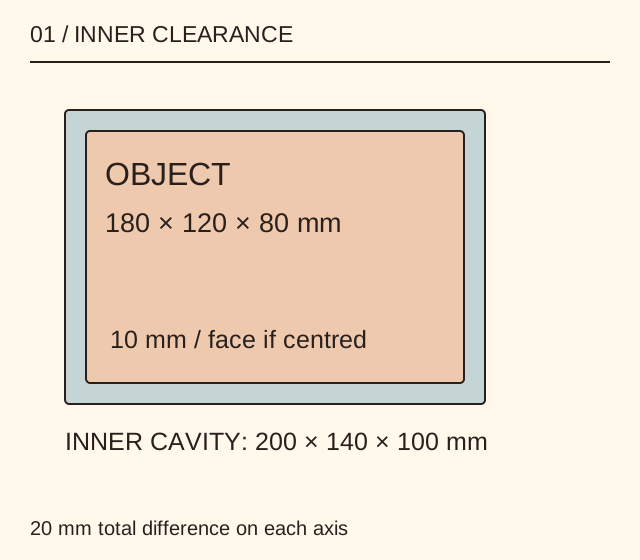
01 / INNER CLEARANCE · OBJECT · 180 × 120 × 80 mm · INNER CAVITY: 200 × 140 × 100 mm · 10 mm / face if centred · 20 mm total difference on each axis
- Object
- Proposed cavity
- Nominal difference
- Approval pair
Put it into practice
For an illustrative ceramic object measuring 180 × 120 × 80 mm, a proposed 200 × 140 × 100 mm internal cavity leaves 20 mm total on each axis. Centring would give 10 mm on each opposite face. That arithmetic says nothing about whether a particular protective material is adequate: the supplier must design and verify the actual system.
Illustrative example, not a reported client project or test.
Your take-away checklist
Prototype a package before ordering the print run
- □ Object: ____________________
- □ Proposed cavity: ____________________
- □ Nominal difference: ____________________
- □ Approval pair: ____________________
Before you act
Fragile, hazardous or regulated goods need the appropriate packaging expertise and carrier requirements. This worksheet does not establish drop resistance or transit certification.
A completed example record
This is the illustrative case above. Download the blank version to record your own task.
- Object
- 180 × 120 × 80 mmMeasured without the transport protection
- Proposed cavity
- 200 × 140 × 100 mmSupplier confirms usable interior
- Nominal difference
- 20 mm on each axisNot an impact-protection rating
- Approval pair
- Structure S02 + artwork A04Both referenced on the order
Inspect the opening
Photograph the closed sample and each opening step without exposing customer information. Check whether instructions, accessories and small components remain obvious. An insert that holds the object but hides an essential part needs another review.
Keep claims specific
Ask what a recycled-content or recyclability claim covers: the board, coatings, inserts or complete pack. Keep the supplier’s evidence and local disposal information. The older article’s universal recycling and carbon-saving claims are not specifications for this package.
Sources & context
The earlier page, Corrugated And Cardboard Packaging For Retail Stores, was published 2021-05-28 under the Maria Baldwin byline. This guide develops its subject into a new procedure and worked example by MichaelT editorial.