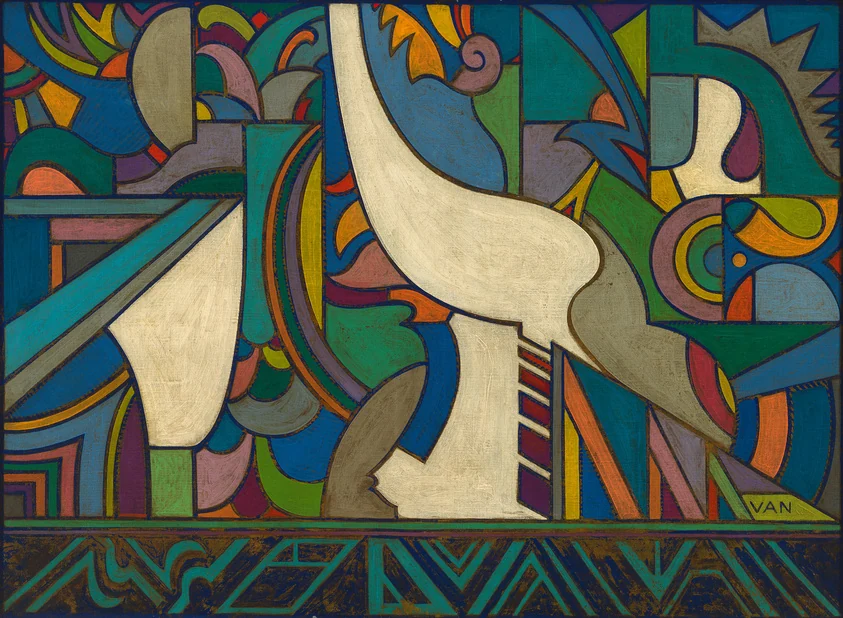

A useful way through
- Start with a brief description of visible elements: shapes, colours, marks, material and arrangement. Use precise observations rather than a verdict about whether the work matches a room. If you are viewing a reproduction, note that the screen may hide scale or surface detail.
- Read the actual label or artist’s documented statement. Record title, maker, date, medium and source only where provided. Do not infer an attribution, artistic movement or historical claim from a seller’s decorative category.
- Choose one visual relationship to investigate: repetition, contrast, edge, scale or the way your attention moves. Describe where you see it. Keep your interpretation as an interpretation, supported by the visible details you named.
- Return to the image or object and refine the description. If you plan to acquire or display a work, keep questions about dimensions, rights, condition and installation in a separate practical record. A personal response is not an authenticity assessment.
Read the map as text
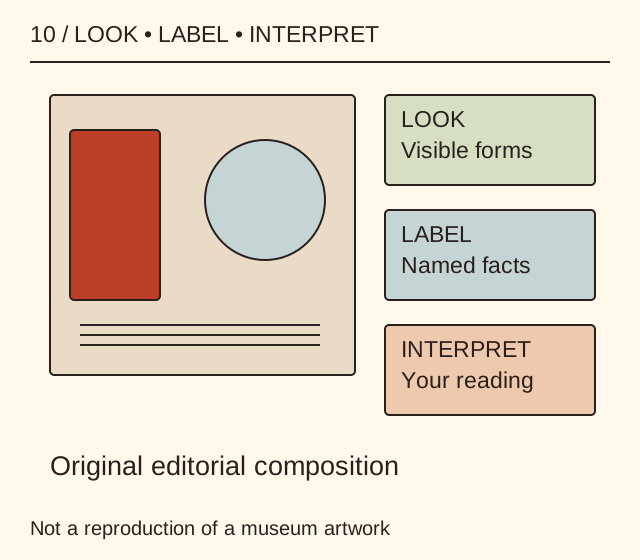
10 / LOOK • LABEL • INTERPRET · LOOK · Visible forms · LABEL · Named facts · INTERPRET · Your reading · Original editorial composition · Not a reproduction of a museum artwork
- Observed
- Documented
- Interpreted
- Unknown
Put it into practice
Using the original schematic illustration on this page, a reader can observe three differently sized coloured areas and a repeated line. “The small high-contrast area draws my attention first” is a personal observation. Naming it as a painting by a known artist would be an unsupported attribution: the diagram is an editorial exercise.
Illustrative example, not a reported client project or test.
Your take-away checklist
Look closely at a contemporary artwork before choosing a description
- □ Observed: ____________________
- □ Documented: ____________________
- □ Interpreted: ____________________
- □ Unknown: ____________________
Before you act
The schematic is original editorial graphics, not a reproduction or newly discovered artwork. Check the actual rights, provenance and condition before acquiring a work.
A completed example record
This is the illustrative case above. Download the blank version to record your own task.
- Observed
- Three areas differ in sizePoint to the visible detail
- Documented
- Editorial schematicNot a museum object
- Interpreted
- Contrast guides my attentionA reader’s response
- Unknown
- Meaning beyond the exerciseDo not invent an artist statement
A short looking notebook
Write visible detail; location within the work; label fact; source; interpretation; question. Leave a blank where the source does not establish something. The notebook can be used with a gallery label, a book reproduction or an artist’s own page.
A useful next question
Ask how the interpretation would change if the work were larger, textured or seen in a different light. Then identify which of those conditions you actually know. This keeps a compelling description attached to evidence.
Sources & context
The earlier page, Modern Wall Art Paintings: Brief Introduction to Contemporary Art, was published 2021-04-02 under the Maria Baldwin byline. This guide develops its subject into a new procedure and worked example by MichaelT editorial.