A useful way through
- Record the recruiter’s identity, organisation and contact route, then verify the role through an appropriate independent channel. Ask what service is being offered and who pays for it. A professional-looking message is not proof of an employer relationship or a guaranteed vacancy.
- Ask for the role, location, working arrangement, essential requirements and available remuneration information. Mark what the recruiter has confirmed and what remains unknown. Keep an advertised range separate from an offer and avoid sending sensitive identity or financial information merely to obtain basic details.
- Agree whether your profile may be submitted to the named employer for the specific role and which document version will be used. Keep a record of that instruction. Do not assume that an introductory conversation authorises unlimited circulation of your CV.
- Track the submission, interview arrangements and next update with dates and contacts. If details change, ask for clarification before proceeding. Use appropriate official advice for employment rights or suspected fraud; this sheet helps organise facts rather than decide those issues.
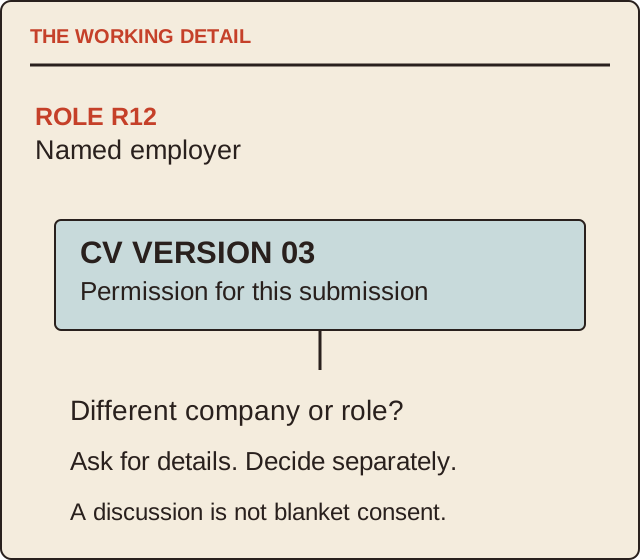
Read the map as text
THE WORKING DETAIL · ROLE R12 · Named employer · CV VERSION 03 · Permission for this submission · Different company or role? · Ask for details. Decide separately. · A discussion is not blanket consent.
- Recruiter
- Role
- Submission
- Follow-up
Put it into practice
A fictional candidate discusses role R12 with a recruiter and agrees to submission of CV version 03 to one named employer. A later request concerns a different company. The candidate asks for the new role details and makes a separate decision. The record avoids treating one conversation as blanket permission for every application.
Illustrative example, not a reported client project or test.
Your take-away checklist
Keep a recruiter enquiry and application permission record
- □ Recruiter: ____________________
- □ Role: ____________________
- □ Submission: ____________________
- □ Follow-up: ____________________
Before you act
This is an application-organising procedure, not employment, immigration or legal advice. No recruiter or vacancy is endorsed.
A worked record
Use the example to see the decisions, then download a blank record for your own task.
- Recruiter
- Verified contact routeIdentity still needs checking
- Role
- R12 / named employerUnknown details remain marked
- Submission
- CV03 for this roleRecord the instruction
- Follow-up
- Date and next updateOffer is not assumed
A compact application log
Use employer, role reference, recruiter, document version, permission date, stage and next action. Avoid storing unnecessary identity-document copies in the log. A useful record can reduce duplicated applications without becoming a dossier of sensitive material.
Separate claims and commitments
An agency may say it has a suitable role; the employer may later make an offer. Those are different events. Preserve the actual wording and seek the right advice about fees, contracts or rights instead of relying on a generic promise of affordability.
Sources & context
The earlier topic was published 2022-09-23 under the Maria Baldwin byline. The present procedure, examples and diagrams are new work by MichaelT; they do not attribute a new test or professional assessment to the earlier author.
Source: Common Crawl preservation record ↗
Keep a screening-report correction separate from a hiring decision
Record an error in your own report through the appropriate official process without treating a search result as proof about another person.
Identify your own report and the process
Use the actual report provider, report date and the relevant employment process. The US FTC explains rights around employment background reports in its jurisdiction. This addition concerns a person checking their own information, not searching for private bank details, identity numbers or criminal accusations about someone else.
Describe a specific disputed item
Record the item reference, what appears inaccurate or incomplete and the legitimate supporting evidence available. Keep identity and financial documents private and follow the reporting company’s verified secure dispute route. A common-name match, old web result or instant-check advertisement is not enough to identify a person or establish wrongdoing.
Track correction and hiring separately
Retain the dispute date, receipt and actual outcome. A dispute submitted is not a correction completed, and a corrected report is not a job offer. Keep the employer’s separate process and applicable rights with appropriate advice. Do not invent a universal response deadline, guarantee deletion or describe the report provider as the organisation making the hiring decision.
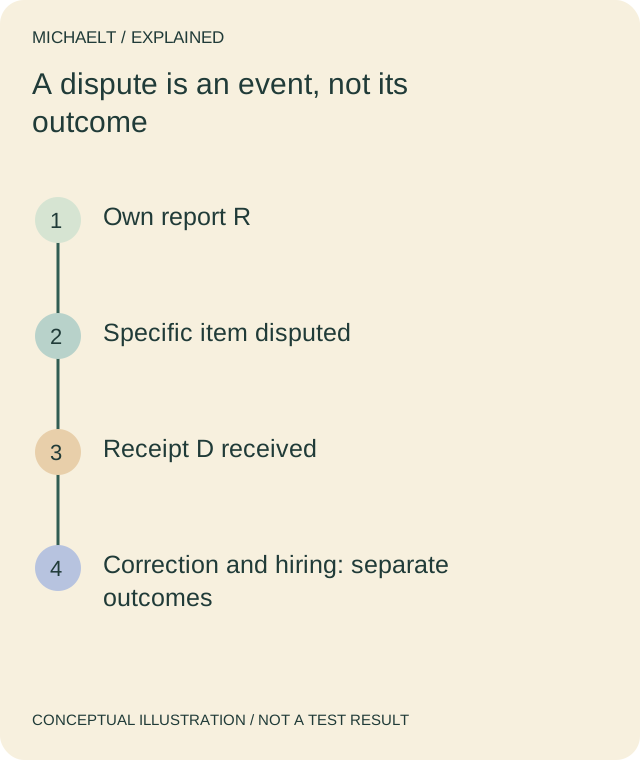
Read the drawing as text
Receiving a dispute receipt does not establish a correction or a hiring result. Keep each state and its evidence separate.
Work through an example
A fictional applicant’s report R contains an item with an unmatched identifier. The applicant uses the verified provider route to dispute that item and keeps receipt D. The record marks correction pending and employment outcome separate. No real report, criminal allegation or hiring decision is published.
Illustrative example; figures, people and organisations in the worked record are fictional.
The example record
Report R
- Evidence
- Own report / actual provider
- State
- Private
Disputed item
- Evidence
- Specific mismatch
- State
- Not a public accusation
Dispute D
- Evidence
- Verified receipt
- State
- Correction pending
Hiring process
- Evidence
- Separate employer decision
- State
- No offer guaranteed
Download blank worksheet (.csv) ↗Download worked example (.csv) ↗
Keep your own record
Use the result within its scope
Use current rights and secure procedures for the actual jurisdiction. This record is neither a background-search service nor a determination of someone’s suitability for employment.
Reference sources
Earlier articles on this subject
- Ensure Safety With Instant Background Check ↗ — 2021-08-24, Maria Baldwin.