A useful way through
- Describe the real tasks and essential requirements with the hiring team. Separate what must be present at entry from what can be learned. Have the appropriate HR or legal adviser review the process for the location and role, including fairness, accessibility and privacy.
- Choose a small set of job-related questions or exercises and define the evidence you want to observe. Agree how reviewers will record answers. Avoid personality labels, invented cost statistics or assumptions about a person’s background as substitutes for role evidence.
- Use the agreed process consistently while providing the appropriate arrangements for candidates. Explain any exercise, expected effort and permitted materials. Record observed evidence and unanswered questions separately; a confident delivery is not itself proof of the required skill.
- Have reviewers make their initial notes before discussion, then compare the evidence against the agreed requirements. Keep the decision and rationale in the approved hiring system. Do not turn an illustrative scorecard into an automated employment decision or a universal prediction of performance.
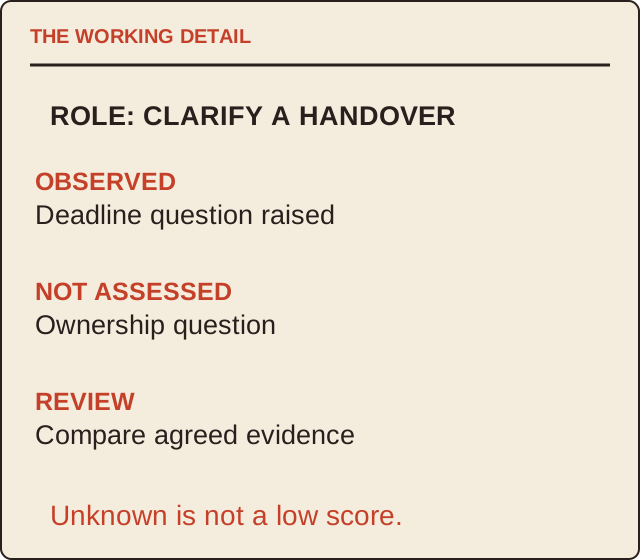
Read the map as text
THE WORKING DETAIL · ROLE: CLARIFY A HANDOVER · OBSERVED · Deadline question raised · NOT ASSESSED · Ownership question · REVIEW · Compare agreed evidence · Unknown is not a low score.
- Requirement
- Prompt
- Evidence
- Review
Put it into practice
For a fictional coordinator role, the exercise asks a candidate to identify missing information in a project handover. The agreed evidence is a clear question and an assigned next action. One reviewer notes that the candidate identifies the missing deadline; another records an unanswered ownership question. The discussion uses those observations instead of a vague cultural-fit score.
Illustrative example, not a reported client project or test.
Your take-away checklist
Prepare an interview scorecard tied to the actual role
- □ Requirement: ____________________
- □ Prompt: ____________________
- □ Evidence: ____________________
- □ Review: ____________________
Before you act
Employment law, fairness, accessibility and data handling require the appropriate review for the actual recruitment process.
A worked record
Use the example to see the decisions, then download a blank record for your own task.
- Requirement
- Clarify an incomplete handoverActual role task
- Prompt
- Same relevant scenarioApproved process
- Evidence
- Question and next actionRecord what occurred
- Review
- Compare notes against requirementNo automatic hire decision
A useful evidence scale
Define what “insufficient”, “partly demonstrated” and “demonstrated” mean for a particular task before interviewing. Keep “not assessed” separate from a low score. An absent opportunity to demonstrate a skill should not quietly become proof that the person lacks it.
Keep the process proportionate
Ask only for work and information relevant to the role and approved process. Agree candidate communication, accessibility and retention arrangements with the responsible team. This public template collects no applicant data and does not replace professional hiring advice.
Sources & context
The earlier topic was published 2022-03-22 under the Maria Baldwin byline. The present procedure, examples and diagrams are new work by MichaelT editorial; they do not attribute a new test or professional assessment to the earlier author.