Follow the task
Define the stored item and location
Write what you want to store, the shelf or drawer it will occupy and how it will be reached. Separate a decorative jar, a food container and a vessel approved for a particular appliance. A material name alone does not establish permitted use.
Measure the complete object
Record maximum width, depth and height with its actual lid attached. Check whether a handle, clip or lid overhang changes that footprint. Compare the usable shelf space and removal path; a listed internal capacity does not give the external dimensions.
Match the lid to the vessel
Copy the manufacturer’s model or component reference for both parts. Ask for the current use-and-care instructions when the intended activity involves food, temperature or an appliance. Never infer that a compatible-looking lid has the same permitted uses as the glass part.
Label the storage plan
Keep a small map of which contents belong in which container and where each lid returns. Test the ordinary removal and replacement task with safe, empty objects when appropriate. Document a limitation rather than forcing an unsafe stack or using an unapproved substitute.
Read the diagram as text
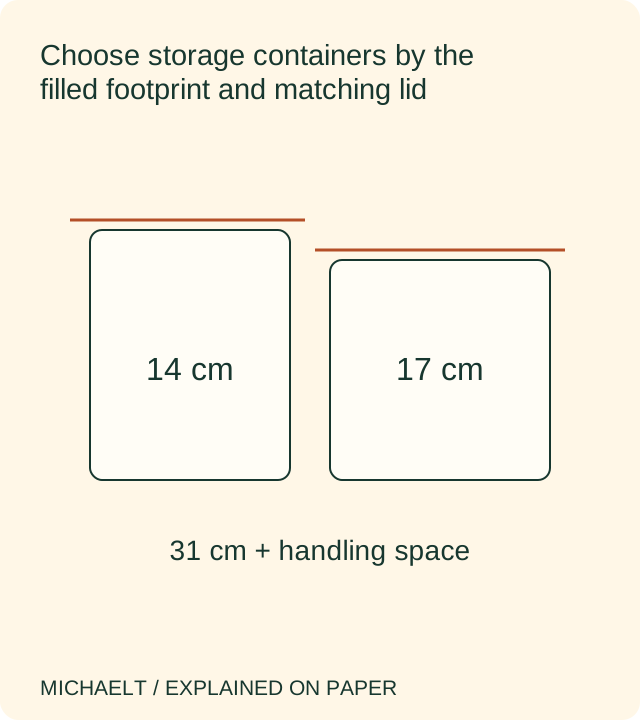
The two fictional closed widths total 31 cm; handling space remains a separate question.
- Contents and intended use
- Named storage task
- Closed external dimensions
- 14 cm + 17 cm = 31 cm in the example
- Exact vessel/lid identifiers
- Match both component references
- Shelf and removal check
- 32 cm shelf; handling remains to be checked
A worked example
A fictional shelf has 32 cm of usable width. Two closed containers have maximum widths of 14 cm and 17 cm, giving a combined footprint of 31 cm before any extra handling space is considered. Their capacities cannot show whether the lids can be removed in place. The worksheet therefore keeps the arithmetic result separate from the still-unchecked handling task.
Illustrative example, not a reported purchase, client project or product test.
The completed record
- Contents and intended use
- Named storage task
- Closed external dimensions
- 14 cm + 17 cm = 31 cm in the example
- Exact vessel/lid identifiers
- Match both component references
- Shelf and removal check
- 32 cm shelf; handling remains to be checked
Download blank record (.csv) ↗Download worked example (.csv) ↗
Your own record
- □ Contents and intended use: ____________________
- □ Closed external dimensions: ____________________
- □ Exact vessel/lid identifiers: ____________________
- □ Shelf and removal check: ____________________
Keep the distinction clear
Pyrex’s manufacturer FAQ illustrates why replacement-cover identification belongs to a particular vessel rather than a general claim about glass. Check the exact brand and product. Do not copy assertions that all glass is unbreakable, lightweight, harmless in every use or suitable for a rapid temperature change.
Where this guide stops
No heating, freezing, thermal-shock, food-storage duration or stacking-load instruction is supplied. Follow the exact manufacturer’s directions.
Continue with a related task
- Measure a sideboard for the things it needs to hold ↗
- Buy an appliance without a fit or delivery surprise ↗
Sources and original context
The earlier topic was published 2022-09-07 under the Maria Baldwin byline. The present procedure and illustrative record are by MichaelT editorial.