A useful way through
- Record the available space and delivery route, including doors, stairs and turns. Use the exact manufacturer’s required clearances and installation information.
- Check the model number, required connections and who will complete qualified installation. Do not infer compatibility from a product photograph.
- Compare item price, delivery, installation, removal and any necessary accessories. Get written responsibility for each part.
- Read the retailer’s current return and damage-reporting process. Inspect delivery as instructed and keep the model, order and condition record.
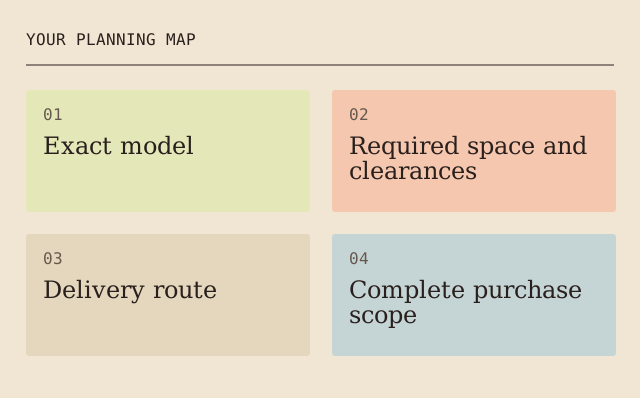
Read the map as text
YOUR PLANNING MAP · 01 · Exact model · 02 · Required space and · clearances · 03 · Delivery route · 04 · Complete purchase · scope
- Exact model
- Required space and clearances
- Delivery route
- Complete purchase scope
Put it into practice
A refrigerator can fit its alcove but fail to pass a narrow stair turn. Measuring the route before ordering avoids treating a delivery obstacle as a product fault.
Illustrative example, not a reported client project or test.
Your take-away checklist
Buy an appliance without a fit or delivery surprise
- □ Exact model: ____________________
- □ Required space and clearances: ____________________
- □ Delivery route: ____________________
- □ Complete purchase scope: ____________________
- □ Inspection and support route: ____________________
Before you act
This page gives no universal return period. Consumer rights and retailer terms depend on location and purchase circumstances.
Sources & context
This guide develops the subject of Buying Appliances Online – What To Look For And How To Buy One?, published 2022-04-26. The original capture is linked below. The new checklist is a planning procedure; product specifications, contracts and local requirements must be checked for the actual situation.
The starting point: Buying Appliances Online – What To Look For And How To Buy One?
The page was credited to Maria Baldwin and dated 2022-04-26. The present procedure and example are by MichaelT.
MichaelT clarification: The exact make and model must be checked before comparing fit, connections and delivery.
Keep finish preference separate from documented fit
List the preferred finish beside, not instead of, model dimensions, required installation scope and the delivery route. A stainless-steel description or higher price does not establish reliability or lower maintenance. Keep a model change visible in the record because it may invalidate a previous fit comparison.
- Exact model
- Fictional model A
- Fit/delivery record
- Current drawing and usable route
- Finish preference
- Personal preference only
- Outstanding confirmation
- Supplier/installer confirms the actual scope
The fictional buyer prefers finish A but has confirmed fit only for model B. The record leaves A unresolved instead of treating a matching colour as evidence that the appliance can be installed.
Earlier topic, 2022-02-28, Maria Baldwin: How To Select The Best Kitchen Appliances For Your Home ↗. New worked record: MichaelT, 23 October 2026.
Compare the complete cycle, not just the advertised batch size
For batch appliances, useful capacity also depends on the conditions before and between batches. An ice-cream maker with a pre-freeze bowl and one with an integrated refrigeration system require different questions. Use the exact manual rather than assuming every appliance is ready for another batch immediately.
Ask about the sequence the manual actually describes
List preparation, the stated cycle, any waiting or reset period and the maker’s permitted next-cycle conditions. Record the source and model for each answer. Do not invent freezing temperatures, food-handling rules, cleaning methods or a batch recipe. A quoted bowl volume is not necessarily the permitted finished or ingredient quantity; ask which quantity the specification describes.
Compare the intended use honestly
Keep actual kitchen space, required accessories and the planned number of batches with the existing fit and delivery record. If pre-freeze timing or repeat-cycle capability is unanswered, leave the comparison incomplete. A higher price, finish or a claim of professional quality does not prove the appliance meets that sequence.
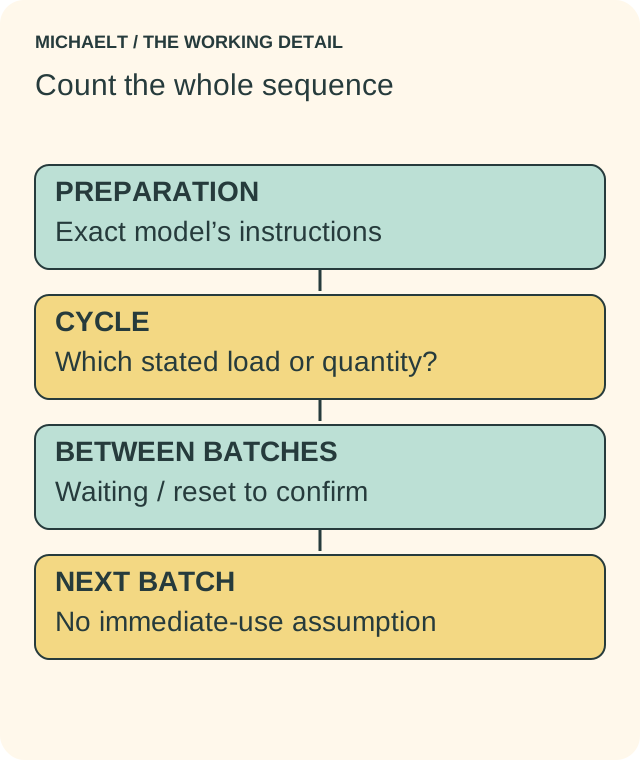
Read the drawing as text
Appliance comparison asks about manufacturer-specified preparation, cycle and between-batch conditions. Bowl volume alone does not establish immediate repeat use or servings.
Work through an example
Two fictional machines both advertise a bowl volume. A’s instructions call for a preparation stage before the cycle; B’s stated setup is different. The buyer records these sequences and asks about a second batch. No processing time, cooling result, food safety or real product performance is measured.
Illustrative example; figures, people and organisations in the worked record are fictional.
The example record
Quantity
- Illustrative record
- Which stated volume or load?
Before cycle
- Illustrative record
- Preparation specified by actual manual
Between batches
- Illustrative record
- Waiting/reset conditions to confirm
Comparison limit
- Illustrative record
- No performance test or recipe
Download blank worksheet (.csv) ↗Download worked example (.csv) ↗
Keep your own record
Use the result within its scope
Follow manufacturer instructions and appropriate food-safety guidance for real preparation. This addition concerns purchasing questions, not operation or a guaranteed number of servings.
Earlier articles on this subject
Compare annual energy figures on the same basis
Add the rating period, capacity and assumed unit price to the existing fit-and-delivery comparison.
Keep the energy label with the exact model
Retain the model-specific energy information, units, stated test basis and capacity. Annual kWh is energy for a stated basis, not instantaneous power and not a promise of the household’s actual use. The EIA distinguishes watts from energy over time. Do not compare a yearly figure from one model with an unexplained wattage from another.
Use one explicitly assumed rate
For a limited cost illustration, multiply comparable annual kWh figures by the same assumed price per kWh. Show the currency and rate date for an actual tariff. Fixed charges and the rest of the bill are separate. A simple multiplication does not include every tariff feature or establish the total cost of ownership.
Keep the purchase decision broader
Retain the existing dimensions, route, required installation and full purchase scope. Compare the actual intended capacity and use, not just the lower number. Old heater, freezer and water-heater advertisements do not establish current efficiency or performance. Ask the manufacturer or qualified supplier about an unexplained rating before treating it as a purchasing advantage.
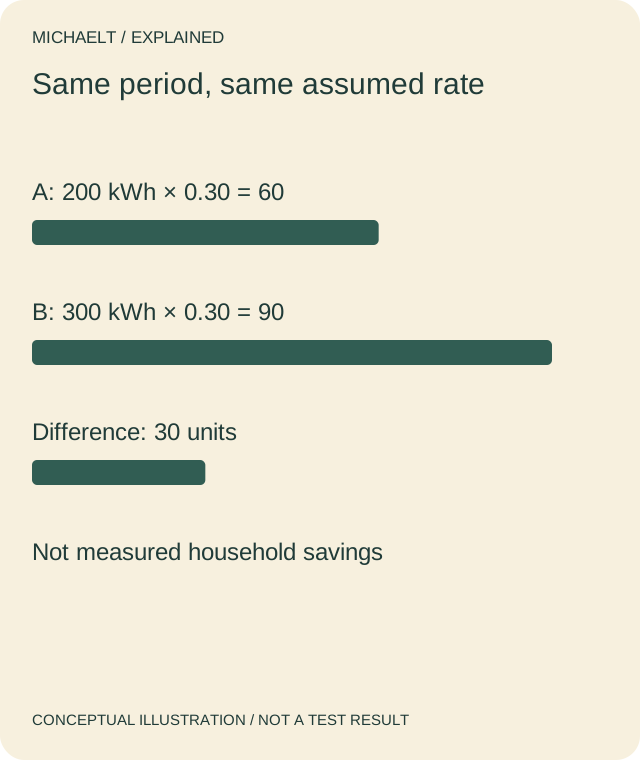
Read the drawing as text
Two fictional annual energy figures produce costs of 60 and 90 at the same invented rate; capacity and test conditions must be comparable.
Work through an example
Fictional appliance A states 200 kWh per year and B states 300 kWh per year on a comparable stated basis. At an invented 0.30 units per kWh, the arithmetic is 60 and 90 units, a difference of 30. No actual tariff, measured saving or payback period is supplied; differences in capacity or test basis would need resolving first.
Illustrative example; figures, people and organisations in the worked record are fictional.
The example record
Annual energy
- A
- 200 kWh
- B
- 300 kWh
Assumed unit rate
- A
- 0.30 units/kWh
- B
- 0.30 units/kWh
Illustrative energy cost
- A
- 60 units
- B
- 90 units
Comparison conditions
- A
- Capacity and basis to confirm
- B
- Keep fit and installation record
Download blank worksheet (.csv) ↗Download worked example (.csv) ↗
Keep your own record
Use the result within its scope
An annual label calculation is a comparison of stated assumptions. Actual use, rates, installation, maintenance and purchase costs remain separate evidence.
Reference sources
Earlier articles on this subject
- Benefits of a New Freezer ↗ — 2022-07-06, Maria Baldwin.
- All About Infrared Heater ↗ — 2022-06-22, Maria Baldwin.
- Replace Your Water Heater on Time ↗ — 2021-12-21, Maria Baldwin.
Match an induction pan’s base to the actual cooktop
Add base material and the maker’s defined size to the existing model, installation and delivery record.
Separate metal name and compatibility
Wolf’s guidance explains that induction-compatible cookware needs an appropriate magnetic base and that some stainless-steel cookware is suitable. Stainless steel and induction are therefore not opposing technologies. Use the actual cooktop and cookware documentation; a shiny finish or broad material label cannot establish compatibility for a particular combination.
Read the specified dimension
Ask which dimension the maker means: outside rim, usable cooking surface or the base that interacts with the cooktop. Retain the exact model’s relevant zone and cookware guidance. Do not transfer one manufacturer’s minimum size or operating rule to every induction appliance. A pan’s widest photographed edge is not necessarily the dimension the specification requires.
Keep the enquiry narrow
Prepare the exact cooktop identifier, pan identifier and unresolved base or size question for the manufacturer. Leave installation, electrical work and operational safety to the actual instructions and appropriate qualified person. This comparison does not test a pan, recommend a converter device or show how to modify cookware. Keep energy labels and cooking-performance claims separate from compatibility.
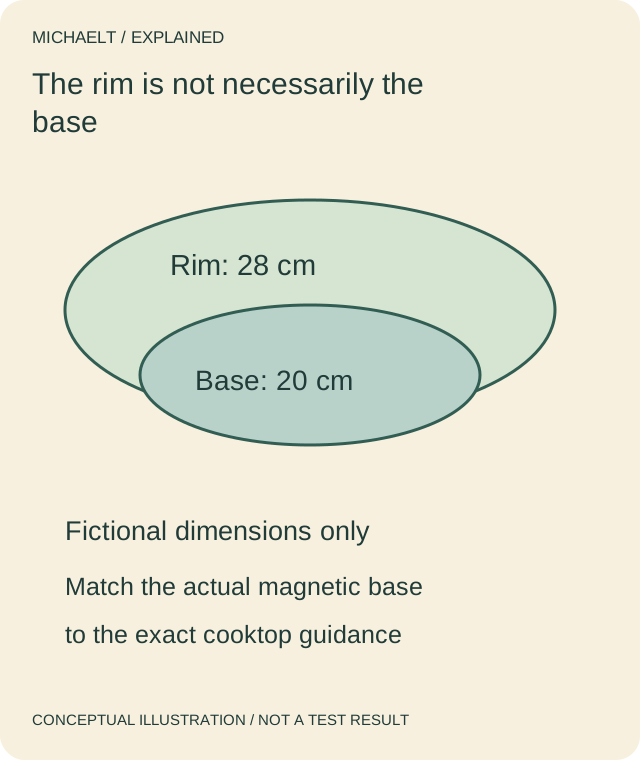
Read the drawing as text
A fictional pan’s 28-centimetre rim and 20-centimetre base are different dimensions. Compatibility remains tied to the actual cookware and cooktop instructions.
Work through an example
A fictional pan lists an outside diameter of 28 cm and a base diameter of 20 cm. The cooktop’s relevant instructions have not yet been matched. The buyer records both dimensions and asks about the actual base rather than calling the pan compatible because the rim is 28 cm or the finish is stainless steel. No real combination is tested.
Illustrative example; figures, people and organisations in the worked record are fictional.
The example record
Cooktop
- Illustrative evidence
- Exact model
- Meaning or next step
- Relevant maker guidance?
Pan rim
- Illustrative evidence
- Fictional 28 cm
- Meaning or next step
- Not automatically the required size
Pan base
- Illustrative evidence
- Fictional 20 cm
- Meaning or next step
- Actual material and zone match?
Result
- Illustrative evidence
- Compatibility unanswered
- Meaning or next step
- No operation or modification test
Download blank worksheet (.csv) ↗Download worked example (.csv) ↗
Keep your own record
Use the result within its scope
Use the actual manufacturer’s answer and instructions. This addition corrects the false material-versus-technology comparison without promising cooking performance, universal compatibility or installation suitability.