
Follow the task
Ask about the gift, not the stereotype
Start with the recipient’s preferences and the occasion. Do not assume everyone wants matching jewellery, alcohol, cosmetics or a public photograph. Offer an unpersonalised or different option when the recipient would prefer it.
Prepare one authoritative text
Create a short list of the exact display names, initials or wording that the recipients have approved. Check accents, capitalisation and the order of initials. Use placeholder names in any public brief; send the real list only to the chosen supplier through an appropriate private route.
Approve at actual size
Request a proof showing the chosen object, printable area, orientation and actual-size text. A name that fits on a large screen may not fit on a small tag. Keep the object code and proof version together, and ask what happens when a name is too long.
Close the quantity and delivery loop
Reconcile one approved record per item, including any spare. Agree who checks the proof, the order deadline and the delivery destination. Check the supplier’s actual terms for personalised work rather than assuming a standard return policy applies.
Read the diagram as text
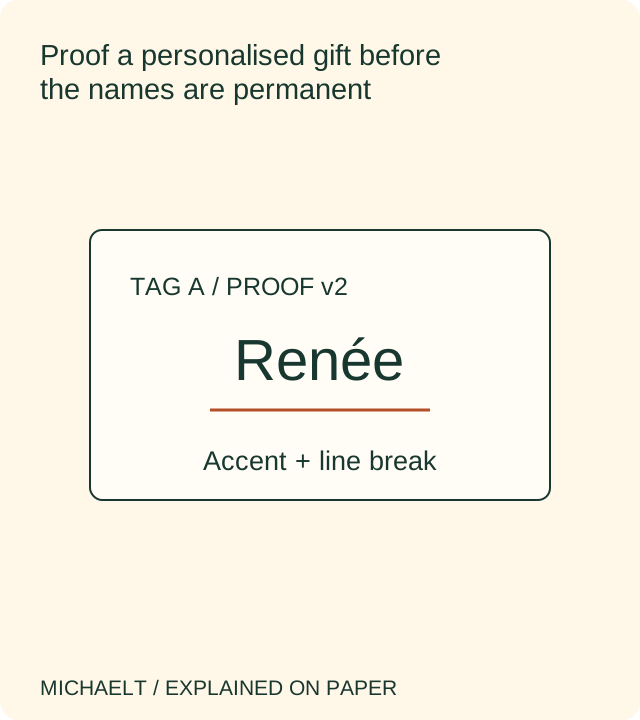
A fictional name proof keeps the accent and approved line break visible before production.
- Recipient/item code
- A / tag model T
- Approved wording
- Renée, accent retained
- Proof and placement
- v2, two lines at actual size
- Quantity and approval
- One item; named approver and date
A worked example
In an illustrative order, three gift tags read “Alex”, “Jo” and “Renée”. A proof has lost the accent in Renée, and its long line has also been reduced. Version 2 restores the agreed spelling and uses an approved second line. The buyer approves v2 only after matching all three item codes to the names. The public working copy uses A/B/C instead of addresses or real recipient details.
Illustrative example, not a reported purchase, client project or product test.
The completed record
- Recipient/item code
- A / tag model T
- Approved wording
- Renée, accent retained
- Proof and placement
- v2, two lines at actual size
- Quantity and approval
- One item; named approver and date
Download blank record (.csv) ↗Download worked example (.csv) ↗
Your own record
- □ Recipient/item code: ____________________
- □ Approved wording: ____________________
- □ Proof and placement: ____________________
- □ Quantity and approval: ____________________
Keep the distinction clear
A gift order has two separate checks: whether the object suits the person, and whether the supplier can reproduce the approved content. Passing the spelling check does not settle preference, material suitability or delivery. Keep each decision explicit. Photograph a received item only with consent and remove private wording before publishing an example.
Where this guide stops
The names and order are fictional. No vendor, delivery date, allergy suitability or right to return a personalised item is guaranteed.
Continue with a related task
- Plan guest favours by the unit you are giving ↗
- Commission a custom figurine without an ambiguous brief ↗
Sources and original context
The earlier topic was published 2021-05-18 under the Maria Baldwin byline. The present procedure and illustrative record are by MichaelT editorial.