

A useful way through
- Write two or three realistic visit windows from your own schedule. Check current opening times, class booking and access restrictions with the club. A pool on a facilities list is not proof that it is available during your intended visit.
- List the activities you want and what the membership actually includes. Ask about induction, reservations, extra charges and accessibility arrangements relevant to you. Keep a facility tour or trial observation separate from a promise about future attendance or health results.
- Read the actual term, joining charge, recurring payments, cancellation, freeze and renewal information. Record unanswered questions for the provider. The rules depend on the contract and jurisdiction; this comparison does not grant a universal cancellation entitlement.
- Compare complete prices over the same period and model a realistic number of visits. If the result depends on attending more often than your schedule allows, revise the assumption. Keep the contract and confirmed answers before making a commitment.
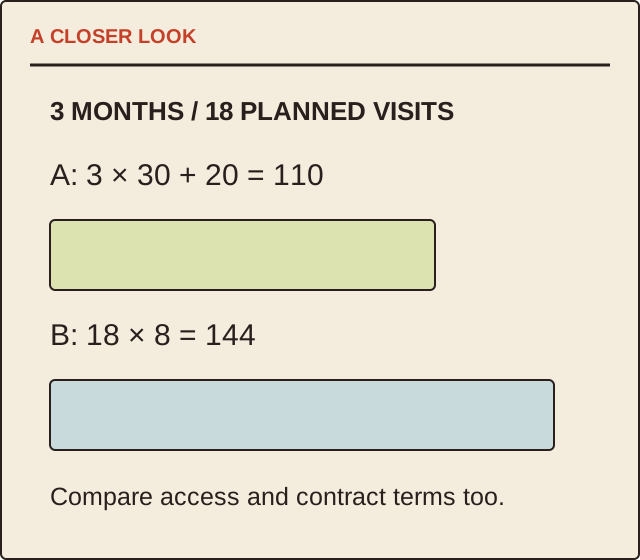
Read the map as text
A CLOSER LOOK · 3 MONTHS / 18 PLANNED VISITS · A: 3 × 30 + 20 = 110 · B: 18 × 8 = 144 · Compare access and contract terms too.
- Period
- A total
- Attendance
- B total
Put it into practice
For a fictional three-month comparison, membership A costs 30 per month plus a 20 joining charge: 110 total. At six planned visits per month, that is 110 ÷ 18 ≈ 6.11 per planned visit. Membership B costs 8 per visit: 144 for eighteen visits. Neither calculation proves the person will attend, and the actual access and terms may differ.
Illustrative example, not a reported client project or test.
Your take-away checklist
Compare gym memberships against the visits you can actually make
- □ Period: ____________________
- □ A total: ____________________
- □ Attendance: ____________________
- □ B total: ____________________
Before you act
This is a purchasing comparison, not exercise, medical or legal advice. No club, attendance outcome or fitness result is endorsed.
A worked record
Start with the example, then keep your own observations and confirmed information in the blank record.
- Period
- 3 monthsUse the same comparison period
- A total
- 3 × 30 + 20 = 110Illustrative currency units
- Attendance
- 3 × 6 = 18 planned visitsNot observed behaviour
- B total
- 18 × 8 = 144Check equivalent access and terms
Test the usable window
Visit or ask about the time you expect to use the club, rather than judging only from a quiet daytime tour. Record which relevant activities were available and which still need confirmation. Avoid collecting or photographing other members’ personal information.
When a cheaper plan is not equivalent
One plan may exclude a class or require a longer commitment. Show those differences next to the totals. A cost-per-visit figure with zero planned visits is undefined; do not disguise it as zero cost. Recalculate if the schedule or quoted fees change.
Sources & context
The earlier topic was published 2021-11-11 under the Maria Baldwin byline. The present procedure and illustrative record are by MichaelT.
Image attribution and reuse details ↗
Source: Internet Archive capture ↗
Compare a recorded class with live and personal feedback
Add the teaching format, observation and response arrangement to the existing access-and-cost comparison.


Name the delivery format
Ask whether the service supplies a recording, a live group session, live individual observation or an asynchronous review. These are different offers even if all are described as online coaching. Record what you can actually access and when. A video library does not establish that a trainer watches your session or responds to your individual question.
Test the practical connection appropriately
Ask about device requirements, captions or other access support, whether a camera is expected and how recordings or personal information are handled. Use an authorised demonstration without broadcasting other people or sharing health details publicly. Keep successful connection separate from the quality or suitability of instruction. A platform opening on a laptop does not establish that the service is available whenever you choose.
Agree the response and change route
Retain the actual question route, response arrangement, cancellation terms and contact if a session cannot proceed. Take individual exercise or health concerns to an appropriately qualified professional. This comparison supplies no exercise routine, diet, rehabilitation programme or promise that online coaching is equivalent to every in-person service. Keep the existing realistic-visit and complete-cost record beside the format information.
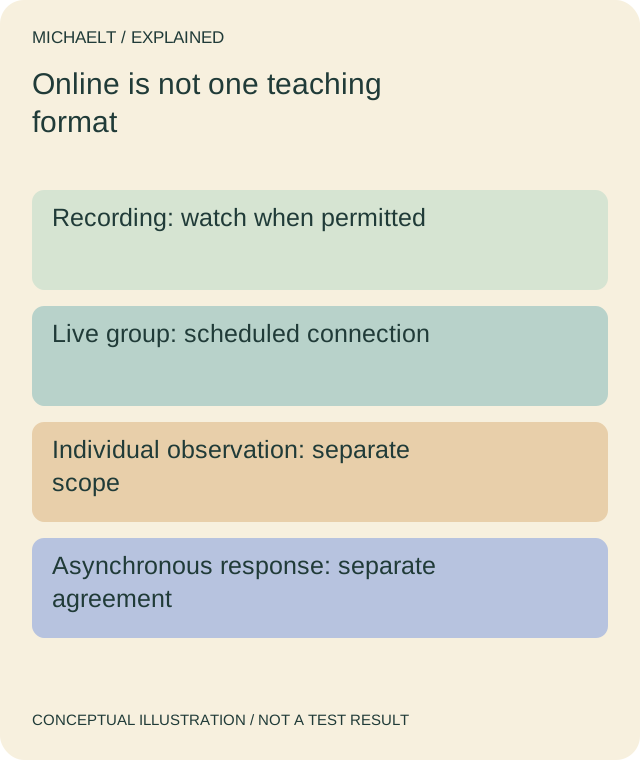
Read the drawing as text
Recorded content, live group access, personal observation and later feedback are different services. The actual offer must identify which are included.
Work through an example
A fictional offer A provides recorded sessions. B provides a scheduled live group but has not confirmed individual observation or replies. The buyer records those differences before comparing prices. A working video link is noted as connection tested, not personal coaching verified. No trainer, class, participant outcome or real service availability is assessed.
Illustrative example; figures, people and organisations in the worked record are fictional.
The example record
Recording
- Illustrative evidence
- A: library access
- Meaning or next step
- No observation implied
Live group
- Illustrative evidence
- B: scheduled session
- Meaning or next step
- Personal feedback unconfirmed
Access/privacy
- Illustrative evidence
- Actual platform questions
- Meaning or next step
- No public health-data test
Response
- Illustrative evidence
- Provider agreement pending
- Meaning or next step
- Keep alongside cost and cancellation
Download blank worksheet (.csv) ↗Download worked example (.csv) ↗
Keep your own record
Use the result within its scope
Choose only from the actual confirmed service and appropriate individual advice. Format and connection checks do not establish trainer competence, clinical suitability or future attendance and fitness results.
Reference sources
Earlier articles on this subject
- Exercise With Convenience – Find Your Place In Online Personal Training ↗ — 2021-12-28, Maria Baldwin.
- The Fitness Training Program ↗ — 2021-02-22, Maria Baldwin.
- Find The Best Fitness Coach ↗ — 2021-04-16, Maria Baldwin.
- How To Hire A Professional Fitness Coach? ↗ — 2022-09-24, Maria Baldwin.
- What Are The Reasons To Take Online Grinds In Ireland? ↗ — 2022-01-06, Maria Baldwin.
- Learn Quran anywhere in the world ↗ — 2021-11-16, Maria Baldwin.