A useful way through
- Open the film through the credited project page. First watch normally and write a one-sentence account of its overall movement.
- Watch a short passage again and note where a musical event coincides with an image change, gesture or transition.
- Replay while focusing on rhythm and texture. Describe what the sound adds: momentum, pause, contrast or continuity.
- Write a short hypothetical alternative. Explain how changing one musical choice might change your reading of the same images, without claiming that was the creators’ intention.
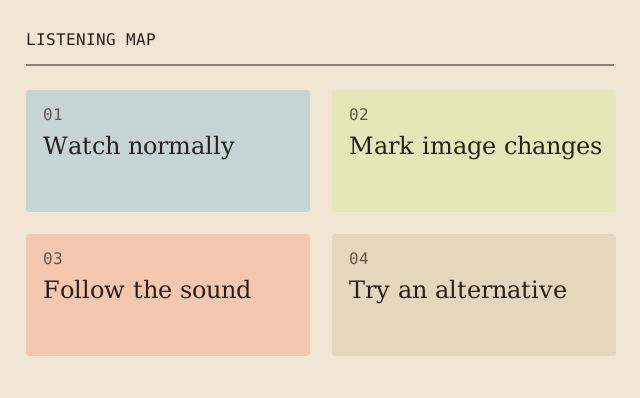
Read the map as text
LISTENING MAP · 01 · Watch normally · 02 · Mark image changes · 03 · Follow the sound · 04 · Try an alternative
- Watch normally
- Mark image changes
- Follow the sound
- Try an alternative
A worked cue plan for an invented three-shot scene
To practise separating image and sound, start with this invented ten-second sequence. It is not a scene description, alternative soundtrack or timestamped analysis of The Story of Sushi. No footage from that film is reproduced here.
| Time | Imagined image | Cue A: underline each action | Cue B: keep one sustained texture |
|---|---|---|---|
| 0–3 seconds | A hand places a closed notebook in a bag. | One short tone when the notebook touches the bag. | A quiet held tone begins before the movement. |
| 3–6 seconds | The bag closes; the person turns towards a door. | A second short tone at the close, followed by a pause. | The same tone continues across the cut. |
| 6–10 seconds | The door opens onto an empty corridor. | A third, longer tone at the opening. | The tone stops when the corridor appears; leave the final seconds silent. |
Turn a reaction into a question
Do not record “A is exciting; B is sad” as a result before making and watching either version. Instead write the comparison you would test: “Does A make me anticipate each action, while B makes me notice the last cut?” The scene and cue plan are specified; the audience response remains unmeasured.
Use the published film without inventing its timing
- Open the credited project through the source below. Note which version and player you used.
- Choose one short passage and write its actual start and end times.
- Watch normally, then watch muted. Record an image change and a sound change separately.
- Replay with sound. Write whether the changes coincide. Describe that timing before proposing an emotional effect.
A useful completed row contains two observed times and a specific relationship, such as a sound continuing across an image cut. A blank timing cell is preferable to a guessed one. The demo brief uses the same distinction between a proposed result and a checked delivery.
New fictional storyboard and cue plan. Historical film credits below identify the published project; this exercise does not report a screening, rescore or audience test.
Your take-away checklist
The Story of Sushi: listen to how a score tells a story
- □ Watch normally: ____________________
- □ Mark image changes: ____________________
- □ Follow the sound: ____________________
- □ Try an alternative: ____________________
Before you act
Use the linked artist, publisher or presenter for exact credits and current availability. These listening and planning exercises are additional exercises, not quotations from a lesson by Michael Thurber.
Sources & context
Motionographer’s 4 June 2012 project credit for The Story of Sushi links Michael Thurber to the score and credits Vincent Peone for direction and photography, and Joe Sabia for executive production, writing and editing. The original michaelt.org home page from 2014 identifies Michael Thurber and frames his Wix music site. Together these establish the musical strand of this domain.