A useful way through
- Start with the documented roles. Alexi Chacon’s Public Theater interview identifies Michael Thurber as composer and Farai Malianga as original drum composer for Merry Wives. Keep their accounts distinct; a collaboration does not make every statement or musical element the work of one person.
- Follow one creative decision. Thurber describes rethinking Falstaff’s musical references after seeing Jacob Ming-Trent rehearse: an initial 1990s hip-hop idea shifted towards late-1980s R&B and pop. Record the rehearsal observation and the changed direction rather than reducing the process to a genre label.
- Attend to the drum’s dramatic role. Malianga discusses the talking drum and its relationship with Shola Adewusi’s Mama Quickly. If you have access to a recording or performance, note the moment and the relationship you hear. The interview’s description alone is not evidence that you heard a particular cue.
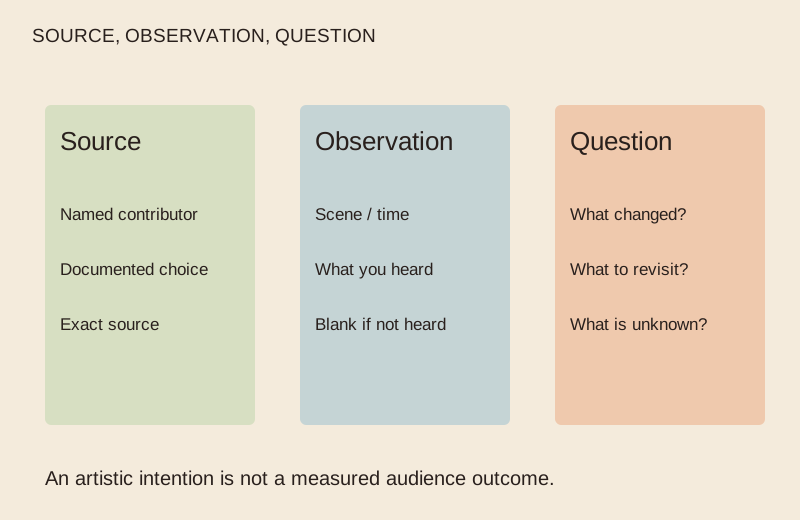
- Separate intention from outcome. The artists discuss reaching a present-day audience through their choices. That explains an artistic intention; it is not a measured audience-accessibility result. In your notebook, keep source statement, personal observation and unanswered question in separate columns.
Read the map as text
SOURCE, OBSERVATION, QUESTION · Source · Observation · Question · Named contributor · Documented choice · Exact source · Scene / time · What you heard · Blank if not heard · What changed? · What to revisit? · What is unknown? · An artistic intention is not a measured audience outcome.
- Character and dramatic moment
- Documented musical reference
- Rehearsal-led change
- What you notice and what is intended
Put it into practice
A sample listening note might read: source statement—Falstaff’s musical reference changed during rehearsal; observation—not entered because I have only read the interview; question—how does the revised sound interact with the actor’s timing? That incomplete observation is more accurate than inventing a cue or claiming every audience member felt the same response.
Illustrative example, not a reported client project or test.
Your take-away checklist
Merry Wives: listen for a character’s musical world
- □ Character and dramatic moment: ____________________
- □ Documented musical reference: ____________________
- □ Rehearsal-led change: ____________________
- □ What you notice and what is intended: ____________________
Before you act
The interview concerns a specific production and collaboration. Do not treat its preserved capture date as the interview’s publication date, an announcement of a 2026 run or a general rule about the musical identity of a community.
A three-column listening notebook
Source statement | your observation with a time or scene reference | a question for another listening. Add the named contributor to each source statement. Leave an observation blank when the performance is unavailable.
Try it on a different scene
Choose a moment with a clear character action. Describe what the music does in that moment before assigning a style label. Compare the observation with a programme or artist statement, retaining any disagreement as a question rather than inventing an explanation.
Sources & context
Presenter’s original address ↗ · Read the preserved programme or interview at Arquivo.pt ↗