Follow the task
Ask the class organiser first
Request the current requirements for the actual session or event. Record permitted uniform type, markings and any other stated conditions. Do not infer a rank, belt, competition approval or garment style from a general article.
Use the supplier’s own method
Match the exact model and size chart. Record whether the chart describes body height, garment dimensions or another measure, and how that supplier says to use it. Keep assumptions about washing and shrinkage out of the calculation unless the actual manufacturer provides them.
Proof any personalisation
Check the approved wording, placement and permitted logo before ordering embroidery or printing. Confirm rights to use an organisation’s mark. Use item codes instead of a child’s full name in documents shared beyond the people who need it.
Keep the care and acceptance record
Retain the label and exact care instructions with the order record. Agree how a wrong item or unapproved marking will be handled under the actual supplier’s terms. A uniform is not protective equipment simply because a description says it is durable.
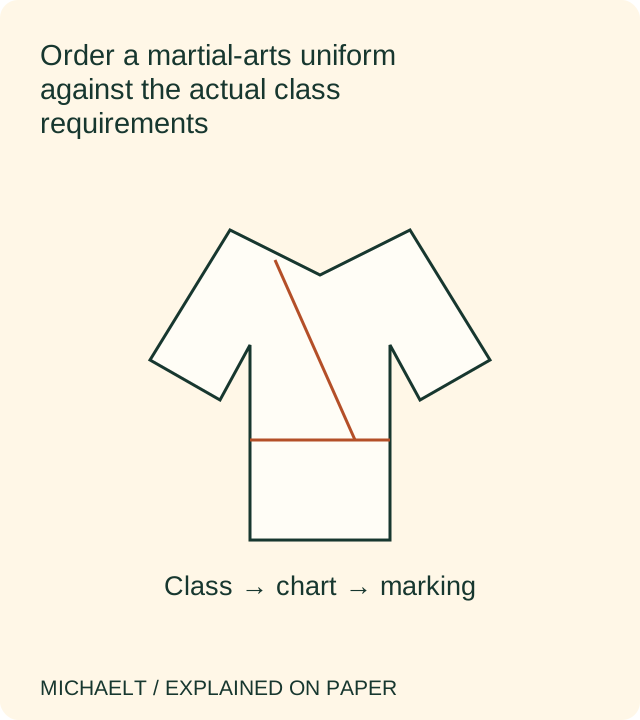
Read the diagram as text
Class requirements, the supplier chart and marking approval are three separate decisions.
- Class/event requirements
- Current organiser reference
- Exact model and chart
- Do not mix chart methods
- Marking approval
- Sleeve mark remains unapproved
- Care and received-item check
- Match item code and actual care label
A worked example
A fictional class requires a plain uniform and gives a supplier-specific chart. A group order proposes a logo on the sleeve, but the organiser has not approved that marking. The order record holds personalisation until written approval and records the selected size method. It does not assign a belt colour or promise that a garment meets an event’s rules.
Illustrative example, not a reported purchase, client project or product test.
The completed record
- Class/event requirements
- Current organiser reference
- Exact model and chart
- Do not mix chart methods
- Marking approval
- Sleeve mark remains unapproved
- Care and received-item check
- Match item code and actual care label
Download blank record (.csv) ↗Download worked example (.csv) ↗
Your own record
- □ Class/event requirements: ____________________
- □ Exact model and chart: ____________________
- □ Marking approval: ____________________
- □ Care and received-item check: ____________________
Keep the distinction clear
Historical terminology can be interesting, but it is a separate subject from deciding what to order today. The old source’s assertions about cuts and tradition are not used as a purchasing authority. The useful evidence is the organiser’s current requirement and the exact supplier’s description for the item you will receive.
Where this guide stops
Not a competition-rules, rank, safety-equipment or exercise guide. Do not publish children’s personalisation details.
Continue with a related task
- Approve a custom T-shirt with a placement and sample record ↗
- Compare a course by what you will practise ↗
Sources and original context
The earlier topic was published 2022-03-12 under the Maria Baldwin byline. The present procedure and illustrative record are by MichaelT editorial.