A useful way through
- Write a task you want to complete afterwards, such as editing a short recording or preparing a website brief. Separate that task from a certificate title.
- Read the current syllabus, level requirements and sample lesson. Ask how much work is practical and what feedback is provided.
- Compare the full commitment: scheduled sessions, independent work, software or materials, fees and access period. Check current terms with the provider.
- Decide how you will evaluate fit before paying. A sample exercise can reveal more about the teaching approach than an unsupported promise of professional success.
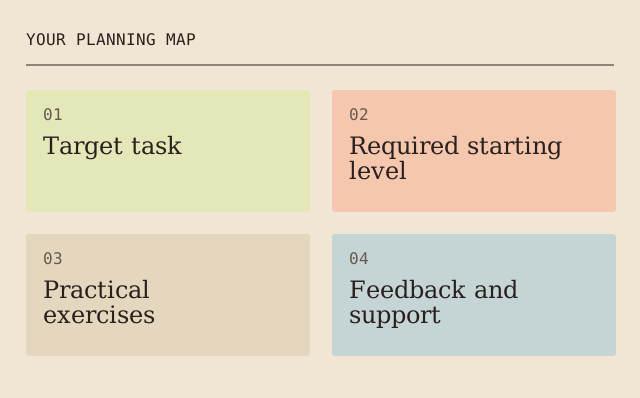
Read the map as text
YOUR PLANNING MAP · 01 · Target task · 02 · Required starting · level · 03 · Practical · exercises · 04 · Feedback and · support
- Target task
- Required starting level
- Practical exercises
- Feedback and support
Put it into practice
One course may include supervised exercises and feedback; another may provide only recordings. Both can cover the same topic while giving a different learning experience. Compare that difference against the task you want to practise.
Illustrative example, not a reported client project or test.
Your take-away checklist
Compare a course by what you will practise
- □ Target task: ____________________
- □ Required starting level: ____________________
- □ Practical exercises: ____________________
- □ Feedback and support: ____________________
- □ Complete time and cost: ____________________
Before you act
Do not assume a certificate is an accredited qualification or a guarantee of employment. Verify any specific accreditation claim with the named awarding body.
Ask for the actual assignment, not a familiar tool name
The older source used outdated platform names and confused what particular services do. A course title or a software logo cannot establish current teaching content. Ask for a dated syllabus, the relevant practical assignment, feedback arrangements and the conditions for completing it. For a specialised course such as wine education, check the actual provider and qualification requirements rather than treating every tasting session as equivalent.
A fictional analytics course says learners will interpret a report. A useful sample assignment names the source, metric definitions, period and question, and asks the learner to distinguish observation from explanation. Ask how feedback will identify an unsupported conclusion. A certificate of attendance and demonstrated ability to carry out that task remain different evidence. Do not assume that every course using the same software gives the same practice.
- Syllabus
- Current dated versionActual topics
- Assignment
- Interpret a defined reportSee representative task
- Feedback
- Identify unsupported conclusionWho reviews it?
- Completion
- Attendance or assessed workKeep the distinction
Sources for this addition
- Why You Should Take A Wine Class? ↗ — 2021-01-20, Maria Baldwin. The present addition is by MichaelT.
- The Online Marketing Courses ↗ — 2021-11-28, Maria Baldwin. The present addition is by MichaelT.
Sources & context
This guide develops the subject of Digital Marketing Courses The Right Tool, published 2021-05-03. The original capture is linked below. The new checklist is a planning procedure; product specifications, contracts and local requirements must be checked for the actual situation.
The starting point: Digital Marketing Courses The Right Tool
The page was credited to Maria Baldwin and dated 2021-05-03. The present procedure and example are by MichaelT.
The top 5 online marketing courses for the upcoming digital marketing campaign this year. Give your online marketing career an extra boost with the top digital marketing courses on the market today.
Ask what a learner produces, not only what a course covers
For any software course, request one practice task, the kind of feedback and a stated completion check. Keep access to software, prerequisites and time expectations separate. An old course advertisement does not establish current modules, price, certification, tax rules or guaranteed career outcomes.
- Practice output
- Fictional labelled report from synthetic data
- Feedback
- Specific correction to one field
- Independent check
- Repeat the task on a new fixture
- Current details to confirm
- Software access and actual course terms
A course that lists many subjects still leaves the practice question unanswered until the provider explains the work. The fictional record compares learning arrangements, not accounting advice or a real qualification.
Earlier topic, 2021-01-13, Maria Baldwin: Why Learn Digital Marketing Courses? ↗. New worked record: MichaelT, 23 October 2026.
Earlier topic, 2022-06-28, Maria Baldwin: Learn Accounting Online With The Best Xero Courses ↗. New worked record: MichaelT, 23 October 2026.
Ask whether a course certificate meets the actual role requirement
Add recognition, provider type and current requirements to the existing practice-and-feedback comparison.
Find the actual requirement first
Identify the role, jurisdiction and body that sets its requirements. Read the current version before choosing a course. England’s EYFS page now points to frameworks effective from September 2026 for different provider types. An old first-aid article or a course sales page must not silently replace the current applicable framework.
Match the certificate’s scope
Ask the training provider to identify the relevant course, assessment, mode of delivery and actual recognition claim. Confirm a specific recognition with the responsible body when needed. Attendance, successful assessment, a professional qualification and permission to undertake a regulated activity are different evidence. Do not assume an online title fulfils every practical, workplace or role-specific requirement.
Keep practical learning in the decision
Retain the existing questions about exercises, feedback and prerequisites. Add a column for the actual requirement and evidence of how the course addresses it. Do not perform gas work, clinical procedures or emergency training from a web article to demonstrate completion. Use appropriately authorised training and professional advice for the actual role.
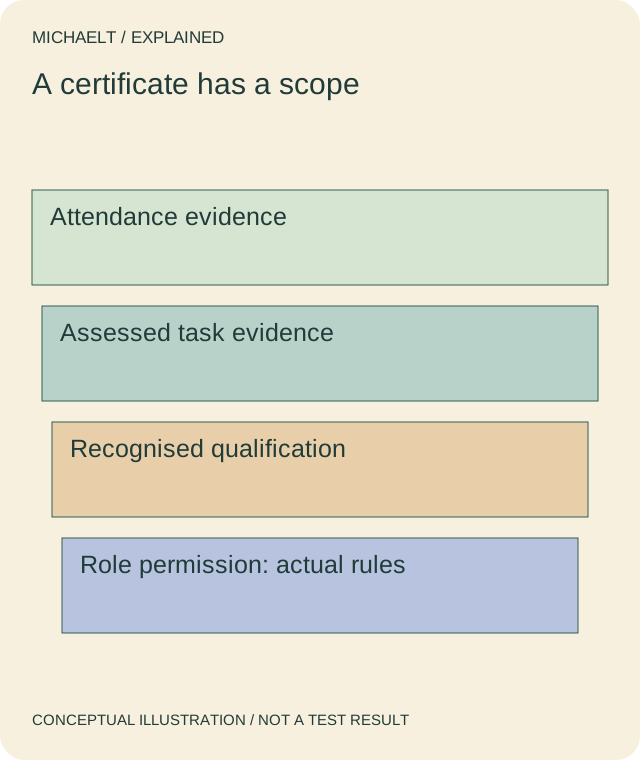
Read the drawing as text
Attendance, assessment, recognition and role permission are different claims. Confirm the relevant link before describing a course as qualifying.
Work through an example
A fictional learner needs requirement R for role T. Course C supplies an attendance certificate but has not identified recognition for R. The learner records the mismatch and asks the responsible body rather than describing C as qualifying them for T. No real training provider or qualification is endorsed or rejected.
Illustrative example; figures, people and organisations in the worked record are fictional.
The example record
Role T
- Evidence
- Current actual requirement R
- Question
- Jurisdiction and provider type
Course C
- Evidence
- Attendance certificate
- Question
- Not assumed qualification
Recognition
- Evidence
- Responsible body confirmation
- Question
- Still unanswered
Practice
- Evidence
- Exercises and feedback
- Question
- Keep separate from permission
Download blank worksheet (.csv) ↗Download worked example (.csv) ↗
Keep your own record
Use the result within its scope
Verify current requirements with the responsible body. The worksheet is a course-selection aid; it is not a certificate, licence or first-aid instruction.
Reference sources
Earlier articles on this subject
- Bloodborne Pathogens Training And Certification ↗ — 2021-11-26, Maria Baldwin.
- How To Become A Gas Fitter ↗ — 2022-05-05, Maria Baldwin.
- Why Should Clinicians Embrace Clinical eLearning? ↗ — 2022-09-15, Maria Baldwin.
- Online Law Education – Your Guide To Making An Educated Decision ↗ — 2021-08-26, Maria Baldwin.
- Business Technology Management and the Importance of an MBA in the IT Industry ↗ — 2021-10-28, Maria Baldwin.
- Advanced Beauty Training Courses ↗ — 2021-10-21, Maria Baldwin.
- Key Areas Covered in Paediatric First Aid Training ↗ — 2020-12-18, Maria Baldwin.