Follow the task
Choose a useful reference
Lay a shirt you comfortably wear on a flat surface without stretching it. Note how you intend to use the next shirt: tucked, untucked or layered. Record measurements as measurements of the garment, not measurements of your body.
Keep the method consistent
Write down where you measured chest width, body length and sleeve length. Compare those points with the seller’s own diagram; a shoulder-to-cuff measurement is not interchangeable with a centre-back-to-cuff measurement. Do not double or halve a number without checking what it represents.
Inspect the details that change use
Record collar fastening, cuffs, pocket placement, placket and the care label. Check whether a print is shown on the actual product or a generic image. A collar name does not establish quality, and a fabric description does not predict how every person will experience it.
Review the real wearing task
Where a try-on is possible, check your own preferred reach, sitting and layering movements without forcing the garment. If ordering remotely, keep unresolved fit questions and the actual return conditions beside the size chart. Choose on comfort and preference, not rules about gender or body shape.
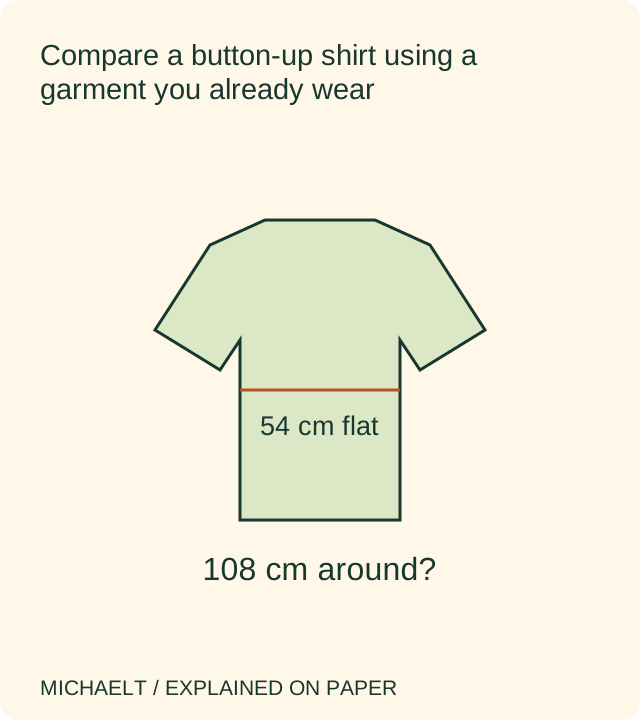
Read the diagram as text
A flat chest width and a circumference are different measurements; compare only confirmed methods.
- Reference garment
- Comfortable shirt, worn untucked
- Measurement method
- 54 cm flat chest, same endpoints
- Candidate specification
- 108 cm circumference if method confirmed
- Unresolved fit question
- Candidate B supplies body range only
A worked example
A fictional reference shirt measures 54 cm across the chest when laid flat. A listing gives 108 cm as garment circumference, so those two numbers describe comparable points only if the seller confirms the method. Another listing gives a body chest range, which stays in a different column. The buyer asks for the missing garment width instead of calling the second shirt too small.
Illustrative example, not a reported purchase, client project or product test.
The completed record
- Reference garment
- Comfortable shirt, worn untucked
- Measurement method
- 54 cm flat chest, same endpoints
- Candidate specification
- 108 cm circumference if method confirmed
- Unresolved fit question
- Candidate B supplies body range only
Download blank record (.csv) ↗Download worked example (.csv) ↗
Your own record
- □ Reference garment: ____________________
- □ Measurement method: ____________________
- □ Candidate specification: ____________________
- □ Unresolved fit question: ____________________
Keep the distinction clear
Write “measured flat” directly beside a width. Record the item’s condition and whether it has already been washed, because your comparison is about those particular garments. Do not invent a shrinkage percentage or apply one label’s care instruction to another fabric. This record is also useful when explaining a return or alteration request without judging the wearer’s body.
Where this guide stops
These are illustrative measurements, not a universal size chart, tailoring specification or promise of fit.
Continue with a related task
- Compare a sweatshirt by measurement rather than the size label ↗
- A practical cashmere care decision ↗
Sources and original context
The earlier topic was published 2022-04-20 under the Maria Baldwin byline. The present procedure and illustrative record are by MichaelT editorial.