A useful way through
- Read the garment label and note the permitted cleaning method. Photograph the label for reference before it fades.
- Check the garment for marks, loose seams and trims. If specialist cleaning is required, show these details to the cleaner before treatment.
- Follow the stated washing and drying method. Do not improvise temperature, agitation or stain chemicals from advice for a different garment.
- Store the clean, fully dry item in a way that supports its shape. Inspect periodically for damage instead of relying on a single seasonal routine.
Read the map as text
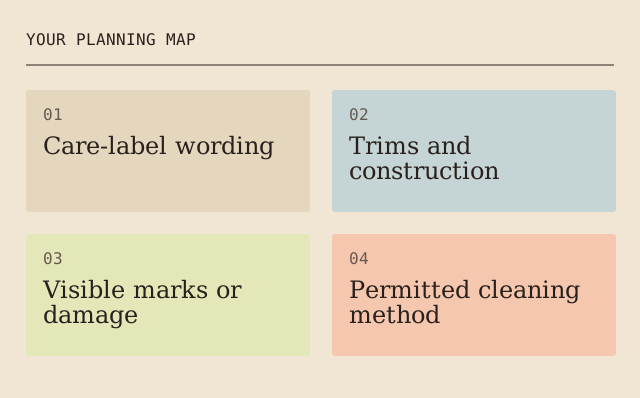
YOUR PLANNING MAP · 01 · Care-label wording · 02 · Trims and · construction · 03 · Visible marks or · damage · 04 · Permitted cleaning · method
- Care-label wording
- Trims and construction
- Visible marks or damage
- Permitted cleaning method
Put it into practice
A plain knitted jumper and a cashmere jacket with structured lining can require different treatment. Similar fibre names do not make their care instructions interchangeable.
Illustrative example, not a reported client project or test.
Your take-away checklist
A practical cashmere care decision
- □ Care-label wording: ____________________
- □ Trims and construction: ____________________
- □ Visible marks or damage: ____________________
- □ Permitted cleaning method: ____________________
- □ Drying and storage arrangement: ____________________
Before you act
For an unidentified stain or missing care label, ask a qualified cleaner to assess the actual garment rather than testing a strong treatment on a visible area.
Sources & context
This guide develops the subject of Cashmere Sweaters For Men and Women – Classy and Comfy, published 2021-07-24. The original capture is linked below. The new checklist is a planning procedure; product specifications, contracts and local requirements must be checked for the actual situation.
The starting point: Cashmere Sweaters For Men and Women – Classy and Comfy
The page was credited to Maria Baldwin and dated 2021-07-24. The present procedure and example are by MichaelT.
MichaelT clarification: Cashmere is a wool fibre, not silk. Read the actual composition and care labels.
Read the fibre percentages separately from the care method
Cashmere is a specialty wool fibre, not silk. The FTC’s US guidance explains fibre-content disclosure and illustrates blends with stated percentages. Read the actual garment label: a product name containing cashmere does not by itself say that every fibre is cashmere. Keep composition and care as different fields; a blend percentage does not determine the correct cleaning method for a lined or trimmed garment.
A complete label record
Copy the fibre names and percentages, retain a private photograph of the label and note the garment identifier. Record the exact care instructions separately. If a listing and the supplied label disagree, ask the retailer to explain the actual item before deciding. Do not perform a burn test, fibre treatment or unapproved wash to identify it. The FTC source is US-specific and does not certify a garment merely because its label uses familiar wording.
Read the drawing as text
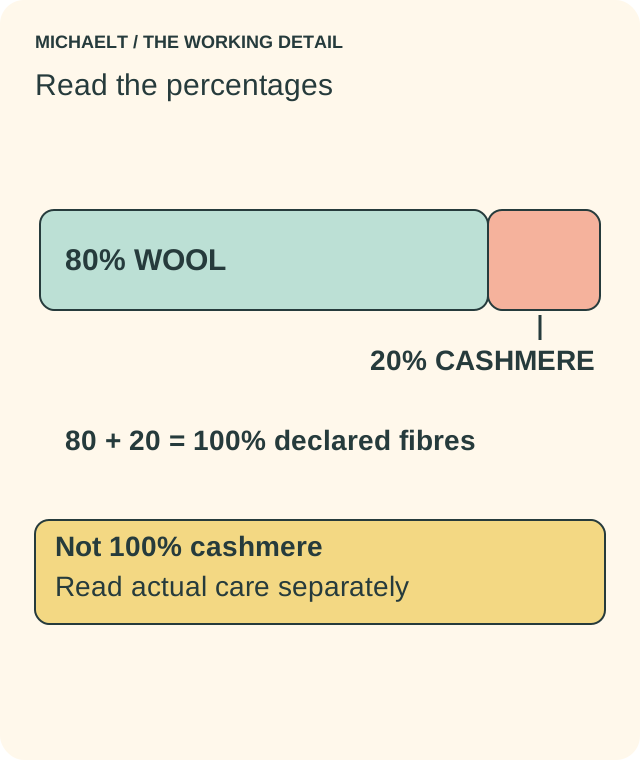
Illustrative fibre label: 80% wool plus 20% cashmere totals 100% declared fibres. It is not 100% cashmere. Care instructions are read separately; no fibre test is claimed.
Work through an example
An illustrative label says 80% wool and 20% cashmere. The percentages sum to 100%, but the item is not described as 100% cashmere. Its care instruction remains the actual garment’s instruction, not an inference from the blend. Neither the composition nor the care has been laboratory tested here.
Illustrative example; figures, people and organisations in the worked record are fictional.
The example record
Fibre statement
- Illustrative record
- 80% wool / 20% cashmere
Sum
- Illustrative record
- 100% declared fibres
Care
- Illustrative record
- Read separately on actual item
Unconfirmed
- Illustrative record
- No fibre-authenticity test
Download blank worksheet (.csv) ↗Download worked example (.csv) ↗
Keep your own record
Use the result within its scope
A label comparison records a claim; it does not independently verify the fibre. Preserve the original wording and seek the retailer’s clarification about discrepancies.
Reference sources
Earlier articles on this subject
- Luxury of Cashmere Sweaters ↗ — 2021-12-03, Maria Baldwin.
- Get The Unique Cashmere Sweaters ↗ — 2021-09-15, Maria Baldwin.