Follow the task
Mark the decision points
Sketch the visitor’s route from the entrance to the destination. Mark where someone must choose a direction and what they can see before that choice. Keep the route’s practical constraints separate from the decorative design of the sign.
Use one destination name
Match the wording on the invitation, directory, door and sign. Separate a destination label from a promotional message. Ask whether a visitor unfamiliar with the building could connect the words, rather than expecting them to know an internal abbreviation.
Make a temporary proof
Use a harmless paper mock-up at the intended reading size. Walk the ordinary visitor approach with the venue’s permission and check visibility, lighting and visual competition. Do not attach objects to walls or cover required signs as part of the experiment.
Record the observation
Ask a willing tester what destination they think the sign indicates and what they would do next. Write down the actual response and the observed location. Revise an ambiguous label or arrow, then check the changed route again; do not invent a conversion percentage from one walk-through.
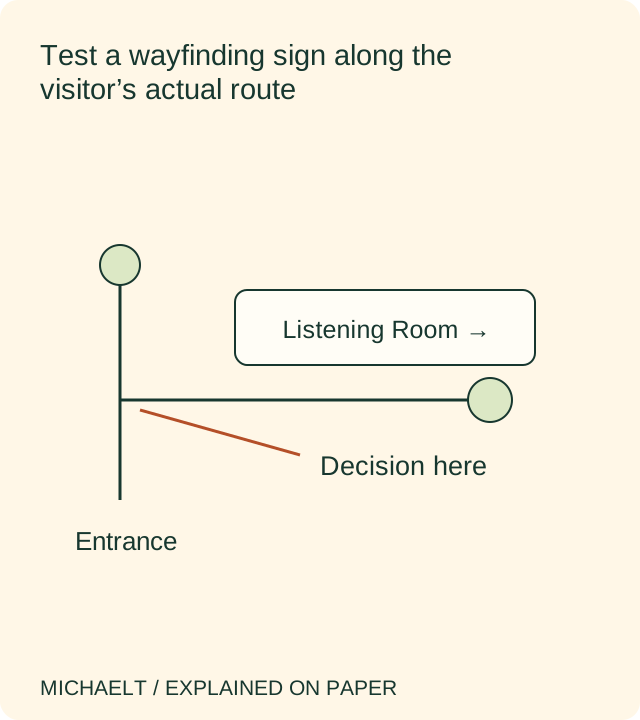
Read the diagram as text
Place the direction before the junction where the visitor needs to decide.
- Destination vocabulary
- Listening Room everywhere
- Approach and junction
- Entrance → junction → room
- Proof version
- Paper v2 at intended size
- Observed next action
- Record the tester’s words, not a guessed success rate
A worked example
In a fictional venue, an invitation says “Listening Room” but a corridor sign says “LR2”. The paper proof is replaced with the full name and a direction at the junction. The test record asks the visitor to find the room without coaching. A correct choice at that junction checks that specific route; it does not certify access, fire safety or every visitor’s experience.
Illustrative example, not a reported purchase, client project or product test.
The completed record
- Destination vocabulary
- Listening Room everywhere
- Approach and junction
- Entrance → junction → room
- Proof version
- Paper v2 at intended size
- Observed next action
- Record the tester’s words, not a guessed success rate
Download blank record (.csv) ↗Download worked example (.csv) ↗
Your own record
- □ Destination vocabulary: ____________________
- □ Approach and junction: ____________________
- □ Proof version: ____________________
- □ Observed next action: ____________________
Keep the distinction clear
An arrow can be perfectly drawn and still appear after the place where the decision was needed. Mark the observer’s position on your sketch. If the venue requires an accessible or regulated sign system, consult its responsible specialist. Your informal wayfinding proof must complement those requirements, never replace a mandated sign or route.
Where this guide stops
Not a fire, emergency-exit or accessibility certification. Obtain venue approval and preserve required notices and escape routes.
Continue with a related task
Sources and original context
The earlier topic was published 2021-08-13 under the Maria Baldwin byline. The present procedure and illustrative record are by MichaelT editorial.