Follow the task
Start with the agreed arrangement
Record which pet, which dates and which responsible person the handover concerns. Ask the owner what routine and equipment the carer is expected to follow. Do not infer feeding, exercise or treatment instructions from a shopping article.
Match items to the routine
List the specific bowl, lead, bedding or other item supplied, with a simple identifier. Confirm which item belongs to which animal. Keep the owner’s instructions and manufacturer’s directions where they can be read; appearance alone does not show compatibility.
Rehearse the handover
Have the owner show the intended use of unfamiliar equipment and the relevant contact route. Ask about an uncertain instruction before the care period starts. Leave medical decisions and medication administration outside this general packing worksheet and follow the appropriate professional plan.
Make the return record
Agree what must come back and how damage or a missing item will be reported. Keep phone numbers and addresses in the private handover, not in public photographs of the kit. Verify the responsible carer has the current version rather than an old message thread.
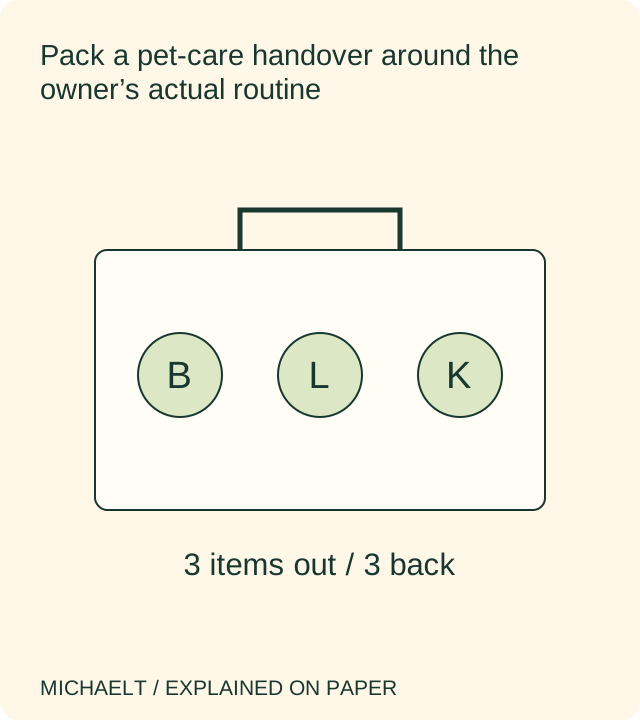
Read the diagram as text
The fictional handover reconciles bowl B, lead L and blanket K as three separate items.
- Pet and care dates
- P / agreed weekend
- Item identifiers
- B, L, K
- Owner instruction reference
- Current private routine, confirmed with owner
- Return and contact route
- Three items reconciled; contacts kept private
A worked example
A fictional handover contains bowl B, lead L and blanket K for pet P. Two similar leads are on the table, so the owner labels the intended one L and demonstrates it. The carer checks the three-item list on arrival and return. The public example omits the animal’s address and contact numbers; it does not invent a feeding schedule or state that the accessories prevent illness.
Illustrative example, not a reported purchase, client project or product test.
The completed record
- Pet and care dates
- P / agreed weekend
- Item identifiers
- B, L, K
- Owner instruction reference
- Current private routine, confirmed with owner
- Return and contact route
- Three items reconciled; contacts kept private
Download blank record (.csv) ↗Download worked example (.csv) ↗
Your own record
- □ Pet and care dates: ____________________
- □ Item identifiers: ____________________
- □ Owner instruction reference: ____________________
- □ Return and contact route: ____________________
Keep the distinction clear
A product photograph cannot establish how a particular animal should be handled. If something is damaged, unfamiliar or inconsistent with the owner’s directions, ask before substituting another item. This worksheet is about a complete handover. It is deliberately not a universal collar-fitting rule, training programme or list of products every animal should have.
Where this guide stops
Not veterinary, feeding or behaviour advice. Use the owner’s actual instructions and appropriate professional help for health or care concerns.
Continue with a related task
- Check a campsite’s dog rules before packing ↗
- Move a personal collection with a box and condition inventory ↗
Sources and original context
The earlier topic was published 2022-03-08 under the Maria Baldwin byline. The present procedure and illustrative record are by MichaelT.
Keep observations separate from a behaviour diagnosis
Alongside the equipment handover, keep a short observation note when something worries the owner. RSPCA guidance says underlying health issues can contribute to separation-related behaviour and advises veterinary help when concerned. A timestamped record can support that conversation; it does not diagnose anxiety or justify punishment.
Record what occurred during the ordinary arrangement
Use date, time, context, directly observed behaviour and the owner’s agreed contact route. Distinguish an observation from an interpretation: heard barking at the recorded time is different from confirmed separation anxiety. Keep any video and location information private. Do not provoke an absence, prolong distress or set up a test to fill a diary. Follow appropriate professional advice for the individual animal.
Report rather than invent a treatment
Tell the responsible owner what was actually observed and use the agreed route for concerns. A carer should not improvise a confinement, training, medication or exercise programme from an accessories article. Record any next instruction and its source separately so a later carer can distinguish it from an earlier assumption.
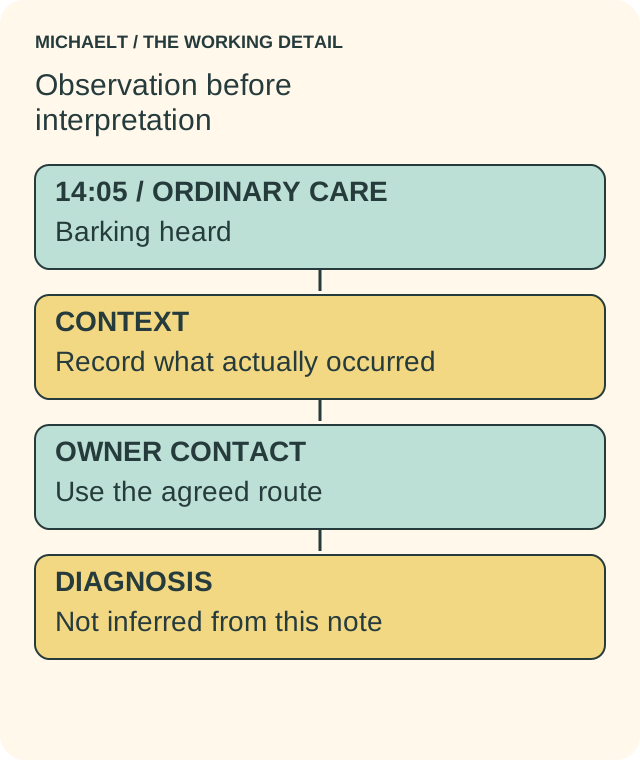
Read the drawing as text
Illustrative 14:05: barking heard during ordinary agreed care. Record context and contact the owner. No diagnosis, provoked absence or treatment is supplied.
Work through an example
A fictional carer notes barking heard during an ordinary agreed care period at 14:05. The note records the context and contact with the owner, while the diagnosis field is deliberately absent. It supplies no duration of recommended absence and no claim that an enclosure or new collar treats distress.
Illustrative example; figures, people and organisations in the worked record are fictional.
The example record
Time
- Illustrative entry
- 14:05 during ordinary agreed care
Observation
- Illustrative entry
- Barking heard
Interpretation
- Illustrative entry
- Not a diagnosis
Next action
- Illustrative entry
- Contact owner through agreed route
Download blank worksheet (.csv) ↗Download worked example (.csv) ↗
Keep your own record
Use the result within its scope
The purpose is an accurate handover and appropriate help, not a home diagnostic experiment or a promise that behaviour can be cured within a fixed time.
Reference sources
Earlier articles on this subject
- Best Puppy Separation Training To Cure Within Time! ↗ — 2021-09-14, Maria Baldwin.
- Help Your Dog To Recover From Separation Anxiety Disorder ↗ — 2022-01-10, Maria Baldwin.
- Why is Dog Runs Important? ↗ — 2022-09-10, Maria Baldwin.