Follow the task
Define one repeat
Draw the motif as a small unit and mark its top edge. Write down whether the pattern repeats by translation, rotation or another deliberate rule. A photograph of an attractive room is not a complete specification for the repeat.
Make a counted grid
Choose an illustrative number of rows and columns and fill every cell using the rule. Label row and column numbers so a change can be identified exactly. Use a paper or digital mock-up; do not assume the grid proves actual room dimensions or quantities to order.
Check the boundary
Look at the edges and corners as well as the centre. Mark how a border interrupts the repeat and whether the pattern should be centred or start from a particular reference. Keep visible alignment preferences separate from the installer’s substrate, joint and cutting requirements.
Keep the approved version
Save a version with orientation marks, a legend and the agreed viewing direction. Ask the supplier or installer to translate the design into a real product and installation plan. A visual proof does not establish slip resistance, waterproofing or waste allowance.
Read the diagram as text
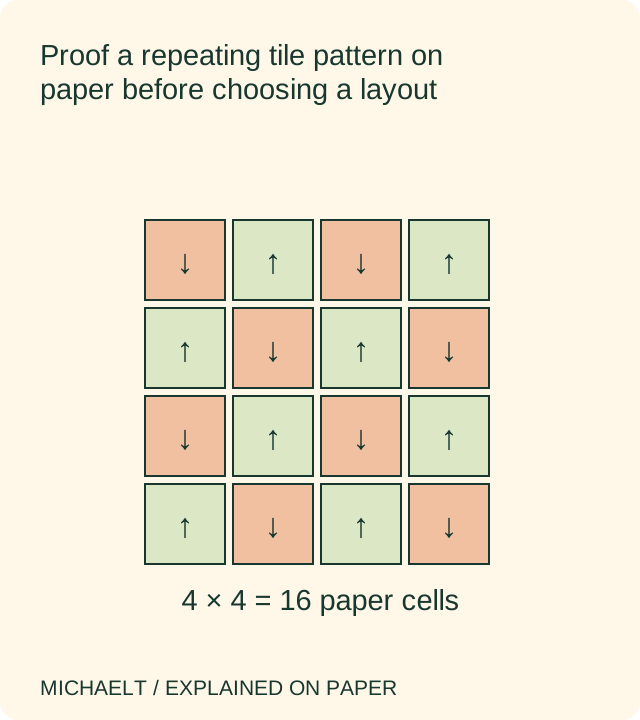
A 4 by 4 paper grid contains 16 cells and makes the orientation rule visible.
- Motif and top edge
- One arrow marks orientation
- Grid and repeat rule
- 4 × 4, 16 illustrative cells
- Boundary decision
- Border compared separately
- Approved proof version
- v2 with numbered rows/columns
A worked example
A fictional 4 × 4 proof contains 16 cells. Alternating the motif between 0° and 180° makes one visual repeat; rotating every second row by 90° makes another. The owner circles cell R3C2 in the rejected version and explains the unwanted break. The approved paper proof records the repeat rule, without claiming 16 real tiles will cover the room.
Illustrative example, not a reported purchase, client project or product test.
The completed record
- Motif and top edge
- One arrow marks orientation
- Grid and repeat rule
- 4 × 4, 16 illustrative cells
- Boundary decision
- Border compared separately
- Approved proof version
- v2 with numbered rows/columns
Download blank record (.csv) ↗Download worked example (.csv) ↗
Your own record
- □ Motif and top edge: ____________________
- □ Grid and repeat rule: ____________________
- □ Boundary decision: ____________________
- □ Approved proof version: ____________________
Keep the distinction clear
A quantity estimate requires actual dimensions, the chosen product and the installer’s plan. Do not turn a decorative mock-up into a universal waste percentage or a cutting guide. The advantage of a paper proof is that a disagreement about a pattern can be resolved before it becomes a material order.
Where this guide stops
Design exercise only. No tiling, structural, wet-area, floor-safety or fabrication instruction is provided.
Continue with a related task
Sources and original context
The earlier topic was published 2022-08-05 under the Maria Baldwin byline. The present procedure and illustrative record are by MichaelT editorial.