A useful way through
- Identify what kind of source you have: artist biography, presenter announcement, programme or post-event account. Keep its publication date.
- Copy the exact role for your notes. Composition, orchestration, music supervision and performance are different credits.
- Separate the event date from the date you checked the page. Do not call an event upcoming after its advertised run has passed.
- Follow the current presenter’s route for any new performance information. An old press release is evidence of an announcement, not proof of current tickets or that every planned event occurred.
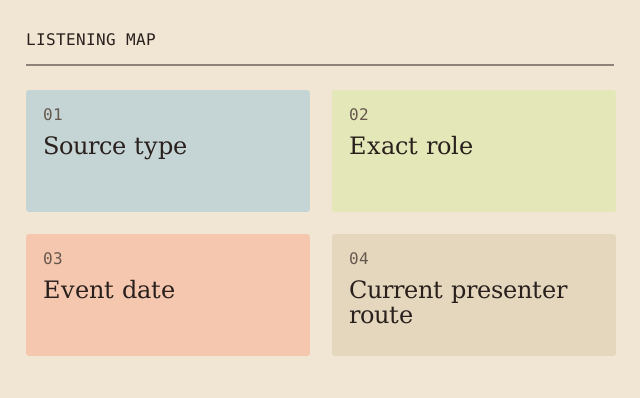
Read the map as text
LISTENING MAP · 01 · Source type · 02 · Exact role · 03 · Event date · 04 · Current presenter · route
- Source type
- Exact role
- Event date
- Current presenter route
Put it into practice
A programme credit reading “original orchestrations and music supervision” supports those roles. It does not, by itself, establish authorship of every song in the production.
Illustrative example, not a reported client project or test.
Your take-away checklist
Michael Thurber in 2026: read the credits carefully
- □ Source type: ____________________
- □ Exact role: ____________________
- □ Event date: ____________________
- □ Current presenter route: ____________________
Before you act
Use the linked artist, publisher or presenter for exact credits and current availability. These listening and planning exercises are editorial additions, not quotations from a lesson by Michael Thurber.
Sources & context
Festival Napa Valley’s summer 2026 page announced a Michael Thurber concerto for Time for Three, associated with its 10 July opening night. A 31 August 2026 Public Theater release for Public Record, scheduled 4–8 September, credits his original orchestrations and music supervision. These dates precede this October edition. The linked presenter pages preserve their own scope and wording.
Public Theater release carried by I LOVE NY, 31 August 2026 ↗