Follow the task
List real situations
Choose a few actual activities and your own comfort and appearance priorities. Work, travel and an event may need different arrangements. Do not start with a generic essential wardrobe claimed to suit every gender or lifestyle.
Inventory what works
Match existing garments to the activities and note condition and care labels. A garment you comfortably wear can provide a measurement reference. Private wardrobe or body photographs do not belong in a public planning example.
Test combinations and timing
Make a garment-by-outfit grid and distinguish tried combinations from ideas. Include periods when something is unavailable for laundry or repair. Several theoretical outfits may depend on the same unavailable item.
Describe the smallest gap
Identify the missing role and the information needed before purchase. Keep the actual seller’s measurements and terms beside the enquiry. Do not fill the plan with an invented discount or unverified local-shop recommendation.
Read the diagram as text
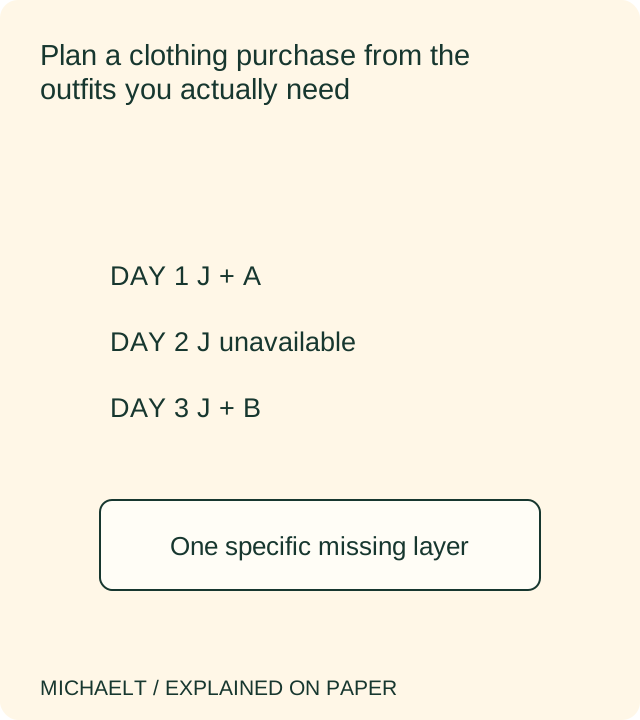
A three-day fictional plan exposes one missing layer when jacket J is unavailable.
- Wearing situations
- Three fictional days
- Existing pieces
- Jacket J; shirts A/B
- Combinations/laundry
- Mark tried versus proposed
- Specific missing role
- One layer, not a whole wardrobe
A worked example
A fictional three-day plan uses jacket J and shirts A/B. J is due for cleaning during one activity, exposing a single missing layer. The person asks about that role and compares an existing garment’s measurements, instead of buying an entire list of supposed essentials.
Illustrative example, not a reported purchase, client project or product test.
The completed record
- Wearing situations
- Three fictional days
- Existing pieces
- Jacket J; shirts A/B
- Combinations/laundry
- Mark tried versus proposed
- Specific missing role
- One layer, not a whole wardrobe
Download blank record (.csv) ↗Download worked example (.csv) ↗
Your own record
- □ Wearing situations: ____________________
- □ Existing pieces: ____________________
- □ Combinations/laundry: ____________________
- □ Specific missing role: ____________________
Keep the distinction clear
Care requirements are part of the use plan; follow each actual label. A capsule plan is an organisation method, not an instruction to discard clothes or a measured environmental improvement. Keep the wearer’s preferences open until they decide. The archived article’s gender stereotypes supply no evidence for the new procedure.
Where this guide stops
No universal wardrobe, guaranteed fit, savings or environmental claim. The plan is fictional and preference-led.
Continue with a related task
- Choose hangers around the garment, not the wardrobe photo ↗
- Compare a sweatshirt by measurement rather than the size label ↗
Sources and original context
The earlier topic was published 2022-07-04 under the Maria Baldwin byline. The present procedure and illustrative record are by MichaelT editorial.