A useful way through
- Measure the finished insert. Include folds, extra sheets and any card or enclosure. Decide whether the recipient should receive it flat or folded. Record the quantity separately from the size so a later quantity change does not silently alter the paper or envelope specification.
- Ask the printer for usable internal dimensions and construction. A nominal envelope size is not a guarantee of clearance around a thick insert. Request a physical sample and confirm that the flap closes without forcing the contents or obscuring important information.
- Prepare the artwork to the printer’s template. Keep the address, return route and postage area readable and clear of decorative elements. Verify personalised data with a small controlled proof rather than sending an unchecked address list. Avoid exposing customer addresses in public screenshots.
- Approve a complete filled sample. Check insertion, closure, legibility and the actual carrier’s size, weight and thickness limits. Save the approved specification, print proof and packing note; a photograph alone cannot confirm paper stock or postal eligibility.
Read the map as text
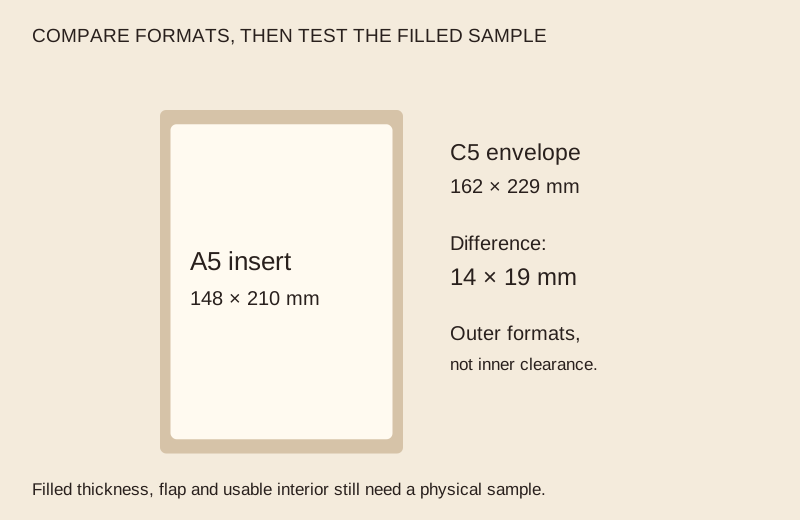
COMPARE FORMATS, THEN TEST THE FILLED SAMPLE · A5 insert · 148 × 210 mm · C5 envelope · 162 × 229 mm · Difference: · 14 × 19 mm · Outer formats, · not inner clearance. · Filled thickness, flap and usable interior still need a physical sample.
- Insert dimensions and thickness
- Usable envelope interior
- Address and print proof
- Filled sample approval
Put it into practice
A flat A5 insert is nominally 148 × 210 mm; a C5 envelope is nominally 162 × 229 mm. The dimensional differences are 14 and 19 mm, or 7 and 9.5 mm per side if perfectly centred. These are outer-format comparisons, not promised internal clearances. A stiff insert or several sheets still needs a filled sample.
Illustrative example, not a reported client project or test.
Your take-away checklist
Order printed envelopes that fit and travel
- □ Insert dimensions and thickness: ____________________
- □ Usable envelope interior: ____________________
- □ Address and print proof: ____________________
- □ Filled sample approval: ____________________
Before you act
Postal formats and prices depend on the carrier and country. For example, Royal Mail’s UK letter limits include thickness and weight as well as length and width. Check the actual service; C5 is not a universal promise of a particular postage rate.
A complete approval line
Record insert revision; folded size; number of sheets; envelope product code; paper; artwork proof version; address-data check; filled dimensions; filled weight; service checked; approver and date.
If the proof fails
Name the failure: insert catches, flap does not close, address is obscured, or filled item exceeds the chosen service. Change one relevant specification and approve a new sample. Do not hide the issue inside “printer to adjust”.
Sources & context
The earlier Find Custom Envelopes & Business Envelopes with Digital Printing page was dated 2021-06-25. Its subject is developed here as a new procedure, with the original byline retained separately. This edition does not carry forward the page’s supplier recommendations or unsupported outcome claims.