Follow the task
Copy what the bottle actually says
Record the producer or bottler as printed, the wine name, the stated place or designation, vintage where shown, and bottle identification. Preserve accents and spelling. Do not treat a shop’s category heading as text from the label.
Follow the named designation
Use the corresponding regulator or producer to check unfamiliar terminology. A Rioja source explains Rioja; it does not establish the rules for every Spanish wine. Keep a document date beside any regulated classification you consult.
Separate harvest from later dates
A vintage refers to the harvest year, as Rioja’s Control Board explains. Do not silently replace it with the bottling, purchase or tasting date. If a year is absent, record “not stated” rather than choosing one from an image search.
Add observations in another section
If you choose to taste, keep your description separate from copied facts. A personal preference is not a certificate of origin, an investment forecast or proof of a category’s quality. Non-drinkers can complete the label-reading exercise without tasting anything.
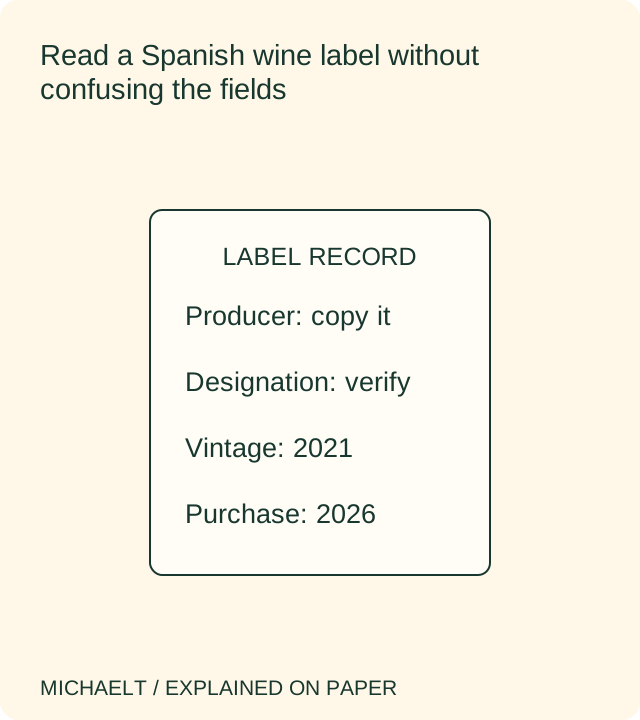
Read the diagram as text
Vintage and purchase year remain separate fields in the illustrative label record.
- Producer/name
- Copy the exact label wording
- Place or designation
- Check the regulator for that designation
- Vintage and other dates
- Harvest 2021; purchase 2026 in the fictional example
- Observation versus verified fact
- Preference stays in a separate note
A worked example
An illustrative note records a fictional bottle name, a label vintage of 2021 and a purchase in 2026. The worksheet keeps 2021 in the vintage field and 2026 in the purchase field. A shop description says “oak”, but the label record does not turn that word into a grape variety. Any classification question is checked against the named designation’s current information.
Illustrative example, not a reported purchase, client project or product test.
The completed record
- Producer/name
- Copy the exact label wording
- Place or designation
- Check the regulator for that designation
- Vintage and other dates
- Harvest 2021; purchase 2026 in the fictional example
- Observation versus verified fact
- Preference stays in a separate note
Download blank record (.csv) ↗Download worked example (.csv) ↗
Your own record
- □ Producer/name: ____________________
- □ Place or designation: ____________________
- □ Vintage and other dates: ____________________
- □ Observation versus verified fact: ____________________
Keep the distinction clear
The earlier text mixed geographical, production and ageing statements without a dependable chain of evidence. This procedure retains the useful label-reading question and removes the unsupported rankings and category-wide assertions. Use the producer and regulator for the actual bottle; a current rule should not be inferred from an old general article.
Where this guide stops
For adults of legal drinking age. No health benefit, consumption target, investment value or universal ageing rule is offered.
Continue with a related task
Sources and original context
The earlier topic was published 2022-03-23 under the Maria Baldwin byline. The present procedure and illustrative record are by MichaelT editorial.