A useful way through
- Map the area and the hours when shade is wanted. Observe the actual sun path and nearby obstacles before requesting a proposal.
- Explain the intended use and how the awning will be operated and stored. Include access needs and the position of furniture.
- Ask a qualified supplier to assess the fixing surface, local requirements and the specified product’s operating limits.
- Compare a written scope covering survey, structure, controls, electrical work if relevant, installation, maintenance and warranty.
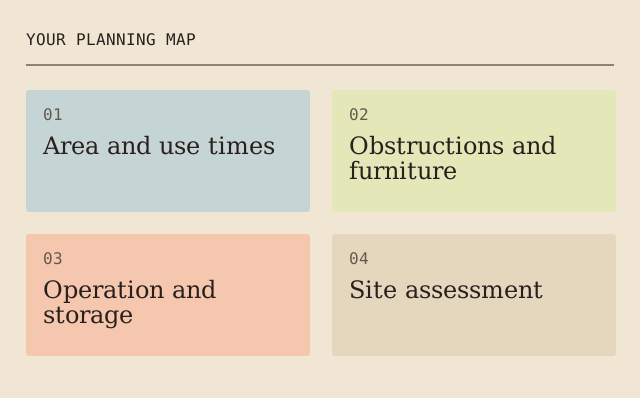
Read the map as text
YOUR PLANNING MAP · 01 · Area and use times · 02 · Obstructions and · furniture · 03 · Operation and · storage · 04 · Site assessment
- Area and use times
- Obstructions and furniture
- Operation and storage
- Site assessment
Put it into practice
A wide awning may still leave the dining table exposed at the time it is usually used. A proposal based on the actual afternoon sun position is more useful than choosing by frontage width.
Illustrative example, not a reported client project or test.
Your take-away checklist
Decide whether a retractable awning fits the space
- □ Area and use times: ____________________
- □ Obstructions and furniture: ____________________
- □ Operation and storage: ____________________
- □ Site assessment: ____________________
- □ Installation and maintenance scope: ____________________
Before you act
Never use a general online recommendation as a wind limit or structural fixing specification. Follow the assessed product and installer instructions.
Sources & context
This guide develops the subject of 2 Important Benefits Of Having A Retractable Awning, published 2022-01-04. The original capture is linked below. The new checklist is a planning procedure; product specifications, contracts and local requirements must be checked for the actual situation.
The starting point: 2 Important Benefits Of Having A Retractable Awning
The page was credited to Maria Baldwin and dated 2022-01-04. The present procedure and example are by MichaelT.
MichaelT clarification: Shade preference and product operating limits are different questions; follow the exact assessed product and its current instructions.
Read an awning’s operating limits in the right state
Keep the exact product, extended or retracted state and actual weather instructions together instead of trusting an all-weather promise.
Identify the assessed product
Retain the exact awning or roof product, manual revision and installer information. A retractable fabric awning and a different roof system may have different requirements. Do not transfer a number, weather claim or procedure from an older manual to a different model. The SunSetter owner resources are a manufacturer-specific example, not instructions for every outdoor structure.
Separate operating states
Ask which actual instructions apply when extended, partly extended, retracted or not in use. Keep wind, rain, snow and unattended-use questions distinct where relevant to the product. A marketing phrase such as all-weather or a picture showing rain is not an operating limit. A sensor does not by itself establish that every condition is automatically handled.
Keep the decision with the real instructions
Ask the qualified supplier to explain the current product and installation-specific limitations and how unresolved questions are handled. Follow those instructions rather than experimenting with a structure in adverse weather. This record does not supply wind thresholds, water-resistance ratings, structural fixings, sensor settings or electrical work. Keep the shade-location plan separate from approval of the installation.
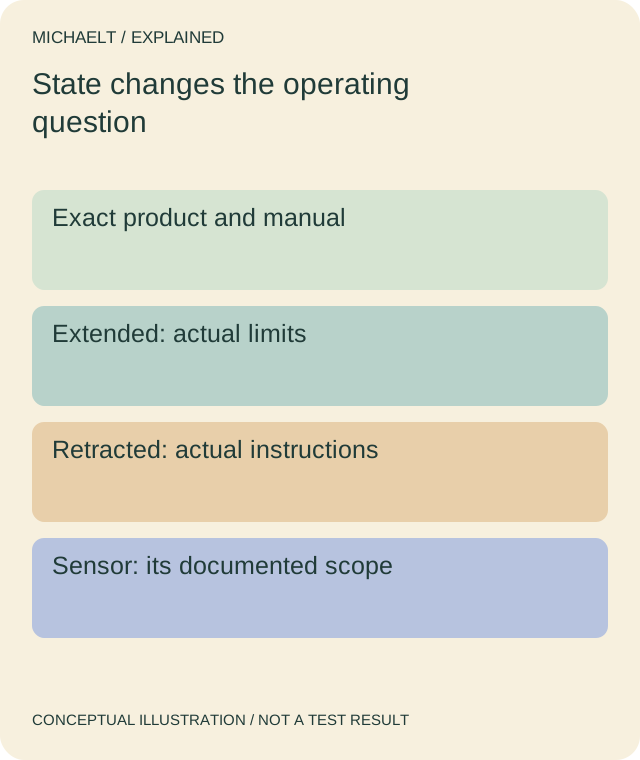
Read the drawing as text
An awning’s extended and retracted states need their own actual instructions. A sensor and an all-weather slogan do not fill missing limits.
Work through an example
A fictional proposal calls system A all-weather but supplies no matched manual. The buyer asks for the actual instructions in extended and retracted states and for clarification of the sensor’s scope. Those fields remain unanswered instead of being completed from another product’s PDF. No installation, weather exposure, waterproofing or automatic operation is tested.
Illustrative example; figures, people and organisations in the worked record are fictional.
The example record
Product
- Illustrative evidence
- A / matched manual requested
- Meaning or next step
- Not a generic roof photograph
Extended
- Illustrative evidence
- Actual limits unanswered
- Meaning or next step
- No invented wind threshold
Retracted
- Illustrative evidence
- Own instructions needed
- Meaning or next step
- Not automatically every-weather proof
Sensor
- Illustrative evidence
- Scope to clarify
- Meaning or next step
- Not a universal safety guarantee
Download blank worksheet (.csv) ↗Download worked example (.csv) ↗
Keep your own record
Use the result within its scope
Use the exact product and competent site assessment. A planning record does not establish structural suitability, watertightness, ultraviolet protection or safe operation in every weather condition.