Use the exact catalogue and lot references
Record the maker, catalogue identifier, datasheet version and any lot-specific certificate reference. A short name such as human protein can conceal different constructs. Keep the actual intended research question separate from the product’s name. This is a documentation-reading exercise, not a synthesis, purification, assay or handling protocol.
Separate species, sequence and expression host
Read the named species, sequence or accession and the actual portion represented. Record the expression host and any tag as separate fields. The linked Thermo Fisher CD19 product illustrates these distinct descriptors. A human protein expressed in a named host does not mean the host and species fields are interchangeable. Two similarly named products may represent different constructs.
Read each analytical claim in context
Keep the stated purity measure with its method, and distinguish a calculated molecular mass from an observed analytical result where the document does so. A purity percentage alone does not establish activity, identity for every purpose or suitability for a particular application. Ask the manufacturer about missing characterisation or lot evidence instead of filling gaps with an unrelated datasheet.
Match the stated scope to the question
Record which applications the maker actually supports and what remains untested or unspecified for the intended research. Use appropriate qualified review before purchasing or using material. Do not interpret a research catalogue page as clinical approval, patient suitability or permission for therapeutic use. Preserve the product and lot references when obtaining a technical answer so it remains traceable.
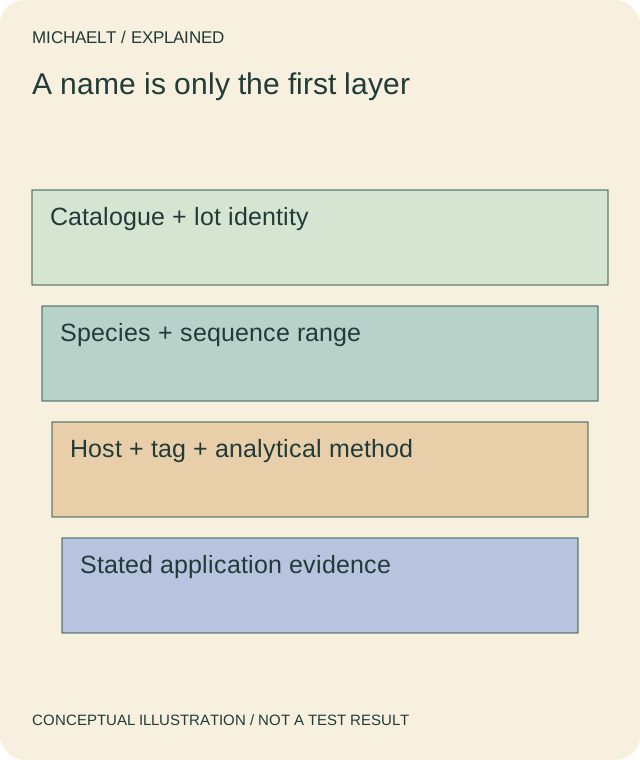
Read the drawing as text
A catalogue name does not supply sequence, host, analytical scope or application evidence. Keep each layer explicit.
Work through an example
A fictional comparison has construct A with a specified sequence range and tag, while construct B omits those fields. Both share a common protein name, but the reviewer does not merge them. The query asks for B’s construct and application evidence. No laboratory experiment, activity result or therapeutic effect is invented.
Illustrative example; figures, people and organisations in the worked record are fictional.
The example record
Identity
- Evidence to retain
- Catalogue / lot / sequence
- Comparison question
- Same construct?
Production
- Evidence to retain
- Species and expression host
- Comparison question
- Different descriptors
Tag and analysis
- Evidence to retain
- Tag / method / stated result
- Comparison question
- Do not infer activity
Application
- Evidence to retain
- Maker’s actual scope
- Comparison question
- Suitability needs qualified review
Download blank worksheet (.csv) ↗Download worked example (.csv) ↗
Keep your own record
Use the result within its scope
Consult the complete current datasheet, certificates and qualified technical advice. This page neither validates a reagent nor provides an experimental or medical procedure.
Reference sources
Earlier articles on this subject
- Why Do We Need Recombinant Proteins? ↗ — 2021-10-23, Maria Baldwin.