

Define the proposed use
Record the days, hours, space and services the proposal actually concerns. Keep access, booking arrangements, supplies, storage and client communication as separate questions. A photograph of a salon does not establish the contents of a rental agreement. Ask for the current written terms and confirm which organisation or person can agree changes.
Build a comparable weekly example
Separate fixed charges for the agreed period from costs per appointment or other variable uses. Keep taxes, deposits, notice terms and additional charges visible rather than silently treating them as included. Convert different quoted periods consistently and label invented numbers as assumptions. A daily chair rate alone cannot establish the cost of a working week or a profitable number of appointments.
Ask who controls the work
HMRC’s hair-and-beauty guidance explains that employment status depends on the actual working arrangement, not just a self-employed label. Ask appropriate questions about the proposed control, responsibilities and independence, and obtain suitable advice for the real case. This worksheet does not classify employment, determine tax or supply a chair-rental contract.
Confirm responsibility before a commitment
Ask who is responsible for equipment care, consumables, insurance questions, access issues and the client records relevant to the arrangement. Use the actual agreement and applicable local requirements. Do not assume that renting a chair grants ownership of client data or permission to reuse the salon’s marketing photographs. Recalculate the proposal when days, inclusions or appointment assumptions change.
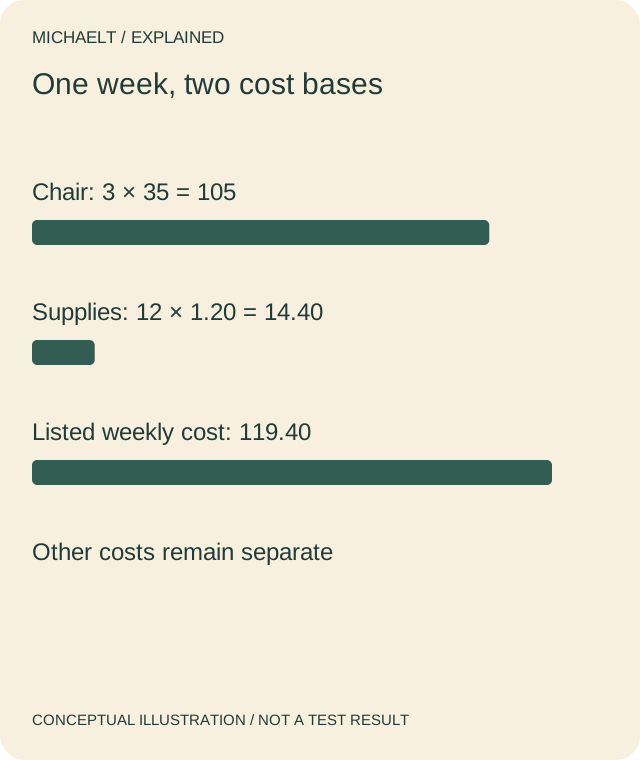
Read the drawing as text
The fictional weekly total combines a per-day charge and per-appointment cost. It excludes labour, tax and unspecified items.
Work through an example
A fictional proposal charges 35 units per day for three days, plus 1.20 units per appointment for twelve appointments. Listed weekly costs are 105 + 14.40 = 119.40 units. Labour, tax, insurance and other unlisted costs are outside this example. The arithmetic does not establish earnings or the legal status of the worker.
Illustrative example; figures, people and organisations in the worked record are fictional.
The example record
Chair
- Assumption
- 3 days × 35 units
- Result
- 105 units
Variable supplies
- Assumption
- 12 × 1.20 units
- Result
- 14.40 units
Listed total
- Assumption
- Same fictional week
- Result
- 119.40 units
Arrangement
- Assumption
- Actual terms and responsibilities
- Result
- Status not decided here
Download blank worksheet (.csv) ↗Download worked example (.csv) ↗
Keep your own record
Use the result within its scope
Use current professional advice for legal, employment and tax questions. A comparison sheet is useful only when the real scope and assumptions stay attached to its total.
Reference sources
Earlier articles on this subject
- What You Need to Know Before You Rent a Chair Contract? ↗ — 2021-11-22, Maria Baldwin.
- Important Components to Pick the Ideal Salon ↗ — 2021-05-21, Maria Baldwin.