Treat a suggestion as a hypothesis
Write the role you want to explore and why it interests you. The National Careers Service presents skills exploration as a way to discover possibilities, not a pass-or-fail employment test. Keep quiz answers or personality labels separate from evidence about an actual occupation. A matching title does not establish that its daily work, conditions or entry route suit your circumstances.
Read an actual role profile
Identify two or three recurring tasks in a current official career profile or genuine vacancy. Record the source, date and location because titles and requirements vary. Separate required credentials from preferred experience and from a provider’s course advertisement. Do not infer eligibility, pay or a guaranteed vacancy from a general occupational description.
Ask about one concrete working day
Prepare a short information enquiry for an appropriate person or service: what output is produced, who reviews it and which constraints shape the work? Ask about a representative task rather than requesting confidential client files or a promise of employment. Keep the reply in its context; one person’s experience does not represent every workplace.
Choose a proportionate next step
Select a lawful, non-sensitive practice exercise relevant to the role and record what you learned about the task. Use public or fictional materials instead of performing unqualified professional work. Compare the experience with the original interest and list unresolved entry questions. A practice exercise can inform exploration without becoming a competence certificate, recruitment score or prediction of long-term success.
Read the drawing as text
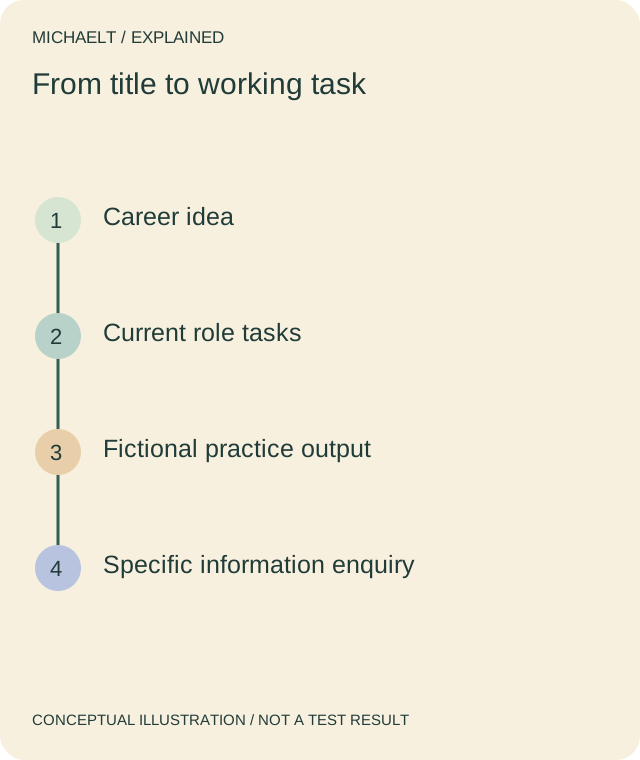
A role title becomes a task to investigate, a limited practice output and a more precise enquiry; it is not a recruitment judgement.
Work through an example
A fictional learner is interested in project coordination. An official role profile mentions organising information and following actions. The learner uses a fictional meeting note to produce a short action list, then asks what real review and escalation look like. The result is a better career question, not evidence that the learner qualifies for a particular job.
Illustrative example; figures, people and organisations in the worked record are fictional.
The example record
Idea
- Evidence
- Project coordination
- Question
- Which work interests me?
Role task
- Evidence
- Organise and follow actions
- Question
- Current profile reference
Practice
- Evidence
- Fictional action list
- Question
- What was difficult?
Next enquiry
- Evidence
- Ask about review process
- Question
- Entry requirements unresolved
Download blank worksheet (.csv) ↗Download worked example (.csv) ↗
Keep your own record
Use the result within its scope
Use current qualifications and employment guidance for actual applications. This exercise does not rank people, diagnose personality or promise a salary or job.
Reference sources
Earlier articles on this subject
- Understanding Your Passions for a Future Career ↗ — 2021-05-22, Maria Baldwin.
- Personality Test- The Basic Of Employment ↗ — 2022-03-26, Maria Baldwin.