Identify the movement and parties
Use a private shipment and equipment reference, the relevant terminal, carrier and agreed service. Keep sensitive commercial identifiers out of public examples. Record the actual documents and parties responsible for answering each question. A general drayage article does not establish who controls a particular appointment, release or return arrangement.
Record actual events with time zones
List the availability notice, release information, appointment request and confirmation, pickup and return evidence when present. Preserve timestamps and the time zone rather than comparing an email time with an unexplained terminal date. Mark requested and confirmed appointments separately. A planned pickup is not a gate-out event, and a sent return request is not evidence that equipment was returned.
Attach the actual charging terms
The US FMC distinguishes demurrage associated with terminal free time from detention associated with extended equipment use. For a real invoice, retain the applicable contract or tariff, free-time basis, claimed dates and current jurisdiction-specific guidance. Do not apply a universal number of free days, assume weekends count the same way everywhere or derive legal liability from this simplified timeline.
Prepare a traceable question
Compare the claimed period with the actual notices and movement records, identifying any missing event or conflicting time. Ask the relevant party to clarify the specific discrepancy and keep the response. Use current qualified advice for legal deadlines or disputes. This page does not calculate a legally payable charge, submit a complaint or promise that a fee will be waived.
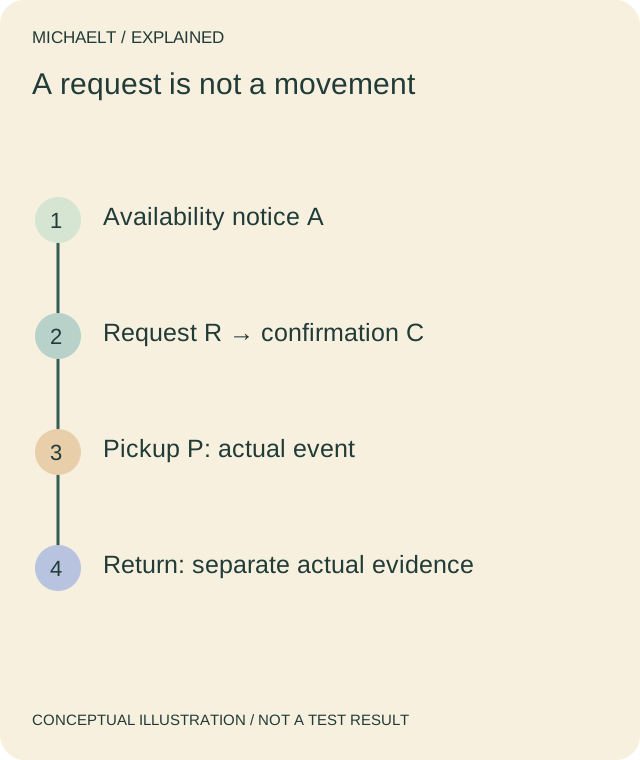
Read the drawing as text
Availability, requested and confirmed slots, pickup and return are distinct events. Charges require the actual applicable terms.
Work through an example
A fictional timeline records availability notice A, appointment request R and confirmation C, followed by pickup P. The invoice refers to a period before C, but the actual charging terms have not yet been reviewed. The coordinator preserves those events and asks a precise question instead of labelling the whole invoice valid or invalid.
Illustrative example; figures, people and organisations in the worked record are fictional.
The example record
Availability A
- Evidence
- Dated notice
- What it establishes
- Stated availability
Request R
- Evidence
- Message timestamp
- What it establishes
- Request only
Confirmation C
- Evidence
- Appointment evidence
- What it establishes
- Confirmed slot
Pickup/return
- Evidence
- Actual movement records
- What it establishes
- Separate from planned dates
Download blank worksheet (.csv) ↗Download worked example (.csv) ↗
Keep your own record
Use the result within its scope
Keep commercial terms and current rules with the evidence. This operational record supports a discussion without replacing legal advice or the actual agreement.
Reference sources
Earlier articles on this subject
- The Benefits of Virtual Drayage ↗ — 2022-09-19, Maria Baldwin.