Name the service and the people involved
Ask how the provider describes coaching and which role they are offering for the actual engagement. Keep coaching, mentoring, consultancy and clinical treatment distinguishable. Record who the client is, who pays and whether another party expects information. A polished website, high price or crowded calendar does not establish qualifications, suitability or ethical practice. Verify any claimed credential through its actual issuing organisation.
Discuss the agreement before the sessions
The ICF’s current Code of Ethics, effective 1 April 2025, calls on ICF professionals to explain the nature of coaching and agree roles, responsibilities, confidentiality and financial arrangements before it begins. Its scope concerns the ICF ecosystem; it is not a universal licence for every person calling themselves a coach. Use it as a named source for specific questions, not a promise that a provider follows it.
Clarify privacy and practical terms
Ask what information is recorded, who can receive it, the limits of confidentiality and what happens when an employer or other sponsor pays. Use the actual agreement rather than assuming the payer receives everything or nothing. Confirm the session format, scheduling, fees, cancellation and ending arrangements. Keep sensitive personal information out of a public comparison sheet and obtain appropriate advice where legal or health questions arise.
Choose an observable session aim
Agree what you want one session to help you explore and how you will recognise a useful next step. At the end, record the action you actually chose and any question still open. A session receipt or encouraging feeling does not prove a business, mental-health or career result. Revisit the arrangement if the scope or participants change. This worksheet neither diagnoses a problem nor says that asking about coaching means you need it.
Read the drawing as text
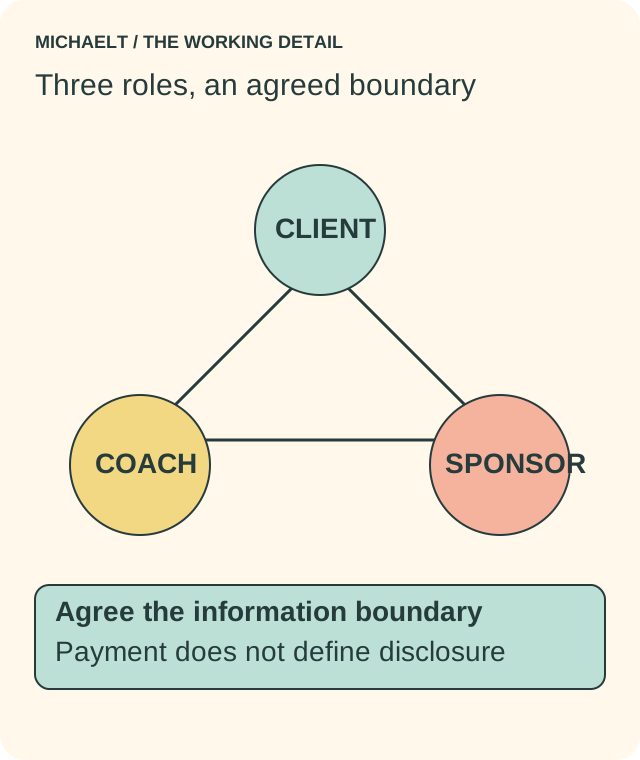
Client, coach and sponsor are separate roles. Agree which information may be shared, the commercial terms and the session aim. Payment alone does not define confidentiality.
Work through an example
A fictional workshop coordinator wants to clarify which of two project tasks to address next. A sponsor is paying, so the coordinator asks which administrative information the sponsor receives and which discussion remains within the agreed limits. The session aim is one prioritised action with a reason. No confidential discussion, actual coach, successful treatment or guaranteed productivity improvement is invented.
Illustrative example; figures, people and organisations in the worked record are fictional.
The example record
Roles
- Illustrative question
- Client, coach and sponsor?
- Record
- Each role named
Information
- Illustrative question
- What may be shared, with whom?
- Record
- Actual agreed limits
Commercial terms
- Illustrative question
- Fee, cancellation and ending?
- Record
- Current agreement version
Session aim
- Illustrative question
- Which project task comes next?
- Record
- Chosen action, not promised outcome
Download blank worksheet (.csv) ↗Download worked example (.csv) ↗
Keep your own record
Use the result within its scope
Ask the provider to resolve unclear terms before proceeding. Appropriate clinical care, legal advice or business consultancy may be a different service. This page recommends no coach and provides no therapy or guarantee of results.
Reference sources
Earlier articles on this subject
- Signs of a Professional Life Coach ↗ — 2020-12-26, Maria Baldwin.
- LIVE HAPPILY with Personal Coaching For Successful Results ↗ — 2022-08-01, Maria Baldwin.
- How to Get the Most From Your Life Coaching Sessions ↗ — 2021-02-10, Maria Baldwin.