Name what is being weighed
Identify the goods, the container or pallet and the purpose of the weight record. State the unit next to every number. A gross observation includes the load and relevant packaging; a tare value represents the packaging or container being subtracted for that calculation. Keep the actual definition and procedure with the instrument’s instructions and the applicable process. A label such as pallet scale does not establish fitness for every load or commercial purpose.
Retain where the tare came from
Record whether the tare was observed for that container or taken from a stored value, and when it was obtained. If the packaging changes, do not silently reuse an unrelated tare. NIST’s weighing FAQs discuss gross, net and tare indications and the special requirements that can apply to stored tare operations. Applicable legal-for-trade and instrument requirements need the relevant authority; this arithmetic worksheet approves none of them.
Calculate without mixing units
In a simple same-unit example, net equals gross minus tare. Keep all three numbers, not just the final result. If one value is in grams and another in kilograms, convert explicitly before subtraction. A negative result, missing unit or tare greater than gross is a question to investigate, not a value to round away. The resolution shown by an instrument is not by itself proof of accuracy or allowable load.
Close with a traceable observation
Keep the instrument identifier, date, relevant procedure and observer alongside the values where the actual process requires them. Distinguish a recorded reading from a verified calibration or inspection. If a display is unreadable or the load arrangement is outside the permitted procedure, do not improvise handling instructions to complete a form. Ask the competent operator or supplier about the actual equipment and task.
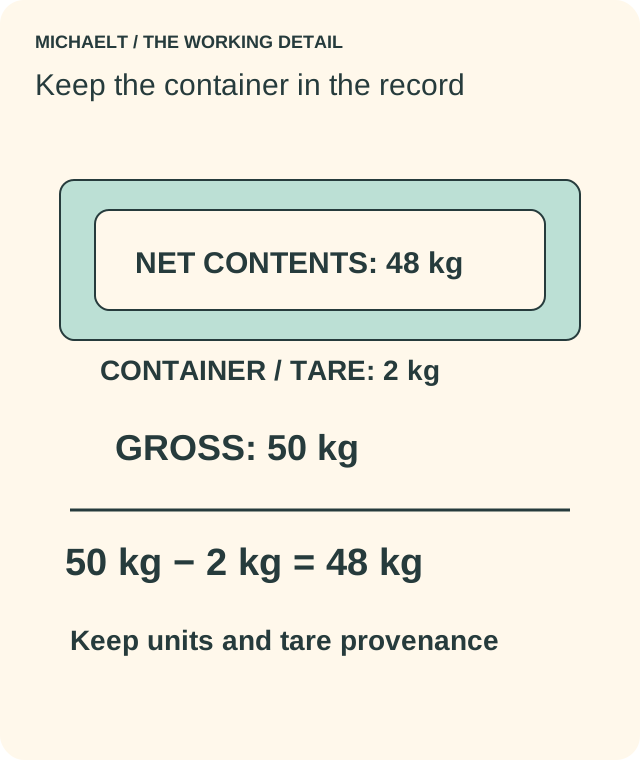
Read the drawing as text
Illustrative gross 50 kg minus tare 2 kg equals net 48 kg. Keep units and tare provenance. This does not establish calibration or instrument approval.
Work through an example
A fictional record gives gross 50 kg and tare 2 kg. The net contents are 48 kg. A second record gives gross 50, with no unit, and tare 2 kg: that record is incomplete until the unit is confirmed. Neither example demonstrates that a particular pallet truck is calibrated, legally approved or safe for a particular load.
Illustrative example; figures, people and organisations in the worked record are fictional.
The example record
Gross
- Illustrative reading
- 50 kg
- Interpretation
- Load plus relevant container
Tare
- Illustrative reading
- 2 kg
- Interpretation
- Container used in this example
Net
- Illustrative reading
- 48 kg
- Interpretation
- 50 kg − 2 kg
Missing unit
- Illustrative reading
- Gross 50
- Interpretation
- Do not calculate until clarified
Download blank worksheet (.csv) ↗Download worked example (.csv) ↗
Keep your own record
Use the result within its scope
Retain the original values when correcting a transcription. The method is deliberately limited to understanding a record; it is not an instruction to operate a pallet truck, exceed a capacity or certify a commercial weighing instrument.