Follow the task
Identify the finished sample
Record the supplier’s full product code, substrate description and stated colour pairing. Use a finished sample suitable for safe handling and follow the supplier’s directions. Do not improvise cutting, coating, kiln or heat-treatment steps.
Make the two views explicit
Record a view looking through a suitably transparent sample separately from a view of light reflected from its surface. Coatings by Sandberg distinguishes those two colour descriptions. An opaque backing may remove the through-view, so note the backing instead of calling the sample defective.
Keep viewing conditions comparable
Record light source, background, angle and which side faces the observer. A photograph should show the whole sample and a note of the setup. Treat a changed colour under another condition as an observation to describe, not proof the coating has been removed.
Send a usable sample brief
Provide the code, intended display context and the two observation records to the maker. Ask them to confirm material compatibility and any fabrication requirements. A phone image or a descriptive colour name is not approval of a final installed panel.
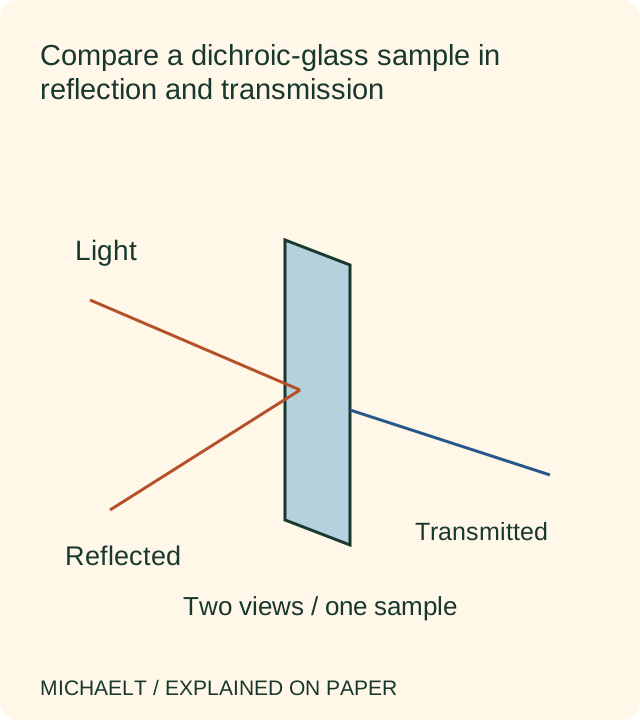
Read the diagram as text
Reflection and transmission describe different viewing paths through a conceptual finished sample.
- Product/substrate
- Exact sample code, finished edges
- Through-view
- Record only if the sample permits transmission
- Reflected view
- Record the surface reflection separately
- Light/background/angle
- Keep the two setups documented
A worked example
A hypothetical clear sample is labelled Blue/Gold, matching the manufacturer’s explanation of blue transmission and gold reflection. Its two notes record different viewpoints instead of choosing one as the “real” colour. A dark backing then removes the through-view from the comparison. That does not demonstrate that the material has lost its coating. The example follows the manufacturer’s terminology, not a measured MichaelT optical test.
Illustrative example, not a reported purchase, client project or product test.
The completed record
- Product/substrate
- Exact sample code, finished edges
- Through-view
- Record only if the sample permits transmission
- Reflected view
- Record the surface reflection separately
- Light/background/angle
- Keep the two setups documented
Download blank record (.csv) ↗Download worked example (.csv) ↗
Your own record
- □ Product/substrate: ____________________
- □ Through-view: ____________________
- □ Reflected view: ____________________
- □ Light/background/angle: ____________________
Keep the distinction clear
The earlier source described removing a colour with a dark object. That is not a sound fabrication instruction and is not reproduced here. The useful task is to communicate a sample’s appearance accurately. Describe the condition that produced each observation, then leave manufacturing compatibility and thermal processing to the actual maker’s documentation.
Where this guide stops
No cutting, heating, fusion, structural glazing or optical-performance instruction. The diagram is conceptual; the colour example comes from CBS terminology.
Continue with a related task
- Commission a glass panel with a daylight sample brief ↗
- Plan a decorative glass-painting sample before making a gift ↗
Sources and original context
The earlier topic was published 2022-06-08 under the Maria Baldwin byline. The present procedure and illustrative record are by MichaelT editorial.