Identify the system and period
Record the proposed system, location context, estimate source and period. Distinguish a supplier’s model from actual meter readings. Energy Saving Trust describes how household use and exported electricity affect the financial picture. A screenshot from another property cannot establish generation, installation cost or a return for yours. Keep the quote and its assumptions together.
Reconcile the energy first
Use the same unit and period for generated energy, energy used on site and energy exported. In a simplified example without additional flows, on-site use plus export equals generation. Real systems may have storage, losses or other accounting boundaries, which need their own definitions. Do not silently call all generation a reduction in purchased electricity.
Keep rates and money streams separate
An assumed value for avoided purchases and an assumed export rate are different inputs. Retain the source, date, eligibility and contract questions for actual rates; this guide quotes no current tariff. Calculate a labelled illustrative value only from stated assumptions. Do not describe a hypothetical annual figure as a guaranteed bill saving, investment return or tax-free payment.
Ask which assumptions need confirmation
Record the household use pattern, current quotation, installation scope, maintenance and any relevant financing or scheme questions for a competent provider or adviser. A payback calculation that omits costs or assumes unchanged future rates has a limited scope. This page does not design or install a system, approve a roof or determine scheme eligibility.
Read the drawing as text
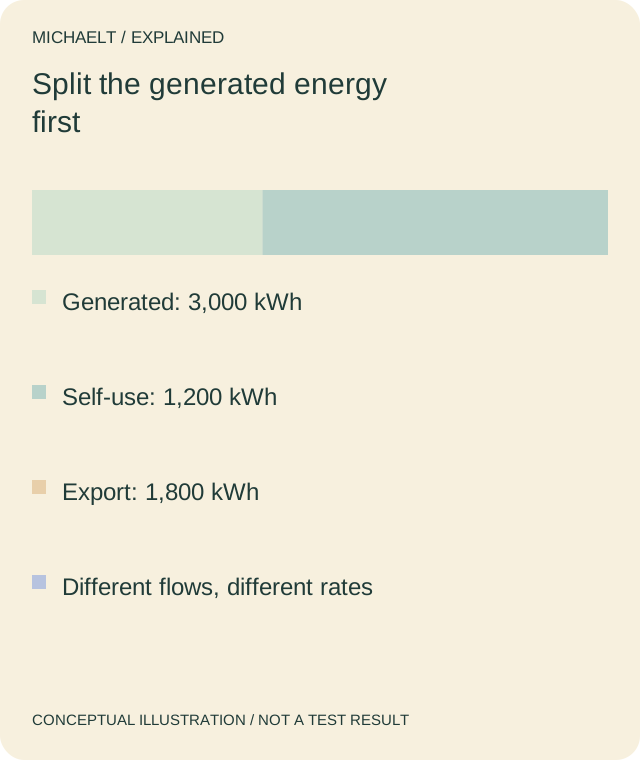
The fictional generation splits into 1,200 kWh self-use and 1,800 kWh export. Their assumed financial rates are different and are not current quotations.
Work through an example
A fictional annual model has 3,000 kWh generation, 1,200 kWh self-use and 1,800 kWh export. Assumed values of 0.30 and 0.05 units per kWh produce 360 and 90 currency units respectively, totalling 450 before costs and other omitted factors. These are invented inputs, not a quoted tariff or measured saving.
Illustrative example; figures, people and organisations in the worked record are fictional.
The example record
Generation
- Assumption
- 3,000 kWh
- Illustrative value
- Not all bill reduction
Self-use
- Assumption
- 1,200 × 0.30
- Illustrative value
- 360 units
Export
- Assumption
- 1,800 × 0.05
- Illustrative value
- 90 units
Total value
- Assumption
- 360 + 90
- Illustrative value
- 450 before omitted costs
Download blank worksheet (.csv) ↗Download worked example (.csv) ↗
Keep your own record
Use the result within its scope
Use actual current terms and qualified assessment for a purchase. This is a model-reading example; no payback period, future tariff or traffic-independent financial result is promised.
Reference sources
Earlier articles on this subject
- How Much Does a Solar Panels Cost in the UK? ↗ — 2022-09-08, Maria Baldwin.
- Choosing The Right Solar Panel Company In Garland ↗ — 2021-09-20, Maria Baldwin.