Define the proposed demonstration
Ask the supplier to identify the machine configuration, material, product or inert demonstration load, settings under its control and the proposed observation interval. Agree who is competent to operate and supervise it. This worksheet is for commissioning and recording a demonstration; it gives no instructions for operating, guarding, adjusting or servicing machinery. Keep claims about food-contact suitability, shelf life and safety separate from a speed observation.
Agree acceptable before the run
Write the checks that determine whether an output unit counts as acceptable for this demonstration. A sample size, method, limit and responsible reviewer should be explicit where applicable. A seal that looks tidy is not automatically evidence of leak performance or sterility. If a specific test is needed, ask the relevant qualified people to agree the applicable method and interpretation. Do not invent a standard or acceptance limit from this article.
Use one interval and keep every count
Record the start and end of the agreed interval, total units, rejected units and acceptable units. Note interruptions and whether setup, replenishment or changeover is included. Subtract rejects from total output and divide by the same elapsed time for a simple observed acceptable-output rate. Keep proposed rated speed, short demonstration rate and sustained production performance in separate rows.
Reconcile the decision and its limits
Ask the reviewer to record which agreed criteria were met and which remain open. Keep the actual sample and report references with the quote. A demonstration using one material cannot prove performance for every product, and a faster short run cannot establish return on investment. If the commercial case needs longer-term operating costs, staffing, waste or changeover data, request those separately rather than filling the gaps with optimistic assumptions.
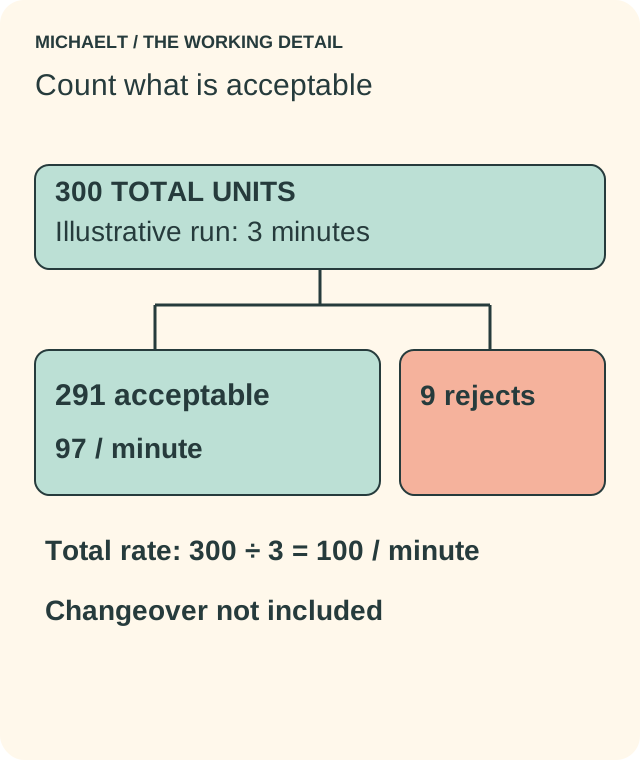
Read the drawing as text
Fictional 3-minute run: 300 total units, 9 rejected, 291 acceptable. Total rate is 100/minute; acceptable rate is 97/minute. No changeover observation is included.
Work through an example
A fictional three-minute demonstration produces 300 units. Nine fail the agreed illustrative acceptance check, leaving 291 acceptable units. Total rate is 100 units/minute; acceptable rate is 97 units/minute. The record says no changeover was included. It makes no claim about an actual machine, validated seals, food safety or future factory output.
Illustrative example; figures, people and organisations in the worked record are fictional.
The example record
Elapsed interval
- Illustrative value
- 3 minutes
- Calculation or meaning
- Same interval for both rates
Total / rejected
- Illustrative value
- 300 / 9
- Calculation or meaning
- 291 acceptable
Total rate
- Illustrative value
- 100 per minute
- Calculation or meaning
- 300 ÷ 3
Acceptable rate
- Illustrative value
- 97 per minute
- Calculation or meaning
- 291 ÷ 3
Excluded observation
- Illustrative value
- Changeover
- Calculation or meaning
- No sustained-output claim
Download blank worksheet (.csv) ↗Download worked example (.csv) ↗
Keep your own record
Use the result within its scope
The acceptance record should contain the agreed method version and reviewer as well as the numbers. Do not use this calculation to certify a process, choose safety measures or replace the actual technical and regulatory assessment.
Earlier articles on this subject
- How Investing In Automatic Packaging Machines Can Help You Grow Your Food Business? ↗ — 2021-01-29, Maria Baldwin.
- Achieving A Quality Sealed Product Through Leak Testing ↗ — 2021-05-12, Maria Baldwin.
- All You Need To Know About Balers ↗ — 2021-11-18, Maria Baldwin.