Describe the question and the accessible scope
Write what you want the inspection to clarify and which area it concerns. Ask the provider to define the agreed method, access arrangements, competence and exclusions. Do not enter an unsafe area, climb a roof or disturb a material to complete this worksheet. A roof image, drain-camera recording and building survey have different scopes; a generic service name cannot establish that all of them are included.
Give evidence a location and an identifier
Ask for each observation to be linked to a photograph, clip or report reference and an identifiable area. If a clip is supplied, a time reference can help distinguish one observation from another. Keep observed condition separate from a proposed cause, a repair recommendation and a cost. A wet mark might be visible; its source may require further investigation. Neither an attractive photograph nor confident wording resolves that difference.
Read the limits as part of the result
Record areas not seen, unsuitable viewing conditions and the provider’s stated limitations. An inaccessible section should remain unknown. Ask which additional investigation, if any, is recommended and who is competent to interpret it. Do not translate no visible defect in the observed area into whole-building structural safety, no asbestos, no mould or a guarantee against future leaks.
Connect the next decision to the actual report
When a quote follows, match each proposed work item to the relevant observation or assessment. Ask about unexplained work and separate investigation from repair. Retain the report version and date with the quote so a later decision is not based on an older image. Completion, certification and any agreed follow-up observation need their own evidence; they are not implied by paying for the inspection.
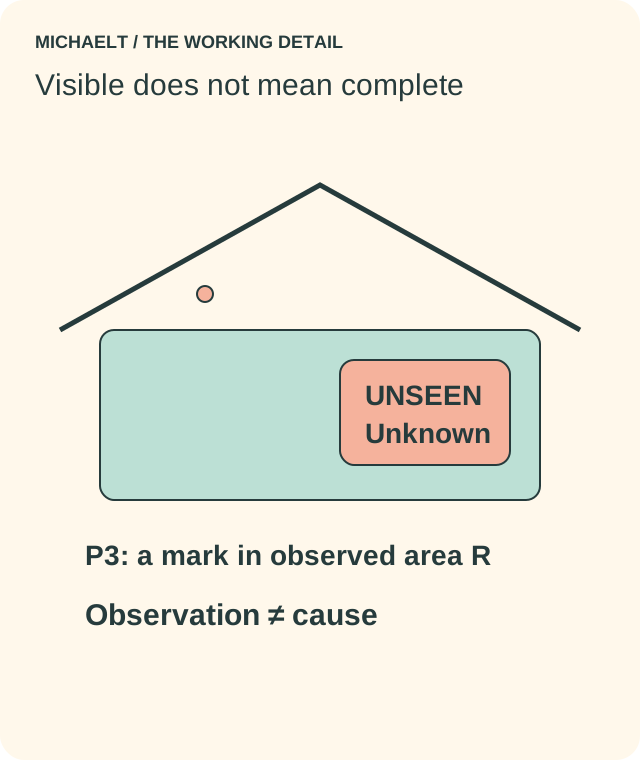
Read the drawing as text
Photo P3 records a mark in area R. An unobserved rear area stays unknown. The observed mark is not a diagnosis of its cause or proof of a completed repair.
Work through an example
In a fictional roof report, photo P3 shows a mark beside area R. The report says the rear section was not visible from the agreed position. The owner records the mark as an observation, leaves its cause open and asks what further assessment would answer that question. A separate repair quote cannot close the unseen-area row merely by describing the roof as restored.
Illustrative example; figures, people and organisations in the worked record are fictional.
The example record
Observation
- Illustrative entry
- P3 / mark near area R
- What it does not establish
- Cause of the mark
Extent
- Illustrative entry
- Agreed visible section
- What it does not establish
- Whole roof condition
Limit
- Illustrative entry
- Rear area not observed
- What it does not establish
- No defect in rear area
Next step
- Illustrative entry
- Ask about further assessment
- What it does not establish
- Completed repair
Download blank worksheet (.csv) ↗Download worked example (.csv) ↗
Keep your own record
Use the result within its scope
This is a report-reading method, not an inspection or remediation procedure. Actual access, diagnosis, testing and work require the appropriate competent assessment. Keep the scope narrower than the conclusions the evidence can support.
Earlier articles on this subject
- Hiring the Best Roofing Company in Arlington Heights ↗ — 2021-09-03, Maria Baldwin.
- Why Are Roof Inspections Important In West Palm Beach? ↗ — 2022-04-09, Maria Baldwin.
- The Professional Service of Gutter Cleaning ↗ — 2022-06-08, Maria Baldwin.
- The Art Of Roof Cleaning For Asphalt Shingle Roofs ↗ — 2022-03-04, Maria Baldwin.
- Understand What a Roofing Contractor in Sydney Actually Does ↗ — 2022-01-18, Maria Baldwin.
- Benefits Of Hiring Professional Roofing Contractors ↗ — 2021-12-27, Maria Baldwin.
- Roof Restoration Companies Are Becoming Increasingly Popular ↗ — 2022-02-04, Maria Baldwin.
- Benefits Of Hiring Roofing Company In Palm Bay ↗ — 2022-02-14, Maria Baldwin.
- Detecting Sewer Line Issues With Pipe Inspection Camera ↗ — 2021-08-12, Maria Baldwin.
- Different Types of Inspectors ↗ — 2022-09-21, Maria Baldwin.
- How Much Time It Will Take To Repair Water Damage? ↗ — 2021-12-13, Maria Baldwin.
Continue with a related task
Add a dated moisture-observation log to the inspection enquiry
Give the professional a sequence of observations without turning a damp mark into a diagnosis of its source.
Use a repeatable reference
From a safe accessible position, assign the observed area a reference and keep the date, time and viewpoint. If a photograph is appropriate, avoid personal or neighbouring details. Describe what was visible rather than declaring a structural, plumbing or waterproofing fault. Do not open walls, enter unsafe areas or disturb a suspect material to improve the picture.
Keep context and cause separate
Record known context such as observed rain or a relevant event, identifying where that information came from. A wet mark seen after rain is a timing association, not proof of an entry path. EPA’s moisture guidance explains the importance of addressing moisture; it does not diagnose a particular property from a notebook. Follow appropriate professional advice for a real moisture or health concern.
Hand over the sequence with its gaps
Keep the earlier and later observations under the same area reference and preserve unobserved periods. Ask the competent inspector what further assessment could answer the specific question. A later dry-looking photograph does not prove the cause was repaired or certify the area free of mould. This addition supplies no cleanup, drying, chemical treatment or drainage design.
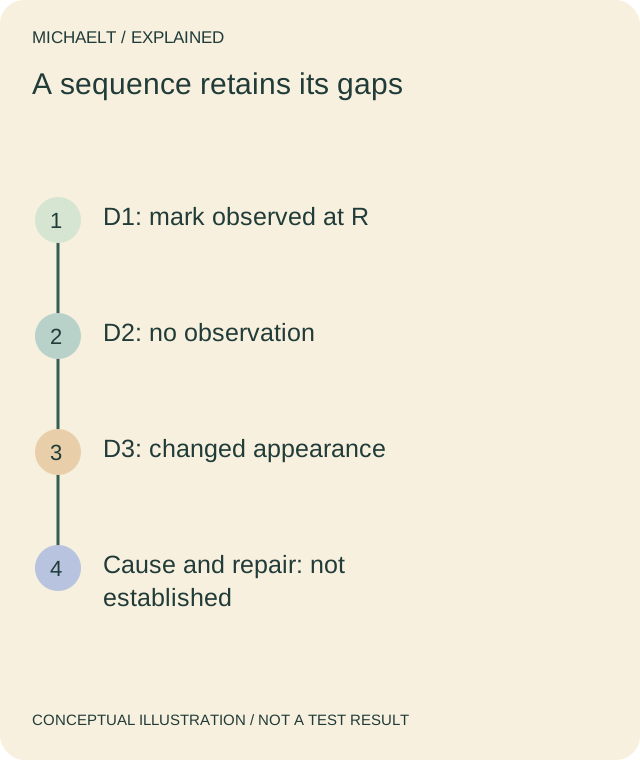
Read the drawing as text
The fictional moisture log preserves an unobserved day. Timing after rain and a later appearance do not establish the cause or a completed repair.
Work through an example
A fictional log notes a visible mark at area R after observed rain on date D1. D2 has no observation; D3 records a changed appearance from the same safe viewpoint. The sequence is given to a competent inspector with D2 marked missing. No leak path, exposure, mould status, structural condition or completed repair is inferred.
Illustrative example; figures, people and organisations in the worked record are fictional.
The example record
Reference
- Illustrative evidence
- Area R / fixed viewpoint
- Meaning or next step
- Identify the same area
D1
- Illustrative evidence
- Mark seen after observed rain
- Meaning or next step
- Context is not a cause
D2
- Illustrative evidence
- Not observed
- Meaning or next step
- Do not invent a dry interval
D3
- Illustrative evidence
- Changed appearance recorded
- Meaning or next step
- Professional assessment remains
Download blank worksheet (.csv) ↗Download worked example (.csv) ↗
Keep your own record
Use the result within its scope
Use the log as supporting context for the actual assessment. It cannot determine a cause, establish health safety, prove a waterproofing system works or authorise remediation.