Agree the output before collecting everything
Ask what the accountant has been engaged to produce: a reconciliation, a report, a filing-related preparation task or another named output. Record the entity, period, currency and cut-off date. Confirm who answers questions and who approves the result. Do not assume that a general accounting subscription includes every return, payroll task or forecast. Tax duties, deadlines and advice must come from the appropriate professional for the actual jurisdiction.
Build an index rather than a heap of attachments
Give each supplied file a neutral identifier, description, date range, format and version. Keep statements, invoices, prior reports and explanatory notes distinguishable. Ask which original exports and supporting documents are required. Preserve the original files and identify any transformation separately. A spreadsheet total is not evidence that every transaction has been included, and a screen image may not be an adequate replacement for the requested export.
Treat overlaps and gaps explicitly
Check whether successive exports overlap or leave a missing period. Record the last included date and whether it describes a transaction, booking or statement period. If a file is missing, put it in an exception list with a responsible person and requested next action. Never create plausible numbers to make a handover look complete. Ask how corrections should be submitted so a replacement does not silently overwrite the version already being reviewed.
Close with receipt and responsibility
Use the agreed secure transfer route. Do not put account passwords, personal identifiers or client records into this site’s checklist. Ask the recipient to confirm the file list received, the period understood and any immediate omissions. Delivery and acceptance are separate events: an upload receipt does not prove that the accountant has reconciled the records. Keep the questions, responses and agreed output version together.
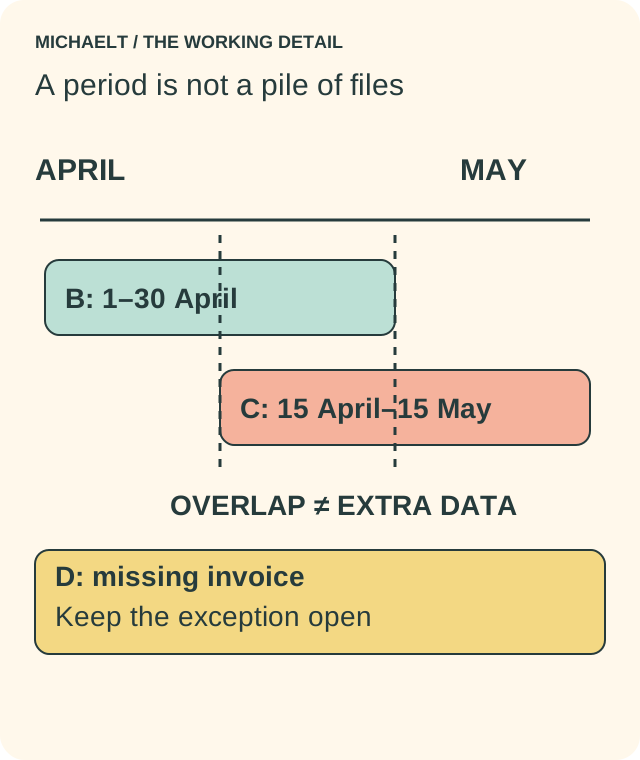
Read the drawing as text
File B covers all of April. File C overlaps from 15 April into May. Do not add overlapping exports. Missing invoice D remains an exception.
Work through an example
In a fictional handover for April, file B covers 1–30 April and file C covers 15 April–15 May. The owner does not add their totals together. The index flags the overlap and asks which export should be used for the agreed period. Invoice D is missing; the exception remains open. The accountant’s receipt confirms two files, not a completed reconciliation.
Illustrative example; figures, people and organisations in the worked record are fictional.
The example record
B
- Range or state
- 1–30 April
- Decision
- Candidate period export
C
- Range or state
- 15 April–15 May
- Decision
- Overlap: ask before combining
D
- Range or state
- Missing supporting invoice
- Decision
- Owner to provide securely
Output
- Range or state
- April reconciliation requested
- Decision
- Acceptance still pending
Download blank worksheet (.csv) ↗Download worked example (.csv) ↗
Keep your own record
Use the result within its scope
Use a versioned correction note: file replaced, reason, date, sender and recipient acknowledgement. This preserves a usable audit trail of the handover without claiming that the books, tax position or forecast have been professionally verified.
Earlier articles on this subject
- Hire Medical Accountants for Tax Filing in Massachusetts ↗ — 2021-04-21, Maria Baldwin.
- Does your business need an accountant? ↗ — 2021-12-09, Maria Baldwin.
- Cloud Software For Online Access Of Accounts ↗ — 2021-01-14, Maria Baldwin.
- Making The Most Of Accounting Services ↗ — 2021-04-05, Maria Baldwin.
- Small Businesses Using Accounting Solutions ↗ — 2021-10-27, Maria Baldwin.