
Identify the claim and product
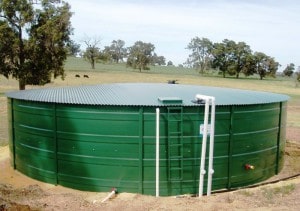
Keep the actual product identifier, material or component, supplier document and claim wording together. Distinguish a tank’s capacity, a material description and a certification statement. A photograph of a similar tank does not identify the installed product. An old article saying tanks are mandatory does not establish a current rule for your property or country.
Read the standard’s scope
NSF explains that NSF/ANSI/CAN 61 evaluates health effects of materials, components, products and systems in contact with drinking water, with requirements organised by product type. Match the exact listed product and conditions rather than relying on a broad logo. Record the certification body, standard and current listing details where available. Do not extend one component’s evidence to every connected part.
Keep the installed system separate
Ask the responsible competent professional or local water authority which installation, inspection and water-quality requirements apply. Component certification and actual water quality at a property are different questions. Record any relevant professional report and its date, scope and limitations. A product label alone does not establish that stored water is fit to drink or that the whole installation meets local rules.
Prepare an evidence enquiry
Send the exact identifier and unresolved claim to the verified supplier or appropriate authority, sharing only necessary details. Keep product evidence, installation records and water-quality evidence in separate columns. Follow the actual professional advice for the system. This page supplies no tank-cleaning, disinfection, plumbing or drinking-water treatment instructions and does not set a universal inspection interval.
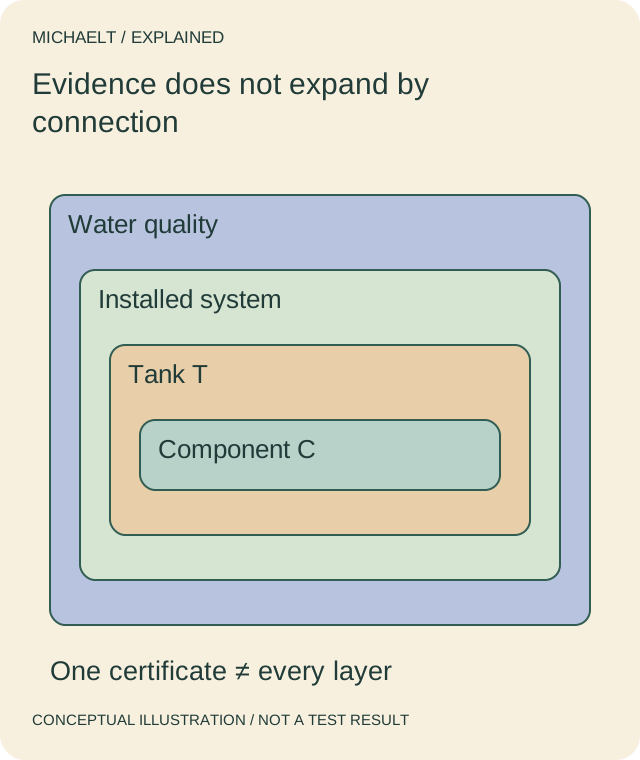
Read the drawing as text
Certification for component C does not automatically certify tank T, its installation or the water at a property.
Work through an example
A fictional supplier provides a certificate for component C, while the proposed tank is T. The buyer asks whether T and its intended conditions appear in the relevant current listing. An installer’s record and any water-quality assessment remain separate. The sheet does not mark the entire system approved simply because C has a certificate. No real product or water sample is tested.
Illustrative example; figures, people and organisations in the worked record are fictional.
The example record
Product
- Evidence
- T proposed / C certified
- Next question
- Do identifiers and conditions match?
Certificate
- Evidence
- Standard and listing requested
- Next question
- Exact scope, body and date?
Installation
- Evidence
- Separate professional record
- Next question
- Applicable local requirements?
Water quality
- Evidence
- No assessment supplied
- Next question
- Cannot infer from component label
Download blank worksheet (.csv) ↗Download worked example (.csv) ↗
Keep your own record
Use the result within its scope
Use exact certification records and local professional requirements. A certificate has a defined scope; it cannot by itself promise a safe installation, potable stored water or a universal legal requirement to install a tank.