Begin with the hazard assessment
A mask photograph does not identify the exposure, workplace conditions or required protection. NIOSH describes respiratory protection as part of a wider control system, not a replacement for controlling the hazard. Ask the responsible workplace professional which assessment and respiratory-protection programme apply. This reading guide cannot authorise entry into a hazardous atmosphere or choose protective equipment for an emergency.
Separate the categories
An air-purifying respirator removes specified contaminants from surrounding air; an atmosphere-supplying system obtains breathing air through a different arrangement. NIOSH’s air-purifying guide makes clear that these devices do not supply oxygen independently of the working atmosphere. A powered filter is not automatically supplied air. An N95 particle-filter class is not a universal gas or vapour cartridge specification.
Read the complete approved configuration
Keep the exact manufacturer, model and relevant approval record together. A familiar thread, military-style appearance or a component sold separately does not establish approval of every assembled combination. Ask the responsible professional about the actual approved configuration, fit requirements, training and limitations. Do not substitute an online fitting demonstration or a claim that one cartridge handles every hazard.
Write the narrower conclusion
Record which category and record were identified and what remains unknown. Protection depends on the real assessment, equipment, fit and use conditions; a percentage in a filter-class name is not a personal infection-risk prediction. Preserve historical pandemic dates when quoting an older article. The worksheet is for reading documentation, not donning, filter selection, maintenance or workplace clearance.
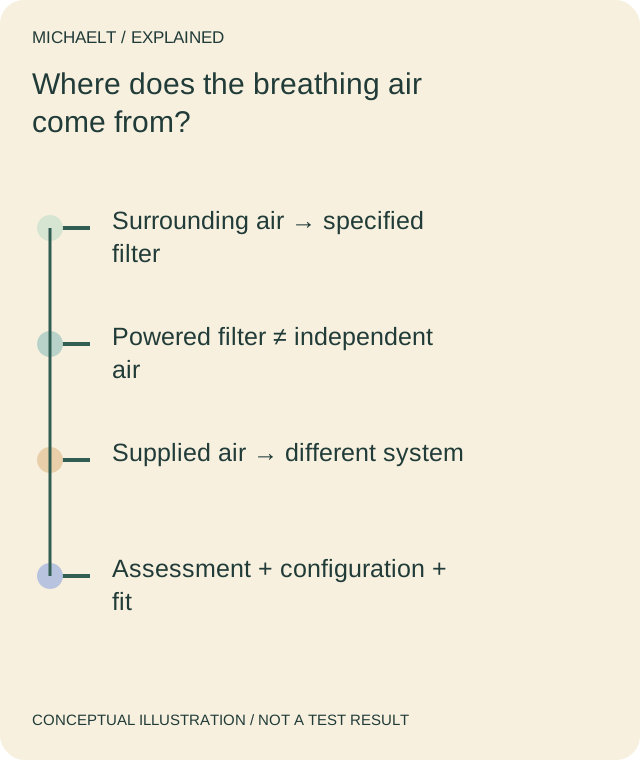
Read the drawing as text
Air purification and atmosphere supply are different categories. A powered filter does not become an independent breathing-air source.
Work through an example
A fictional listing calls product P a supplied-air mask, but its document describes a powered filter drawing surrounding air. The reader records that mismatch and asks the responsible competent person for the correct category and approved configuration. No real device or cartridge is selected. The example does not establish that P is suitable, safe or approved for a particular exposure.
Illustrative example; figures, people and organisations in the worked record are fictional.
The example record
Category
- Illustrative evidence
- Powered filter described
- Meaning or next step
- Not automatically supplied air
Configuration
- Illustrative evidence
- Exact approval record requested
- Meaning or next step
- Component appearance is insufficient
Fit and training
- Illustrative evidence
- Programme-specific evidence
- Meaning or next step
- Not a web demonstration
Conclusion
- Illustrative evidence
- Mismatch unresolved
- Meaning or next step
- No entry or use authorisation
Download blank worksheet (.csv) ↗Download worked example (.csv) ↗
Keep your own record
Use the result within its scope
Use the appropriate professional assessment and actual instructions. A documentation match does not guarantee protection against every contaminant, establish oxygen availability or replace a respiratory-protection programme.
Reference sources
- NIOSH: respirator types and use, 4 March 2025 ↗
- NIOSH: A Guide to Air-Purifying Respirators, August 2018 ↗
Earlier articles on this subject
- Why Wearing A Face Mask Is Important in COVID-19 Pandemic ↗ — 2021-04-23, Maria Baldwin.
- How to Use a Gas Mask ↗ — 2021-12-30, Maria Baldwin.
- Different Types of Gas Masks ↗ — 2021-02-20, Maria Baldwin.
- Do Face Masks Can Help Protect You From Viral Infections? ↗ — 2021-06-17, Maria Baldwin.