Define one visitor task
Choose an honest question a public reader should be able to answer: what service is offered, what evidence is available and how to ask a relevant question. Use only verified professional information and permissions. Financial-services and property examples need particular care with factual claims; do not publish invented qualifications, properties, returns, client results or an offer you cannot actually provide.
Check the public view
LinkedIn’s help distinguishes public-profile visibility settings and what other people can see. Use the actual platform’s permitted public-view route rather than assuming your own signed-in view is everyone’s view. Record what was actually observed and what was not accessible. This article does not change account settings, gather prospect identities or advise sending connection requests to people simply because they appear on a list.
Follow the link to its useful destination
Check that the visible link wording matches the destination and that the page explains the promised task. A homepage is not always the best answer to a specific question, but a dedicated page should still provide real information rather than an empty capture form. Keep date-sensitive service details current. Do not describe a successful link click as a human enquiry, client or sale.
Verify the contact step honestly
Check labels, required fields, instructions and the promised next step. W3C WAI explains the importance of labels associated with form controls. Test only within your actual authorisation; do not send unsolicited messages or submit personal details to a real service as a casual test. A form displaying a success state is not proof that an inbox received a message unless delivery is separately verified.
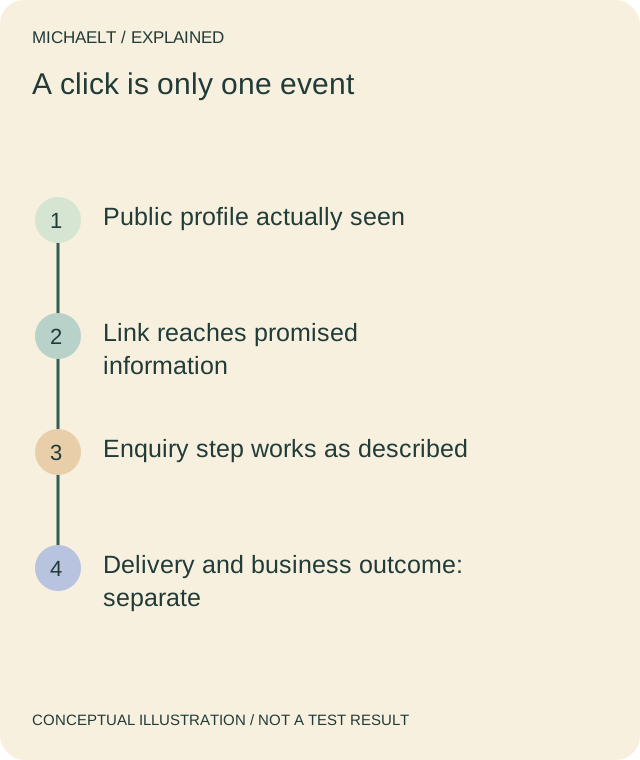
Read the drawing as text
Public visibility, destination, form behaviour, delivery and a business outcome are separate observations. A click does not establish a lead or sale.
Work through an example
A fictional profile promises a sample project brief. Its link opens that brief, which explains the work and provides a clearly labelled enquiry route. The audit records public view observed, destination matched and form behaviour checked in an authorised test. It leaves email delivery unverified. No lead count, real prospect, property offer or financial result is invented.
Illustrative example; figures, people and organisations in the worked record are fictional.
The example record
Public view
- Illustrative evidence
- What was actually visible
- Meaning or next step
- Not just the owner’s view
Link
- Illustrative evidence
- Promised sample brief
- Meaning or next step
- Destination matches wording
Contact step
- Illustrative evidence
- Labels and instructions checked
- Meaning or next step
- No unsolicited submission
Outcome
- Illustrative evidence
- Delivery unverified
- Meaning or next step
- Click ≠ enquiry ≠ sale
Download blank worksheet (.csv) ↗Download worked example (.csv) ↗
Keep your own record
Use the result within its scope
Use the record to improve a real reader task. It does not promise reach, automate outreach, collect contacts or establish that a profile generated customers or revenue.
Reference sources
Earlier articles on this subject
- LinkedIn Lead Generation Tips For Financial Services Professionals ↗ — 2021-09-22, Maria Baldwin.
- What Is The Best Way To Leverage Social Media For Real Estate Marketing? ↗ — 2022-07-15, Maria Baldwin.