
Identify the equipment and request
Record the exact unit reference, relevant manual and the reported problem or planned maintenance request. Keep the request distinct from a diagnosis. A general commercial-kitchen article cannot establish a refrigeration fault, a safe electrical condition or the maintenance interval for an unknown appliance. Use the responsible competent service provider and the actual manufacturer’s instructions for the equipment.
Request an intelligible completion record
Ask the provider to distinguish actions completed, parts changed, observations and work not carried out. Retain dates, responsible party and document references. If measurements are supplied, keep their units and stated conditions, and ask what they mean within the inspection scope. A tick saying cleaned does not explain an electrical inspection, and an installation record does not establish later maintenance.
Keep inspection scope separate
HSE explains that work-equipment inspection needs and frequency depend on risk assessment; not all equipment needs the same formal inspection. Apply the actual rules and responsible assessment for your workplace. Do not convert a generic annual-service advertisement into a legal interval for every unit. Ask which inspection or maintenance obligation the supplied record actually addresses.
Resolve the open findings
Name the person responsible for each unanswered finding and retain the provider’s actual instructions about use, restrictions and next contact. Follow the appropriate process for faults rather than improvising a repair to make the record complete. Record a recommendation as a recommendation until the authorised work and completion evidence exist. Keep safety judgements with the competent professional.
Read the drawing as text
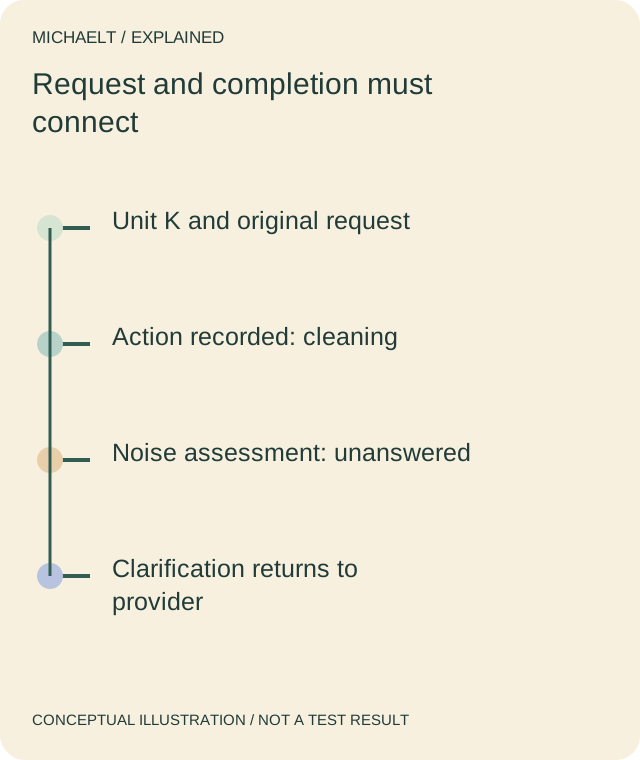
A completed cleaning action does not automatically resolve a different reported fault. Keep the unanswered assessment attached to the request.
Work through an example
A fictional request asks for unit K to be assessed after an unusual noise. The completion record says an external part was cleaned but does not state whether the noise was assessed. The coordinator asks for clarification and retains the original request. Cleaning completed and reported fault resolved therefore remain different states. No kitchen equipment is tested, dismantled or declared safe in this example.
Illustrative example; figures, people and organisations in the worked record are fictional.
The example record
Unit
- Evidence
- K / actual manual reference
- Next question
- Exact equipment?
Request
- Evidence
- Unusual noise reported
- Next question
- Assessment scope agreed?
Completed work
- Evidence
- External cleaning recorded
- Next question
- Does not answer every request
Finding
- Evidence
- Noise assessment unanswered
- Next question
- Responsible competent contact
Download blank worksheet (.csv) ↗Download worked example (.csv) ↗
Keep your own record
Use the result within its scope
A detailed record makes the next question clear. It is not proof of every aspect of safety, energy performance or remaining life, and it supplies no electrical, refrigerant, lubrication or appliance-repair procedure.
Reference sources
Earlier articles on this subject
- About Commercial Kitchen Equipment ↗ — 2020-12-29, Maria Baldwin.
- Reasons You Need Air Conditioning Maintenance ↗ — 2021-04-01, Maria Baldwin.
- Home Air Conditioning Services – General Points ↗ — 2021-01-21, Maria Baldwin.