Describe the insured business
State the legal entity, activity, location and relevant period using the actual insurer’s requested information. Use neutral placeholders in this worksheet and disclose real details through verified private channels. The SBA’s business-insurance overview is a US starting point; local mandatory cover and an individual business’s needs require their own advice. An article about Ontario does not establish worldwide requirements.
Match the quote basis
Record the actual policy type, proposed dates, limit basis and excess or deductible. Ask the insurer or appropriate adviser to explain an unclear term and whether quoted limits apply per event, in aggregate or on another basis. Two premiums are not comparable if the underlying insured activities or periods differ. A trading name similar to yours is not confirmation that the right legal entity is insured.
Read exclusions and conditions
Retain the proposed wording and ask about material exclusions, conditions, optional extensions and activities outside the quoted scope. Record the answer for the exact proposal rather than carrying an assurance between insurers. A certificate or summary may not contain the full terms. Do not turn insurance marketing into a promise that a particular loss, vehicle use or employee incident will be paid.
Keep proposal and cover separate
Distinguish a quote requested, quote received, cover actually arranged and a claim decision. Request the appropriate evidence and effective date through the real process. If a business activity or other relevant circumstance changes, ask how to update the arrangement. A comparison worksheet does not arrange cover, assess risk professionally or substitute for the insurer’s binding documents.
Read the drawing as text
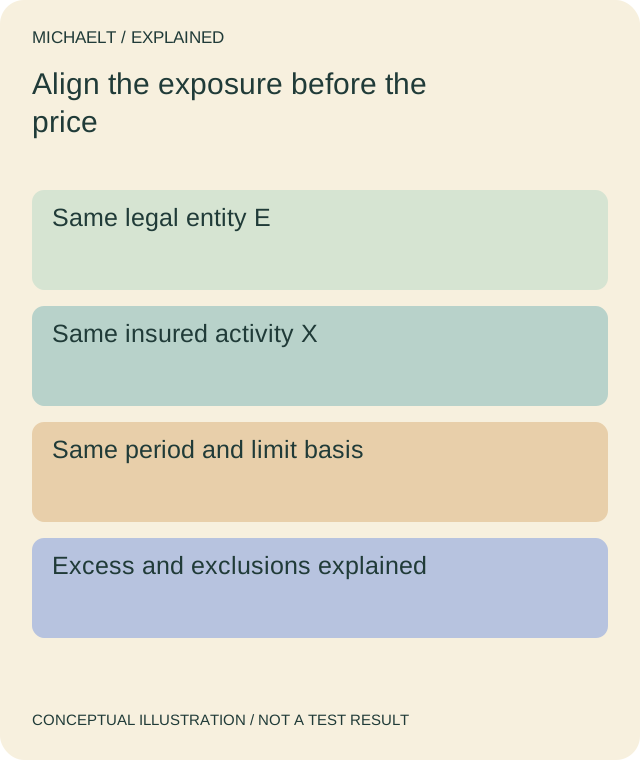
Two fictional quotes cannot be compared by premium until entity, activity, period, limits and conditions are understood.
Work through an example
Fictional quote A names entity E and activity X for twelve months; B covers E but omits X and uses six months. The coordinator first resolves activity and period rather than calling B cheaper. A deductible field is unanswered and stays pending. No premium, insurer, coverage decision or real claim outcome is represented.
Illustrative example; figures, people and organisations in the worked record are fictional.
The example record
Insured entity
- Evidence
- E in both proposals
- Next question
- Exact legal identity?
Activity
- Evidence
- X omitted from B
- Next question
- Resolve exposure mismatch
Period
- Evidence
- A: 12 months / B: 6
- Next question
- Compare same dates
Conditions
- Evidence
- Deductible unanswered
- Next question
- Actual wording and adviser explanation
Download blank worksheet (.csv) ↗Download worked example (.csv) ↗
Keep your own record
Use the result within its scope
Use qualified local advice and the actual policy wording. A comparable quote is useful evidence for a decision; it is not proof of cover, a claim entitlement or a universally correct insurance package.
Reference sources
Earlier articles on this subject
- Business Insurance Solutions for All Business Types In Ontario ↗ — 2022-02-02, Maria Baldwin.
- What Is Car Insurance In NC? ↗ — 2022-08-17, Maria Baldwin.