Identify the work and version
Give the project a neutral identifier and record the files or other contributions under discussion. Use version references rather than vague descriptions such as the final artwork. The US Copyright Office’s Copyright Basics explains authorship and ownership concepts; a team spreadsheet does not itself decide legal ownership or create a joint venture. Use appropriate advice for the actual agreement and jurisdiction.
Describe each contribution
Record who supplied which text, image, recording or other material and the source of any third-party component. Keep a proposed credit separate from a permission to use the material. A person’s participation in a meeting does not automatically give the team rights to every file they possess. Do not invent approval, a release or a transfer simply because a folder is shared.
Ask about a specific use
State the intended publication, format and version when requesting the relevant permission or agreement. Keep the answer and its scope with the contribution reference. A permission for one use should not silently become permission for another medium, audience or changed version. This worksheet is not a licence contract, rights clearance service or determination of fair use.
Reconcile before publishing
Check that the outgoing version uses the contributions actually cleared for that proposed use and that agreed credits are present. Keep unresolved material out of the publication pending the appropriate decision, while preserving the project record. When a contribution changes, revisit the affected permission and credit. Store private correspondence securely and publish only the attribution actually intended for readers.
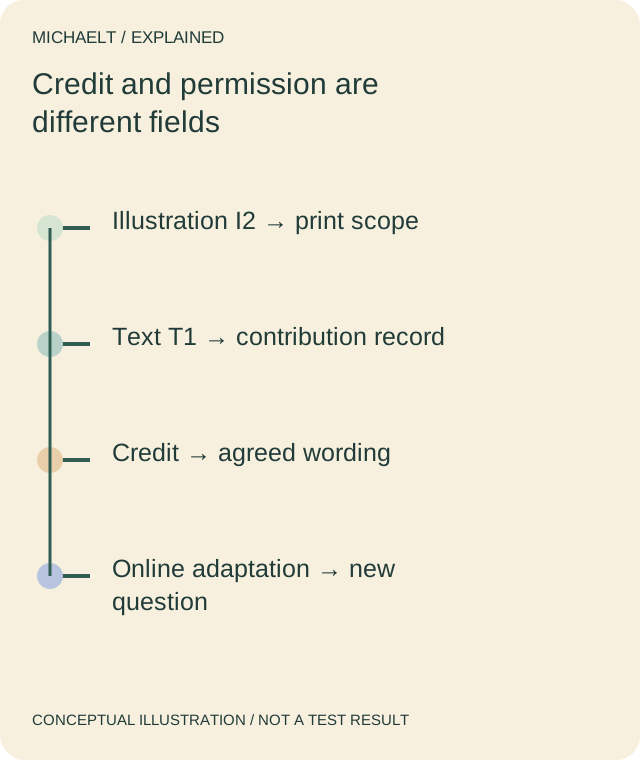
Read the drawing as text
Record a contribution’s exact version and permitted use. Attribution is important, but it does not by itself grant a new publication right.
Work through an example
A fictional booklet B uses illustration I version 2 and text T version 1. Permission for I concerns the printed booklet, while an online adaptation is unanswered. The team records the print permission and asks a separate question about online use. The illustrator’s credit alone is not treated as clearance for the new format.
Illustrative example; figures, people and organisations in the worked record are fictional.
The example record
Project B
- Current evidence
- Print booklet version
- Open question
- Exact outgoing file
Illustration I2
- Current evidence
- Print-use permission
- Open question
- Online use unanswered
Text T1
- Current evidence
- Contributor record
- Open question
- Confirm intended credit
Publication
- Current evidence
- Reconcile cleared version
- Open question
- No inferred rights transfer
Download blank worksheet (.csv) ↗Download worked example (.csv) ↗
Keep your own record
Use the result within its scope
Obtain suitable legal or rights advice where needed. A useful record makes decisions traceable; it does not replace consent, a licence or an agreement.