Choose a simple grouping
Start with one room or category and give each item a unique reference. Use descriptions that another person can distinguish: make, model and relevant identifying details where available. The NAIC’s inventory guidance supports grouping and photographing belongings. You do not need to publish a room tour, install a particular app or collect every serial number in a public document to make a useful private record.
Label the evidence and its date
Link an item to a photograph, receipt, appraisal or other relevant document and record the date and basis of any amount. Purchase price, a current replacement quote and a professional valuation are different figures. Keep the source and currency with the amount instead of replacing an old receipt with an unexplained number. An image may show an item existed without proving ownership, condition or value by itself.
Avoid duplicate and sensitive records
If a single item appears in two room photographs, keep one inventory reference with two evidence links. Store the real inventory securely, using access and backup arrangements appropriate to its sensitivity. Do not place addresses, keys, security details, full receipts or account information in an open worksheet. This site provides fictional fields and does not upload your photographs or belongings list.
Ask a coverage-specific question
Bring relevant entries and the actual policy to the insurer or appropriate adviser. Ask how limits, valuation basis, exclusions and evidence requirements apply; an inventory does not decide those terms. Record the answer’s source and date. Review the inventory after significant changes and preserve earlier versions where useful, so a new purchase or disposal is not silently substituted into an older incident record.
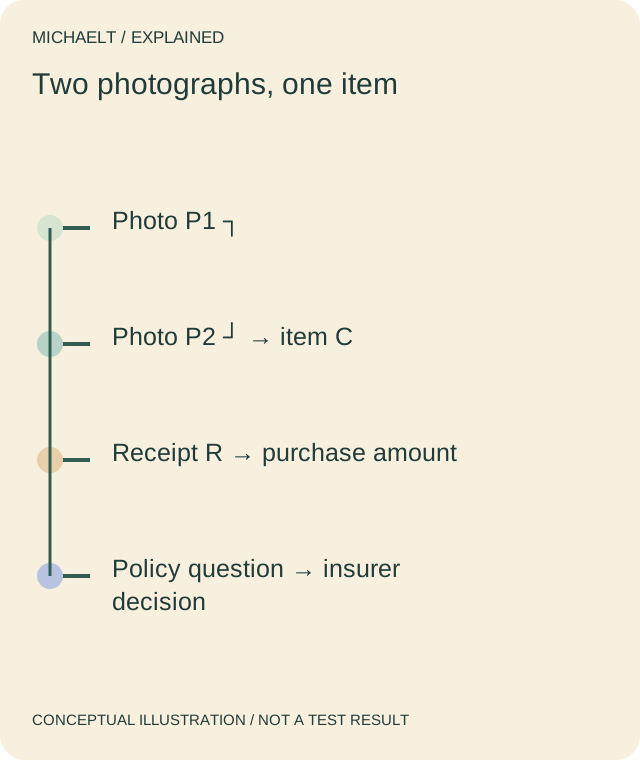
Read the drawing as text
Two images of the same camera link to one inventory reference. Purchase evidence and policy coverage remain different questions.
Work through an example
A fictional camera C appears in living-room photo P1 and cupboard photo P2. It remains one item, linked to two photographs and receipt R. The receipt amount and an unanswered replacement-value question occupy different fields. The example contains no real insured value, claim assessment or promise that a policy covers the camera.
Illustrative example; figures, people and organisations in the worked record are fictional.
The example record
Item C
- Evidence
- Description and model
- Meaning
- One item
Photos P1/P2
- Evidence
- Two views of C
- Meaning
- Not two possessions
Receipt R
- Evidence
- Dated purchase amount
- Meaning
- Not automatic replacement value
Policy question
- Evidence
- Insurer reply pending
- Meaning
- Coverage undecided
Download blank worksheet (.csv) ↗Download worked example (.csv) ↗
Keep your own record
Use the result within its scope
An inventory makes an enquiry more precise. Keep the insurer’s actual requirements and your private evidence; do not treat the worksheet as an appraisal or a settled claim.
Reference sources
Earlier articles on this subject
- Find Out Your Insurance Needs Using a Home Insurance Calculator ↗ — 2021-12-09, Maria Baldwin.
- All You Should Know About Fire Claim Adjuster ↗ — 2021-11-19, Maria Baldwin.
- How Much Does Title Insurance Cost in New Jersey? ↗ — 2022-06-10, Maria Baldwin.