Start with the purpose and property
Record the actual premises, relevant area and intended work with the responsible dutyholder or appropriate professional. Do not identify asbestos from appearance or a building’s age alone. HSE distinguishes a management survey from a refurbishment or demolition survey. Those names concern different purposes; a document labelled survey does not automatically answer every question about planned work.
Read scope and limitations together
Identify which areas were inspected, what access was unavailable and how limitations are recorded. HSE explains that access restrictions can seriously undermine a survey’s usefulness and that uninspected areas need appropriate treatment until assessed. A blank area or no sample recorded is not evidence that the area contains no asbestos. Keep the report’s actual instructions and responsible professional advice attached.
Match the report to the new work
Ask the competent professional whether the existing report covers the proposed area and activity, including material hidden within the building fabric where relevant. A management report for ordinary occupancy is not automatically the right survey for intrusive refurbishment. Do not open a wall, collect a sample or disturb a suspected material to resolve the question yourself.
Use competent survey and analysis routes
Check the appropriate competence and accreditation information using the actual jurisdiction’s framework and HSE’s linked routes where relevant. Retain the report version, date and professional response to changes. This guide does not authorise work, prescribe removal, declare an area fit for occupation or supply a sampling or disposal procedure.
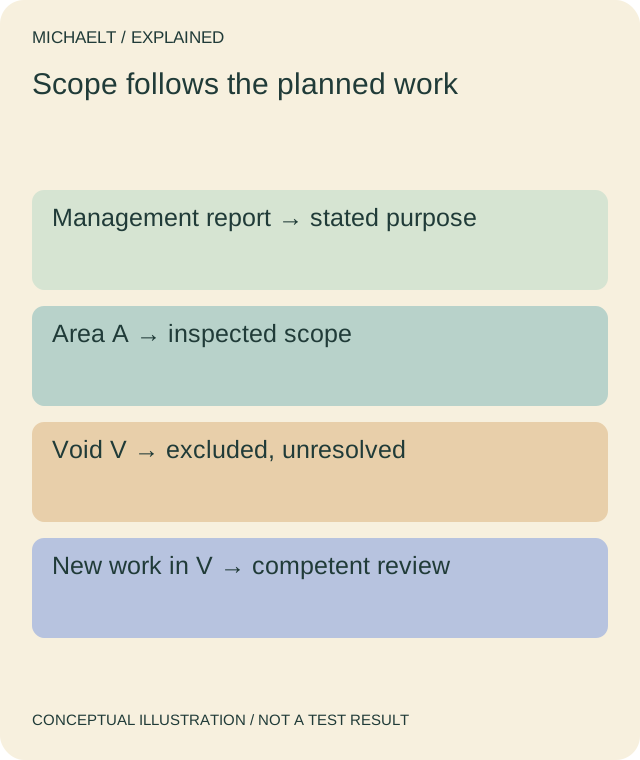
Read the drawing as text
An excluded void remains outside the report’s inspected scope. A new project requires the appropriate competent review, not a reinterpretation of the blank area.
Work through an example
A fictional management report covers accessible area A and excludes void V. A later proposal affects V. The project owner records that mismatch and asks a competent surveyor about the required assessment. The old report is retained; its exclusion is not converted into a no-asbestos statement or permission to begin intrusive work.
Illustrative example; figures, people and organisations in the worked record are fictional.
The example record
Purpose
- Existing evidence
- Management report
- New question
- Proposed refurbishment differs
Area A
- Existing evidence
- Accessible scope
- New question
- Keep actual limits
Void V
- Existing evidence
- Excluded
- New question
- Not a negative finding
Next step
- Existing evidence
- Competent survey advice
- New question
- No DIY access or sample
Download blank worksheet (.csv) ↗Download worked example (.csv) ↗
Keep your own record
Use the result within its scope
Follow current applicable asbestos requirements and competent professional advice. This report-reading procedure does not determine whether a material contains asbestos or approve any disturbance.
Reference sources
Earlier articles on this subject
- Exposure Facts About Asbestos ↗ — 2022-02-26, Maria Baldwin.
- Asbestos and Cancer are Related to Health Risks ↗ — 2021-05-15, Maria Baldwin.
- What Do You Need To Know About Asbestos Removal In Brisbane? ↗ — 2022-02-16, Maria Baldwin.
- Tips to Help You Become a Professional Asbestos Removal Expert ↗ — 2022-08-09, Maria Baldwin.