Identify the assessed system
Record the floor product, location, footwear and other components named in the actual report. The ESD Association describes flooring and footwear as interacting parts of electrostatic control. A tile’s marketing label is not the same evidence as a result for the installed floor and footwear combination. Keep the actual intended environment and responsible technical owner with the enquiry.
Retain the method and conditions
Copy the test-method reference, report version, date, units and stated conditions without converting them into an unexplained pass colour. Different tests and configurations answer different questions. Ask the competent author about missing conditions or an unfamiliar unit. This page does not reproduce proprietary standards, prescribe a threshold or teach a grounding or electrical test procedure.
Separate laboratory and installed evidence
A product sample tested under stated conditions and an installed system assessment may have different scope. Record the material batch and location covered, along with exclusions. Do not generalise one point or sample to every room, every pair of shoes or a changed cleaning regime. A certificate headline cannot resolve a missing connection between the report and the actual installed arrangement.
Take changes back to the responsible expert
List changes to flooring, footwear, environment or care procedures and ask whether the earlier assessment still applies. Keep the competent response and any required reassessment with the earlier report. Do not modify earthing, electrical protection or test equipment to obtain an expected number. An administrative comparison is not an approval of a controlled area or proof that every device is protected.
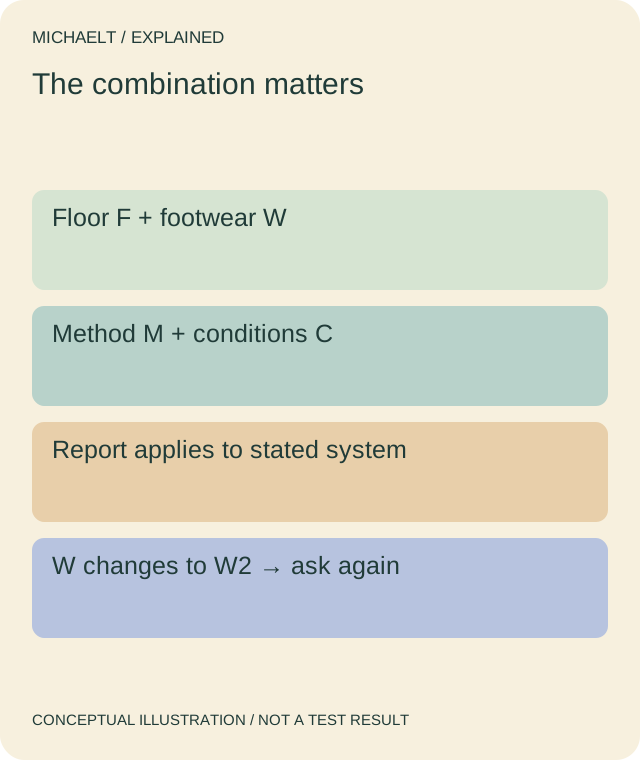
Read the drawing as text
A reported result belongs to its named components, method and conditions; changing footwear creates a new applicability question.
Work through an example
A fictional report names floor F, footwear W and method M under conditions C. A later quotation proposes footwear W2. The reviewer records the changed component and asks whether a further system assessment is needed. The result for F plus W is not relabelled as a result for F plus W2.
Illustrative example; figures, people and organisations in the worked record are fictional.
The example record
Floor
- Report
- F / actual location
- Proposed change
- Unchanged
Footwear
- Report
- W
- Proposed change
- W2 proposed
Method/conditions
- Report
- M / C
- Proposed change
- Must remain attached
Conclusion
- Report
- Scope of original report
- Proposed change
- Expert review requested
Download blank worksheet (.csv) ↗Download worked example (.csv) ↗
Keep your own record
Use the result within its scope
Use the applicable standards and competent ESD professionals for actual assessment. No resistance limit, installation specification or electrical safety procedure is supplied here.
Reference sources
Earlier articles on this subject
- ESD flooring system ↗ — 2022-01-05, Maria Baldwin.