Define one period and one offer
Write what is being sold, the time period and the currency used in the model. Keep this description narrow enough that a per-sale cost has a clear meaning. Separate quotations, existing commitments and guesses. The SBA’s planning guidance distinguishes startup costs and ongoing costs; this worksheet adds a transparent way to keep assumptions visible rather than treating a business plan as a prediction.
Put each cost in the right column
Record one-time setup payments separately from monthly fixed costs and variable costs for each sale. Mark deposits, refundable amounts and timing questions instead of silently treating every cash payment as a permanent expense. Avoid counting the same item both in startup spending and every month. Obtain appropriate accounting advice about tax, depreciation, employment and legal classification; none is decided by the worksheet headings.
Calculate a limited contribution example
For a simple single-offer illustration, subtract the assumed variable cost per sale from the assumed selling price. Divide fixed costs for the period by that positive contribution to calculate the sales count needed to cover those listed fixed costs. If contribution is zero or negative, this particular calculation cannot produce a useful positive break-even count. Keep taxes, financing and omitted costs explicitly outside the simplified example.
Stress the assumptions before committing
Try a lower selling price, fewer sales or an extra recurring cost, changing one assumption at a time. Record what changes and which figures require a real quote. Keep cash needed before the first sale separate from the later operating calculation. Even a coherent break-even model does not show that customers exist, payments arrive on time or funding will be available.
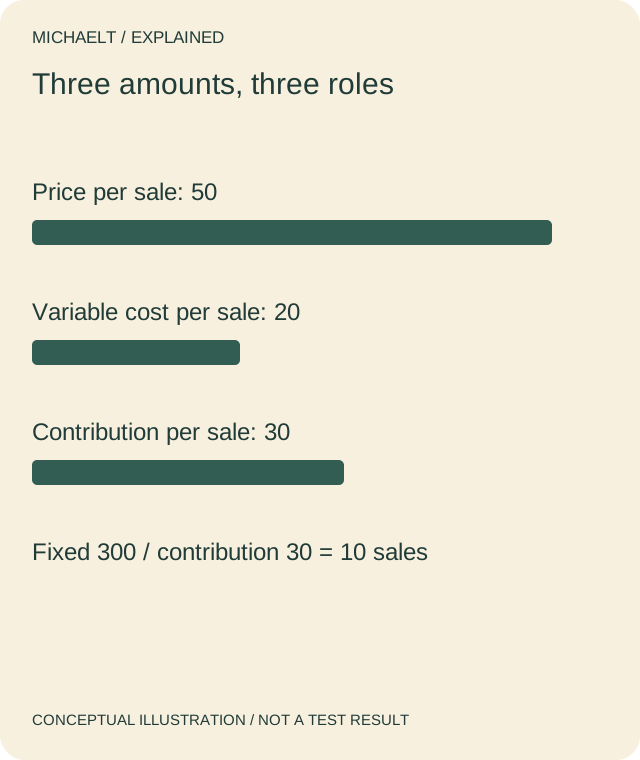
Read the drawing as text
A fictional 50-unit sale less 20 variable cost leaves 30 contribution; 300 monthly fixed costs need 10 sales, before omitted items and separate setup cash.
Work through an example
A fictional offer sells for 50 units and uses 20 units of variable cost, leaving a contribution of 30 units. Listed monthly fixed costs of 300 units therefore require 10 sales to cover those costs in this simplified model. A separate 200-unit setup payment is shown separately; it has not disappeared merely because the monthly example reaches break-even.
Illustrative example; figures, people and organisations in the worked record are fictional.
The example record
Selling price
- Assumption
- 50 units / sale
- Calculation or limit
- Fictional
Variable cost
- Assumption
- 20 units / sale
- Calculation or limit
- Contribution 30
Monthly fixed costs
- Assumption
- 300 units
- Calculation or limit
- 300 / 30 = 10 sales
One-time setup
- Assumption
- 200 units
- Calculation or limit
- Separate cash requirement
Download blank worksheet (.csv) ↗Download worked example (.csv) ↗
Keep your own record
Use the result within its scope
Use actual quotes and qualified advice before a commitment. The worksheet gives neither a forecast of demand nor a guarantee of profit, finance or tax treatment.
Reference sources
Earlier articles on this subject
- Create a Strongly Positioned Start-up with these Appealing Tips ↗ — 2021-08-11, Maria Baldwin.
- Things To Consider When Opening An Osteopathy Business ↗ — 2021-12-29, Maria Baldwin.