

State the question and the place
Write the issue you want advice about, the relevant jurisdiction as you understand it and the next decision you are facing. Keep the wording factual and short. Do not treat a general article about divorce, property, an accident or immigration as a legal route for your own case. If there is a possible deadline, contact an appropriately qualified professional promptly rather than calculating it from an illustrative timeline.
Create an honest chronology
List dated events and the document or message that supports each. Distinguish an exact date from an estimate and another person’s statement from something you observed. Preserve originals privately. Avoid embellishing events to fit a template or publishing another person’s identity, health information or allegation in an open worksheet. A document index can point to D1 and D2 without copying their sensitive contents.
Verify who is offering the service
Use the relevant official register and a verified contact route for that jurisdiction. The SRA’s Solicitors Register is a specific example for solicitors and firms it regulates in England and Wales; it is not a worldwide lawyer directory or a rating of likely success. Match the person and firm, then ask about the actual service, competence and any limitations. A fast reply or polished website does not establish authorisation.
Agree what the first meeting includes
Ask about the fee basis, documents requested, contact person, expected output and what needs a separate engagement. Use the provider’s secure transfer route and send only the material requested for the scoped task. Keep a note of advice received through the proper private channel. An enquiry, a quotation and an accepted engagement are different stages. None guarantees a result or means the professional has already reviewed every document.
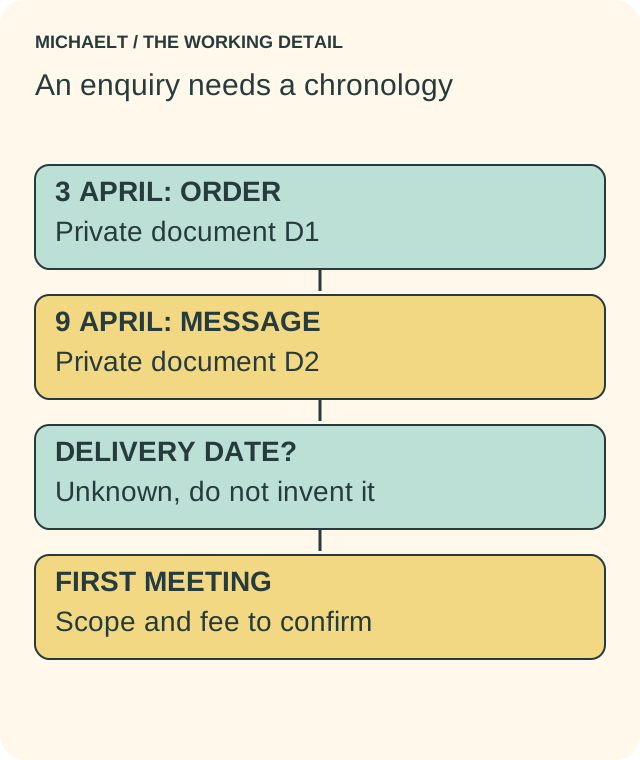
Read the drawing as text
Illustrative dates 3 April order and 9 April message link to private document identifiers D1 and D2. Unconfirmed delivery date stays unknown. Ask for scope and fee.
Work through an example
A fictional enquiry concerns an unresolved service agreement. The chronology lists an order on 3 April, a message on 9 April and an uncertain delivery date marked to confirm. Documents D1 and D2 are indexed privately. The prospective adviser is asked to confirm scope and fee for an initial meeting. No limitation date, liability or entitlement is calculated.
Illustrative example; figures, people and organisations in the worked record are fictional.
The example record
Issue
- Illustrative record
- Unresolved service agreement
- Next question
- Which jurisdiction and advice scope?
Chronology
- Illustrative record
- 3 April order / 9 April message
- Next question
- Delivery date to confirm
Documents
- Illustrative record
- D1 agreement / D2 message
- Next question
- What is needed securely?
Meeting
- Illustrative record
- Scope and fee requested
- Next question
- Engagement not yet assumed
Download blank worksheet (.csv) ↗Download worked example (.csv) ↗
Keep your own record
Use the result within its scope
This is a preparation method, not legal advice, a lawyer recommendation or a claim-filing service. The correct professional must assess the actual facts, urgency, permissions and applicable law.
Reference sources
Earlier articles on this subject
- Choosing the Right Legal Services Advisor: Factors to Consider ↗ — 2023-07-19, Maria Baldwin.
- Need Of Personal Injury Lawyers For Filing Personal Injury Claims ↗ — 2021-04-16, Maria Baldwin.
- Family Law Attorney – Their Services ↗ — 2022-02-21, Maria Baldwin.
- How To Select A Divorce Lawyer ↗ — 2021-10-29, Maria Baldwin.
- Qualities to be Looked in an Immigration Lawyer While Hiring ↗ — 2021-11-09, Maria Baldwin.
- Conveyancing Solicitor – Qualities Of A Good Solicitor ↗ — 2022-02-15, Maria Baldwin.
Continue with a related task
Use the correct US immigration-representation record
A licensed attorney and an accredited representative use different authorisation routes; a job title alone does not establish either.
Identify the role being offered
Ask the person to state their professional role and which organisation they act through. Do not infer legal authorisation from a translation service, document-preparation title, impressive website or a promise of a fast green card. Keep the actual jurisdiction, issue and service scope from the existing enquiry sheet. An introductory contact is not an accepted engagement.
Match the appropriate official route
USCIS directs people to verify an attorney’s eligibility through the relevant licensing body. DOJ’s Recognition and Accreditation Program describes accredited non-attorney representatives acting through recognised organisations. Those records answer different questions. Check the exact person, organisation, current scope and any relevant restrictions through the official routes; do not treat one list as a worldwide lawyer directory.
Keep authority and outcome separate
Ask the appropriate professional to explain their actual permitted scope and engagement terms. A valid record does not guarantee immigration eligibility, an approved application, a deadline extension or a successful case. Use verified secure channels for necessary private documents and qualified advice for the actual facts. This page does not select a visa, file a form or determine a person’s legal status.
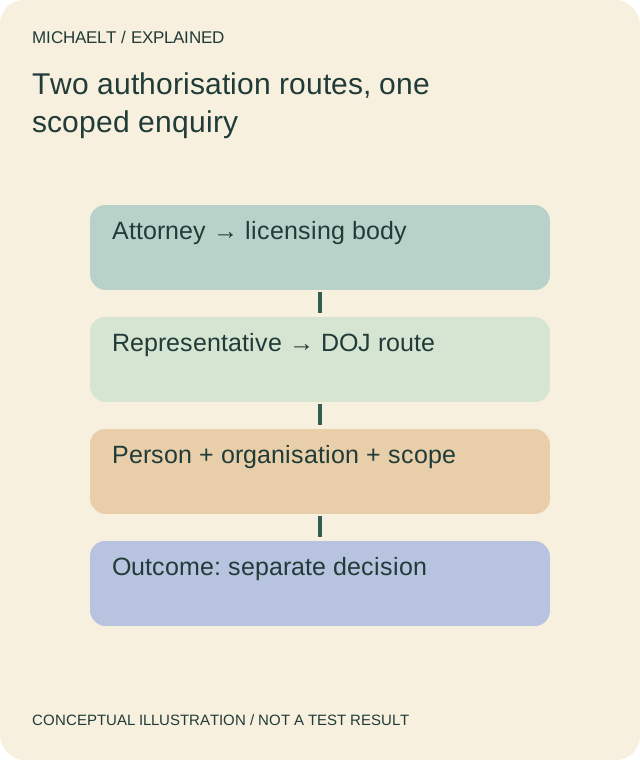
Read the drawing as text
Attorney licensing and accredited-representative recognition are different routes. Neither record guarantees an immigration outcome.
Work through an example
A fictional adviser describes themselves as an accredited representative but supplies only an unrelated business-directory page. The enquirer asks for the matching official person-and-organisation record and scope. No conclusion about a real person is made. The file remains authorisation unverified rather than replacing the missing record with a promise of success.
Illustrative example; figures, people and organisations in the worked record are fictional.
The example record
Role
- Illustrative evidence
- Attorney or accredited representative?
- Meaning or next step
- Different official evidence
Identity
- Illustrative evidence
- Exact person and organisation
- Meaning or next step
- Not a common-name match
Scope
- Illustrative evidence
- Current permitted work
- Meaning or next step
- Read relevant restrictions
Outcome
- Illustrative evidence
- Application not assessed
- Meaning or next step
- Authorisation is not approval
Download blank worksheet (.csv) ↗Download worked example (.csv) ↗
Keep your own record
Use the result within its scope
Use the current official records and appropriate individual legal advice. The worksheet cannot confirm a real representative, determine an immigration route or promise any legal outcome.
Reference sources
- US Department of Justice: Recognition and Accreditation Program ↗
- USCIS: find authorised legal services ↗
Earlier articles on this subject
- Significance Of A Green Card Lawyer ↗ — 2022-05-04, Maria Baldwin.