Start with the responsible assessment
Ask the person responsible for the work what protection is required and how it was determined. A buyer should not choose a safety class from a photograph or treat this article as a hazard assessment. The HSE’s selection guidance places fit, compatibility, user characteristics and instruction alongside product selection. Workwear supplied for appearance and equipment intended for a protective function should not be silently treated as equivalent.
Identify the exact garment and declared function
Record the model, size, label information and the manufacturer’s relevant instructions or conformity documentation. Keep each claimed protective function separate. Visibility, protection against chemicals, weather performance and other properties are different claims. A statement about one cannot establish the others. Match the documentation to the actual item and version; a marketplace image showing a similar garment is not the product record.
Ask about the whole combination
Where several items are worn together, ask the responsible assessor how compatibility and fit are addressed. HSE warns that equipment can interfere with other equipment and that modifying PPE to make it fit is not a suitable solution. Do not add embroidery, remove material or alter a protective garment because an ordinary clothing guide suggests personalisation. Ask the manufacturer and responsible professional about the actual proposed change.
Retain the acceptance question
Before ordering a group batch, seek confirmation that the sample and documentation match the specified requirement. Keep care and replacement information with the item according to the actual instructions. Record the approval role and any outstanding question. A certificate file does not show that each worker has been fitted or trained, and this worksheet cannot approve a respirator, harness or other safety-critical equipment for use.
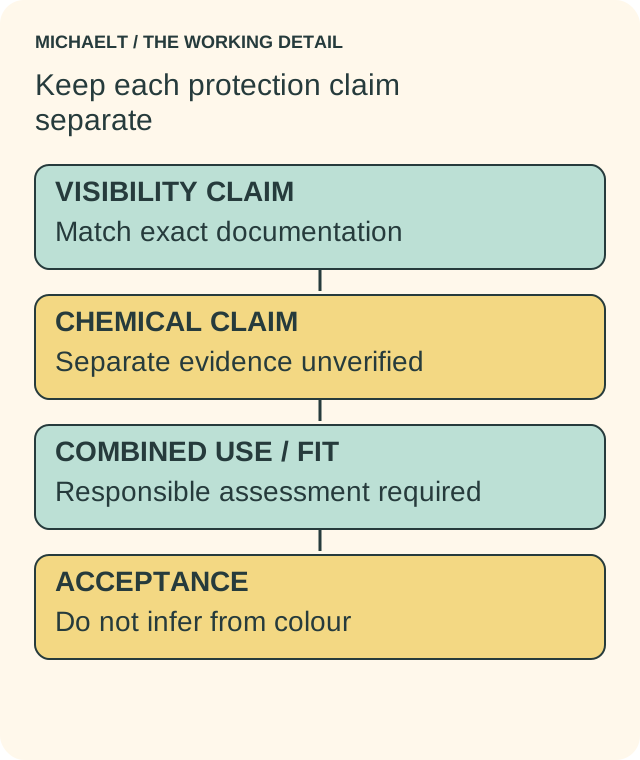
Read the drawing as text
Visibility evidence does not verify chemical resistance. The exact item, assessed requirement, compatibility and named approval must be matched separately.
Work through an example
An illustrative order calls for a specified visibility function. The seller also calls its trousers chemical resistant, but supplies documentation only for the visibility claim. The buyer records the second claim as unverified and asks the responsible assessor before accepting the sample. The example deliberately selects no protective class and performs no exposure test.
Illustrative example; figures, people and organisations in the worked record are fictional.
The example record
Visibility function
- Required evidence
- Exact item documentation
- Status in example
- To match stated requirement
Chemical resistance
- Required evidence
- Separate relevant evidence
- Status in example
- Unverified
Combined use and fit
- Required evidence
- Responsible assessment
- Status in example
- Not decided by colour
Acceptance
- Required evidence
- Named approval and sample version
- Status in example
- Pending
Download blank worksheet (.csv) ↗Download worked example (.csv) ↗
Keep your own record
Use the result within its scope
The actual risk assessment, product instructions and competent approval determine what is needed. Do not treat a high-visibility colour, leather material or a logo as a universal safety guarantee.
Reference sources
Earlier articles on this subject
- Best Hi-Vis Trousers You Can Buy ↗ — 2022-07-22, Maria Baldwin.
- Best Industrial Uniform Suppliers in Dubai ↗ — 2021-01-20, Maria Baldwin.
- The Leather Motorcycle Jacket – Never Going Out of Style ↗ — 2021-05-13, Maria Baldwin.
- Hi-Vis Work Wear: Key Benefits and Tips ↗ — 2022-06-21, Maria Baldwin.