Define the actual interval
List the relevant work period, agreed hours and known commitments. HSE’s Management Standards describe demands in relation to workload, work patterns and the working environment. Keep the discussion about the actual arrangement rather than assuming an individual should simply become more resilient. This worksheet is a planning conversation, not a clinical stress assessment or a diagnosis.
List tasks with their evidence
For each task record the requested output, deadline, estimated effort and the source of that estimate. Distinguish fixed commitments from flexible requests and uncertainty. Do not disguise an estimate as measured time or assume all hours can be scheduled without interruption. Keep private employee or client details out of a shared public example.
Make a trade-off explicit
Compare the listed demand with the agreed capacity for the same interval. Ask the responsible manager which scope, timing, priority or support should change when they do not fit. Do not allocate work to an unconsulted person or imply that a spreadsheet authorises unpaid extra hours. A decision should identify an owner and a next review point, not merely colour an overloaded row red.
Review the actual result
Record what was agreed and whether conditions changed, then revisit unresolved work at the agreed point. Keep estimates and actual observations distinct. If health or safety concerns arise, use the appropriate organisational and professional support routes. A balanced example does not prove an actual workplace is safe or that a person’s needs have been assessed.
Read the drawing as text
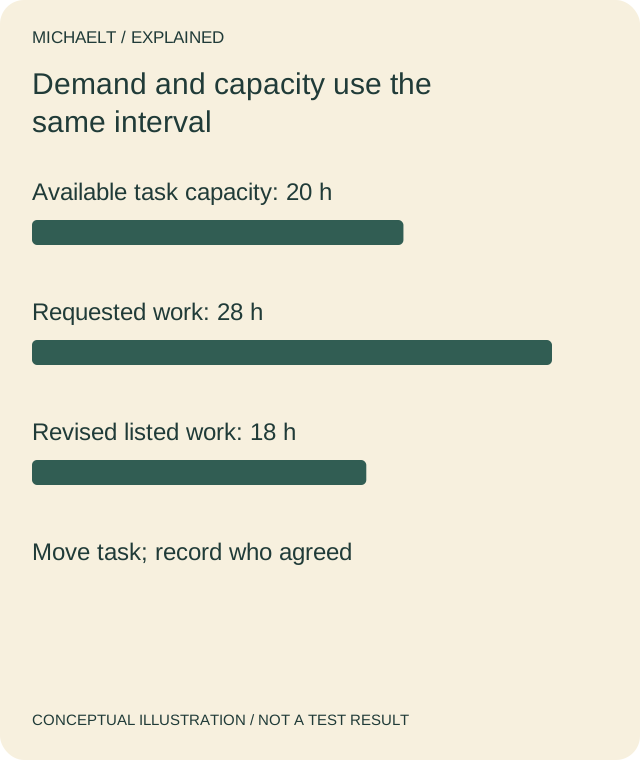
The fictional 28-hour request exceeds 20 task hours. A recorded 10-hour deferral leaves 18 planned hours, still subject to uncertainty.
Work through an example
A fictional interval has 20 hours of available task capacity after stated commitments. Requested tasks are estimated at 12, 10 and 6 hours, totalling 28. The manager agrees to move the 10-hour task, leaving 18 planned hours. The two-hour difference is not claimed as guaranteed spare capacity; the estimates and changing work still need review.
Illustrative example; figures, people and organisations in the worked record are fictional.
The example record
Capacity
- Assumption
- 20 task hours
- Decision
- Defined interval
Demand
- Assumption
- 12 + 10 + 6 = 28
- Decision
- Does not fit
Change
- Assumption
- Move 10-hour task
- Decision
- Manager’s stated decision
Revised plan
- Assumption
- 12 + 6 = 18
- Decision
- Review estimates and interruptions
Download blank worksheet (.csv) ↗Download worked example (.csv) ↗
Keep your own record
Use the result within its scope
Use the actual workplace procedures and appropriate support. The record helps clarify a decision; it is not a personality test, a productivity target or proof that stress has been resolved.
Reference sources
Earlier articles on this subject
- Being Resilient – What Skills You Need ↗ — 2022-02-08, Maria Baldwin.
- Maintain Resilience In The Workplace ↗ — 2021-06-11, Maria Baldwin.