Record an observation, not a diagnosis
Give the location a private room or furniture reference and record the time and what was directly seen. Keep an insect, mark or reported bite as its own observation; a bite pattern alone cannot establish which pest was involved. Use the relevant official guidance and an appropriate competent pest professional for identification. Do not label every small insect in a bed as a bed bug.
Preserve context without spreading material
If an ordinary safe photograph is available, give it a reference and retain its date. Do not move furniture between rooms, distribute suspect items or send live material without the professional’s instructions merely to complete this sheet. The EPA’s prevention guidance explains why attention to belongings and inspection matters. This record supplies no collection, heating, freezing or chemical-treatment method.
Ask for identification and scope
Describe the accessible area and ask what a professional inspection would include, how findings will be documented and what preparation is appropriate. Keep their instructions with their identity and date. Do not apply an outdoor pesticide indoors, mix products or improvise heat treatment. An advertisement’s promise of permanent elimination does not establish an appropriate treatment for the actual situation.
Keep reports and outcomes separate
Record the professional’s finding, stated limitations and proposed follow-up separately from the initial observation. Keep access and occupant information private. A visit completed is not necessarily a confirmed identification or a resolved problem. Use the actual instructions for any follow-up and retain unanswered questions rather than making an all-clear claim from one unremarkable photograph.
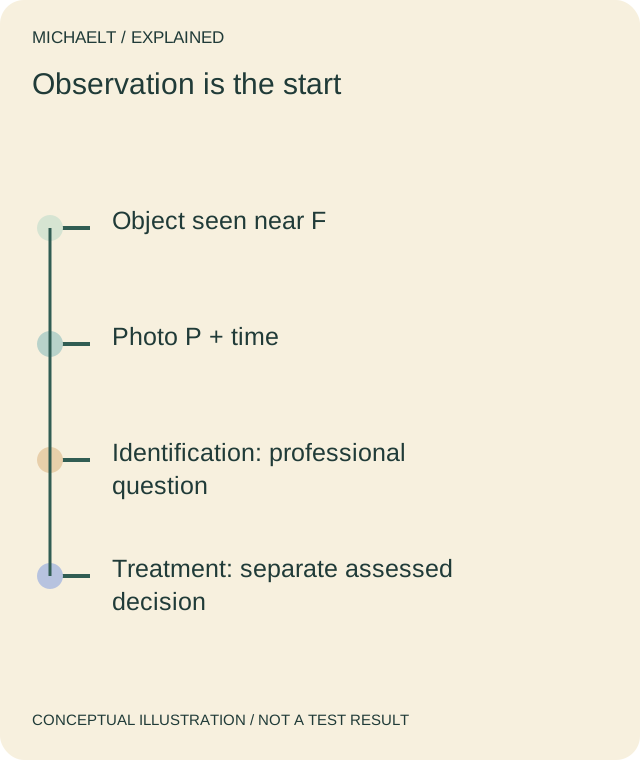
Read the drawing as text
A location and photograph support an identification enquiry; neither is a diagnosis or treatment plan.
Work through an example
A fictional log records a small insect seen near furniture F at 09:20 and photo P. The person does not identify it from the image. An enquiry asks for appropriate identification and inspection scope. The original observation stays in the record even if the later professional finding uses a different description.
Illustrative example; figures, people and organisations in the worked record are fictional.
The example record
Location
- Example
- Furniture F
- Limit
- Private reference
Observation
- Example
- Small insect at 09:20
- Limit
- Identification unconfirmed
Evidence
- Example
- Photo P
- Limit
- Not a diagnostic result
Next step
- Example
- Professional enquiry
- Limit
- No home treatment supplied
Download blank worksheet (.csv) ↗Download worked example (.csv) ↗
Keep your own record
Use the result within its scope
Use appropriate professional help and official product instructions. This is a reporting aid, not pest identification, pesticide selection or a promise that an area is clear.
Reference sources
Earlier articles on this subject
- Bed Bugs Removal Tips and Guidelines ↗ — 2021-02-01, Maria Baldwin.
- Different Types of Pest Control Methods ↗ — 2022-08-23, Maria Baldwin.
- Bed Bug Treatment – How To Get Rid Of Bed Bugs Using Extreme Temperature ↗ — 2022-01-12, Maria Baldwin.