Follow the task
Read the whole pack
Copy the stated prepared yield and required additions from the exact package. A pack’s dry weight and a prepared volume are different quantities. Keep ingredients, allergen information and preparation instructions available rather than relying on a photograph of the front.
Define the planned service
Choose the intended number of bowls and the portion volume for your own event plan. Count any extra portions explicitly. A planning portion is not a nutritional recommendation or evidence that the contents will suit every guest.
Calculate packs separately from method
Multiply bowls by planned volume, then compare with the package’s stated prepared yield. Round the number of packs up when partial packs are impractical. Do not assume that multiplying quantities also tells you a safe batch size, cooking time or suitable equipment.
Confirm preparation and fallback
Follow the exact food instructions and the needs of the actual service. Ask the person preparing the food to confirm equipment and timing. If a package does not state a usable yield, ask its maker before treating a dry-weight estimate as a finished serving count.
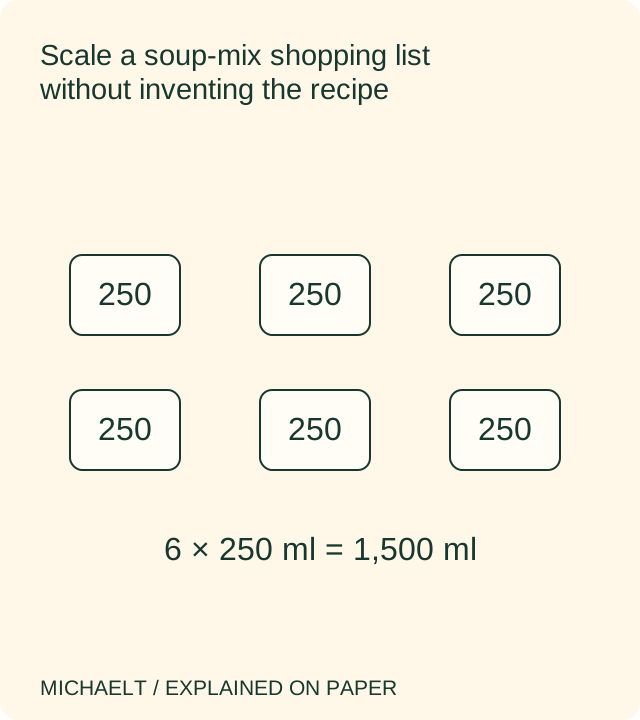
Read the diagram as text
Six illustrative 250 ml portions require 1,500 ml; package yield and preparation remain separate.
- Package yield
- 1,000 ml prepared per fictional pack
- Planned bowls
- 6 × 250 ml
- Required volume
- 1,500 ml
- Packs and preparation reference
- 2 packs; exact package instructions retained
A worked example
A fictional package says it makes 1 litre when prepared as instructed. Six planned 250 ml bowls require 1,500 ml. Two complete packs would provide a labelled total of 2 litres, leaving a planned 500 ml difference. This is a shopping arithmetic example. It does not change the manufacturer’s ingredients, tell the reader to use twice an unknown water quantity, or claim the recipe has been cooked and tested.
Illustrative example, not a reported purchase, client project or product test.
The completed record
- Package yield
- 1,000 ml prepared per fictional pack
- Planned bowls
- 6 × 250 ml
- Required volume
- 1,500 ml
- Packs and preparation reference
- 2 packs; exact package instructions retained
Download blank record (.csv) ↗Download worked example (.csv) ↗
Your own record
- □ Package yield: ____________________
- □ Planned bowls: ____________________
- □ Required volume: ____________________
- □ Packs and preparation reference: ____________________
Keep the distinction clear
Record a substitution as a new ingredient decision, not as a harmless arithmetic change. Different mixes can require different additions and methods. An extra pack is not automatically a suitable emergency option if it introduces an ingredient a guest cannot eat. Keep guest-specific information private and use a qualified food-service contact where the event requires one.
Where this guide stops
Not a recipe, allergen assessment, storage instruction or catering compliance plan. Follow current food-safety guidance and the exact package.
Continue with a related task
Sources and original context
The earlier topic was published 2022-02-07 under the Maria Baldwin byline. The present procedure and illustrative record are by MichaelT editorial.