Identify the stated duty
Record the application question, fluid information supplied to the competent designer and the proposed pump reference. Keep the intended operating conditions with the document version. A catalogue photograph or maximum flow headline does not establish suitability. This page does not select materials, design piping, calculate a safe system or give installation instructions.
Keep Q and H separate
Grundfos describes the duty point as the intersection of the pump Q-H curve and the system characteristic. Flow Q and head H are different quantities. Ask for the actual units and the conditions represented by each quoted point. A maximum flow and a maximum head listed separately are not necessarily a single operating point that the pump can deliver simultaneously.
Convert only what is actually comparable
Convert flow units explicitly when needed: 60 litres per minute equals 3,600 litres per hour, or 3.6 cubic metres per hour. Keep the same time basis and quantity. This conversion does not turn head into pressure without the relevant physical conditions or account for losses in the actual system. Do not infer a motor rating or a compatible fluid from the arithmetic.
Ask the designer to close the gap
Compare the proposal with the actual duty and ask a competent professional about the pump curve, system conditions and unresolved assumptions. Retain their response and the referenced revision. If conditions change, ask whether the selection still applies. A properly converted number supports a precise enquiry; it does not certify performance or replace commissioning evidence.
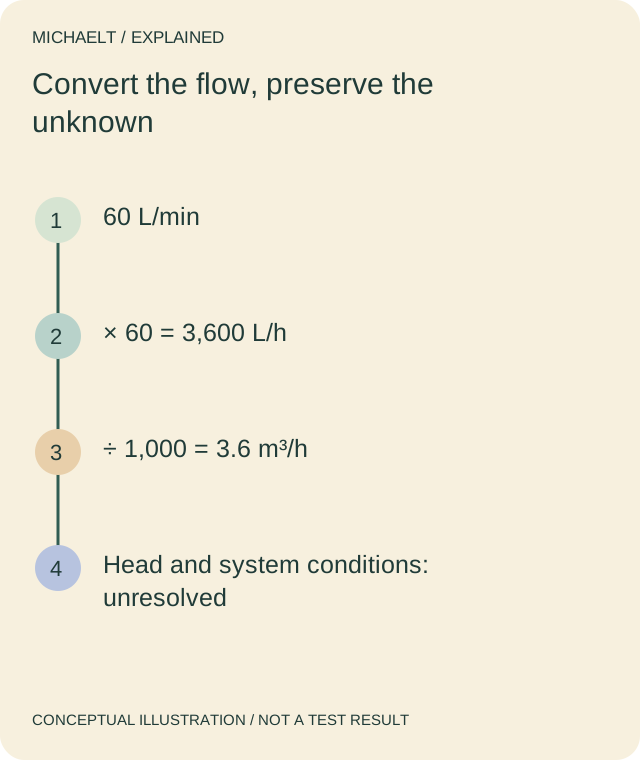
Read the drawing as text
The flow conversion is exact for the stated units. It supplies no missing head, system curve or component selection.
Work through an example
A fictional enquiry states 60 L/min, while the proposal uses 3.6 m³/h. The reviewer shows the unit conversion and confirms that these flow amounts are equivalent. The head and system-condition fields remain unanswered, so no suitable duty point or pump selection is established.
Illustrative example; figures, people and organisations in the worked record are fictional.
The example record
Requested flow
- Example
- 60 L/min
- Conclusion
- Same as 3.6 m³/h
Conversion
- Example
- 60 × 60 / 1,000
- Conclusion
- 3.6 m³/h
Head H
- Example
- Not supplied
- Conclusion
- Duty incomplete
Selection
- Example
- Competent review needed
- Conclusion
- No performance approval
Download blank worksheet (.csv) ↗Download worked example (.csv) ↗
Keep your own record
Use the result within its scope
Use the actual manufacturer documentation and competent engineering assessment. Unit conversion is not a pump-sizing method.
Reference sources
Earlier articles on this subject
- A Quick Guide to Pump Distribution ↗ — 2021-07-30, Maria Baldwin.